Trump Economy Delivers for Blue-Collar Boom: Manufacturing Real Wages Soar
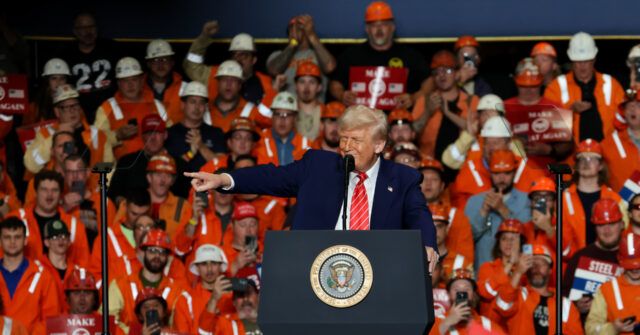
The American factory worker is experiencing an economic renaissance amid President Trump’s policies to revitalize U.S. manufacturing.
The average weekly paycheck for a nonsupervisory durable goods factory worker is up 7.4 percent from a year ago, according to data released by the Department of Labor on Friday. Hourly pay is up 5.3 percent and the average workweek has expanded, particularly due to rising overtime.
Pay growth continued in May. Hourly wages rose 0.4 percent and weekly wages climbed 0.6 percent.
Durable goods manufacturing includes workers making cars, steelworkers, and other employees in fabricated metals, and those building machinery.
Overtime for manufacturing workers has risen to 4.0 hours, up from 3.7 hours a year ago. This suggests that the demand for labor in American factories is growing rapidly. Real durable goods output grew at an annualized rate of 5.8 percent in the first three months of this year, according to the latest data available. Productivity—the amount of good produced for an hour of work—rose at a 5.5 percent annualized rate in the first quarter.
Although inflation is still high, factory worker pay is rising significantly faster than prices. After adjusting for inflation using the April consumer price index (the latest available), real weekly pay is up around 3.5 percent and hourly pay is up 1.5 percent for durable goods workers.
This is a dramatic change for blue-collar factory workers. For the decade preceding the pandemic, annual real weekly wage gains for durable goods workers amounted to just 0.2 percent per year. On a longer timeline stretching back to the 1970s, real weekly pay was stagnant. In the post-Covid recovery period, real weekly pay rose at a modest rate, typically less than one percent annually. The last time weekly real wage gains were consistently this good was in the post-war boom of 1947 to 1969.
Take-home pay gains are even stronger for many workers because President Trump’s One Big Beautiful Bill cut taxes on overtime.
Despite the strong wage gains, durable goods manufacturing payrolls were essentially flat from a year ago. But that understates the health of the sector. With immigration enforcement shrinking the overall workforce, the so-called break-even rate of job growth — the number of jobs needed to keep unemployment stable — has collapsed to near zero. Holding workforce share in that environment is the equivalent of strong growth in prior years. The breadth of the recovery is also widening: the manufacturing diffusion index crossed above 50 in May, meaning more factory subsectors are now adding jobs than cutting them. In May, durable goods businesses added 17,000 workers.