Saddam Hussein’s Peculiar Dreams Were Evidence That God Still Moves in the Affairs of Men
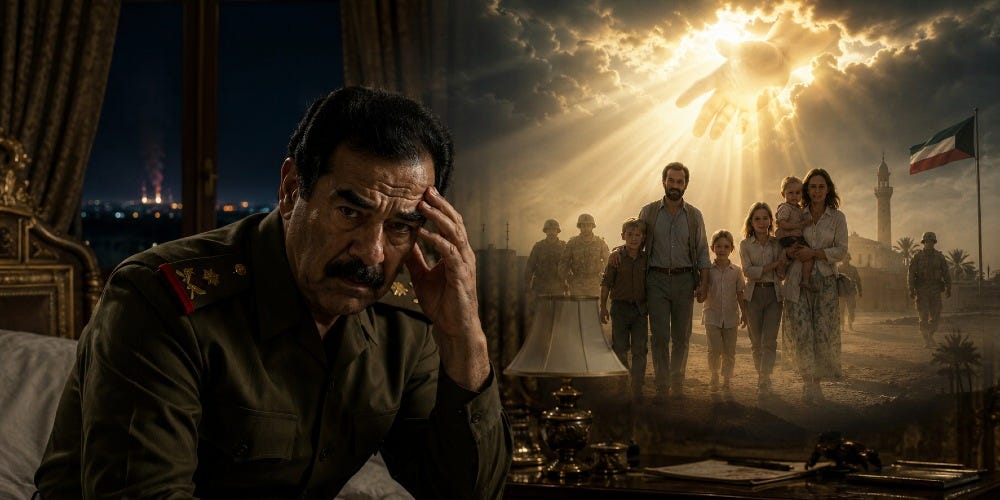
In the winter of 1991, as coalition forces massed against Iraqi aggression in Kuwait, one of the most brutal dictators of the modern era made a decision that defied every strategic calculation. Saddam Hussein, master of human shields and regional terror, abruptly ordered the release of Western hostages.
Among those freed was a missionary father whose family had endured weeks of captivity. The move baffled diplomats, military planners, and even President George H.W. Bush. There was no rational explanation—until you consider the hand of the living God.
Aaron Graham, who was just ten years old when his family was taken hostage in Kuwait, later learned the details. As churches worldwide mobilized in fervent prayer, Saddam began experiencing troubling dreams so intense they robbed him of sleep.
He reportedly confessed that God was troubling his spirit. Shortly after, the hostages walked free. What secular analysts still cannot explain, believers recognize as divine intervention. Prayer moved the heart of a tyrant, proving once again that the Almighty is sovereign over kings and kingdoms alike.
This episode is no mere historical curiosity. It stands as a powerful rebuke to the sterile rationalism that has infected even parts of the church. In an age obsessed with data, psychology, and human agency, we are tempted to reduce faith to moral lessons and social programs. Yet Scripture and history alike declare that Christianity is irreducibly supernatural.
The God who troubled Pharaoh’s dreams and hardened his heart is the same God who can stir the conscience of a modern despot.
Consider the broader pattern. Across the Middle East, reports continue of Muslims encountering Jesus in dreams and visions—encounters that open hearts otherwise closed by fear and tradition. These are not isolated anomalies but echoes of a God who refuses to be confined by our expectations or limited by geopolitical realities.
The same divine power that parted the Red Sea and raised Christ from the dead still operates today, often in the most unlikely places.
Graham’s personal testimony highlights a tension many evangelicals feel. Raised in a tradition strong on biblical truth but cautious about the Holy Spirit’s present-day activity, he yearns for the full expression of New Testament Christianity. Jesus Himself promised that His followers would do the works He did—and greater works—through the power of the Spirit.
This is not fringe charismatic excess but the plain teaching of Scripture. To deny the supernatural dimension is to embrace a form of godliness while denying its power.
The early church understood this. The apostles did not conquer the Roman Empire through superior arguments alone, though they were not lacking in intellect. Their message came with demonstration of the Spirit and power. Paul wrote that his preaching was not in persuasive words of human wisdom but in the convincing proof of divine reality. That same power is available to every believer surrendered to Christ’s lordship.
Yet in our sophisticated age, many believers hesitate. They fear looking foolish or unscientific. They settle for a faith that looks suspiciously like self-help with Bible verses. This is spiritual malpractice. The mission Christ gave His church—to make disciples of all nations—requires nothing less than the fullness of the Holy Spirit. Service gifts matter, but so do the manifestation gifts that display God’s direct intervention: healing, prophecy, discernment, and faith that moves mountains.
Walking in the Spirit does not mean abandoning reason. It means recognizing that reason has limits. Faith is beyond reason without being against it. The resurrection of Jesus Christ is historically attested, yet it transcends natural explanation. It stands as the ultimate vindication that God’s ways are higher than our ways. When we limit God to what our minds can comfortably contain, we rob ourselves of the wonder and power He intends for His people.
The lesson from Saddam’s dreams extends beyond one family’s deliverance. It challenges us to examine our own lives. Have we reduced the Holy Spirit to a theological abstraction, or do we know Him as the living presence who awakens our hearts daily to Christ? Do we eagerly desire the gifts He gives, not for personal spectacle but for the building up of the church and the advancement of the kingdom?
These questions are not peripheral. They determine whether our Christianity will be a dim reflection of cultural Christianity or a vibrant force that shakes the gates of hell.
In a world growing darker, with secular powers arrayed against biblical truth, the church cannot afford a powerless gospel. We need believers who pray with expectation, serve with supernatural enablement, and testify to a God who still does the impossible. The same God who troubled a dictator’s sleep in response to the prayers of His people stands ready to move again—if we will ask.
“And it shall come to pass in the last days, saith God, I will pour out of my Spirit upon all flesh: and your sons and your daughters shall prophesy, and your young men shall see visions, and your old men shall dream dreams.” This promise from Joel, fulfilled at Pentecost, continues until Christ returns. The outpouring has not ceased. The question is whether we will position ourselves to receive it.
Let the story of one family’s rescue through divine disruption renew our confidence. God is not distant. He is actively involved in human history, responding to the cries of His people. In an era of skepticism and spiritual warfare, may we embrace the full supernatural reality of our faith. The mission is too great, the hour too late, and the King too glorious for anything less.