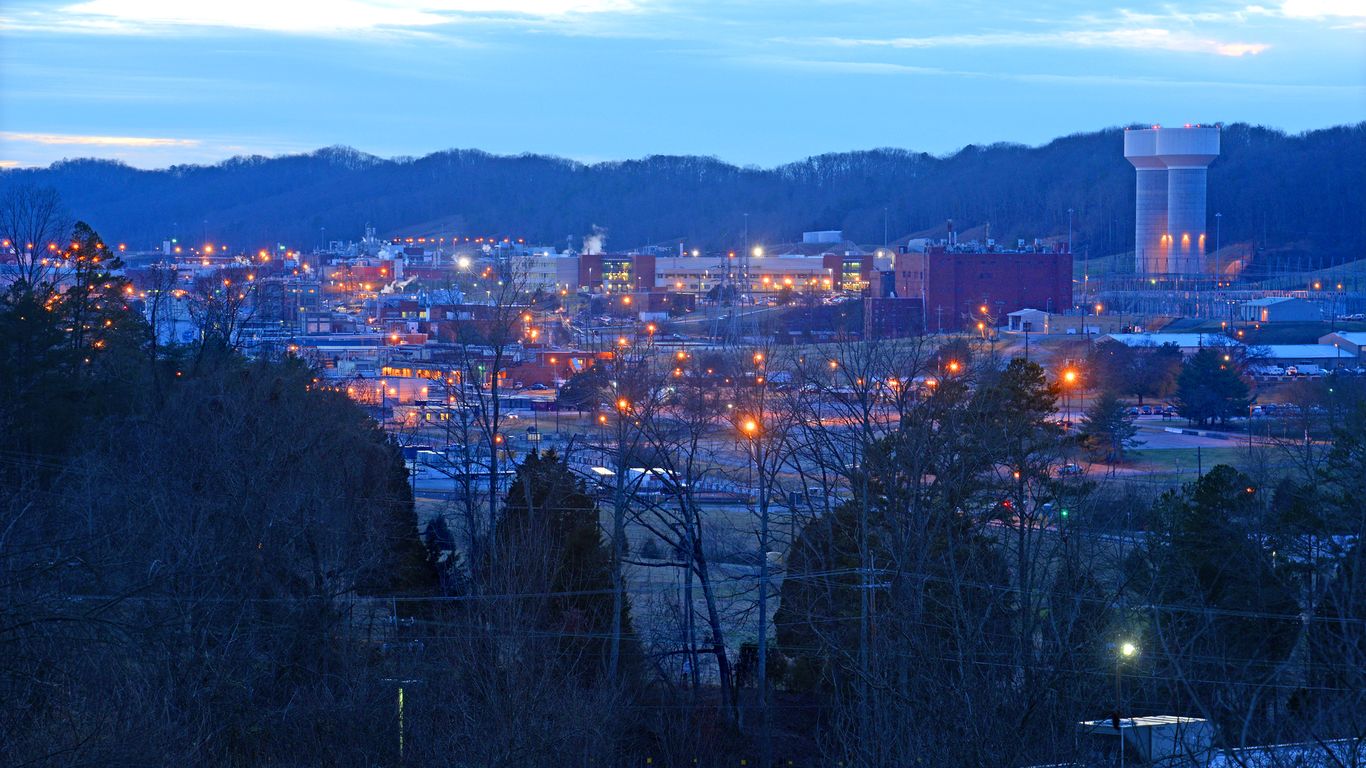
President Trump's envoys Steve Witkoff and Jared Kushner traveled to the national lab in Oak Ridge, Tennessee on Thursday for consultations with a team of technical experts that could play a role in nuclear negotiations with Iran, Axios has learned.
Why it matters: The White House is trying to reach a memorandum of understanding (MOU) with Iran to end the war and begin in-depth nuclear negotiations, and wants to have experts at the ready should those talks be launched.
- The U.S. and Iran are still at odds on several details of the MOU, according to U.S. officials and regional sources involved in the mediation.
- The sources characterized the negotiations as in their final stretch, but it remains unclear whether agreement will ultimately be reached.
- "This meeting in Oak Ridge doesn't mean that a deal is going to happen, but it is a sign that the negotiations are in a very serious phase and that there is a good chance to get it done and we want to be prepared," a U.S. official said.
The intrigue: Axios was alerted on Thursday to the fact that Witkoff had made an unannounced trip to eastern Tennessee. Two U.S. officials later confirmed he and Kushner were visiting Energy Department facilities at Oak Ridge.
- Some of the country's foremost experts in uranium processing and centrifuge technology are based at Oak Ridge National Laboratory and Y-12 National Security Complex. In the past, nuclear materials and equipment — including from Kazakhstan and Libya — were routed through Tennessee.
- The White House declined to comment. The National Nuclear Security Administration did not provide comment.
- The two U.S. officials said a team of roughly 100 experts was recently established to take part in the nuclear negotiations should a preliminary deal be reached. The Iran envoys made the trip to meet with members of that team and discuss preparations for the potential implementation of a nuclear deal.
Driving the news: Witkoff and Kushner agreed terms with their Iranian counterparts last week on a 60-day MOU to extend the ceasefire, reopen the Strait of Hormuz, allow Iran to sell oil and launch talks on Iran's enriched uranium stockpile and limitations on future enrichment.
- Trump asked for two amendments to the text last Friday, and the Iranians said they would ask for tweaks of their own. The U.S. is waiting for the official Iranian response, but the sources said the gaps are relatively narrow.
- For example, Trump asked Tehran to agree that any final deal would include a 60-day deadline to conclude the down-blending of Iran's enriched uranium, but the Iranians want that deadline to be 90 days, according to two sources briefed on the talks.
- There is also disagreement over how much of Iran's frozen billions would be released, and when. The U.S. has said it would release funds after a final deal was reached and concrete steps were taken toward implementing it, a U.S. official said. The Iranians want some of the funds released immediately.
- An adviser to Iran's supreme leader told CNN that the talks were deadlocked over the frozen funds and "the ball is in Trump's court."
Zoom in: If the negotiations advance to the second phase, the team of experts that met with Witkoff and Kushner would have to develop a plan for the disposal of Iran's nuclear material, how to limit the enrichment program further, and how to verify compliance.
- The U.S. officials said some of the same experts with whom Witkoff and Kushner met on Thursday participated in the process of recovering enriched uranium from Venezuela several weeks ago. That material, from a research reactor, arrived last month in South Carolina for processing.
- Some of the nuclear experts who participated in the meeting also joined Kushner and Witkoff in Oman for nuclear negotiations with Iran before the war.
- "These are the top nuclear experts in the U.S. who know how to do the technical things that a deal with Iran will entail," a U.S. official said.
What to watch: U.S. officials claim the White House has been getting positive indications from the Iran negotiators, but think there are internal divisions in Tehran over how to proceed.