Erdogan vs. Netanyahu: Who has Trump’s favor?
Just prior to the NATO Summit in Ankara, Turkey, held on July 7, 2026, Israel’s prime minister, Benjamin Netanyahu, called U.S. president Donald Trump, essentially to remind him of Turkish president Recep Tayyip Erdoğan’s escalating anti-Israel rhetoric. He asked Trump to “rein it in.”
Advertisement
Netanyahu mentioned Erdoğan’s referencing Zionism as “a genocidal ideology” and his claim that Israel poses a threat to Turkey’s survival. Turkish foreign minister Hakan Fidan escalated the anti-Israel rhetoric in an interview on Türk TV by calling Israel “a burden that humanity can no longer bear” and “a problem for the entire world.” Fidan then called on the international community to impose sanctions on Israel. Israeli foreign minister Gideon Sa’ar, called Fidan’s words “a clear call for genocide.” The Jewish people know very well what happens when such words are allowed to go unchallenged. The first step on the road to genocide is dehumanization.
When a reporter at an Oval Office briefing asked Trump about the Turkish dictator’s recent antisemitic remarks about Israel, Trump ignored the question. Instead, he praised Erdoğan, stating, “As you know, he’s a very good friend of mine, and we’ve worked very well together. I like him a lot.”
Advertisement
Erdoğan, now leading a Sunni Muslim coalition, seeks to undermine Israel along with Iran, Qatar, and Iranian proxies. They have made their position clear: They would like to end the existence of the Jewish state.
While expressing his fondness for Erdoğan, and ignoring the threats posed by Erdoğan against Israel, Trump has shown himself to be an unstable friend of Israel and of Netanyahu in particular. He has ignored the fact that Netanyahu was his only partner against the radical regime in Tehran — a regime that has for decades called for “death to America” and was on the verge of assembling a nuclear weapon.
Advertisement
Conversely, Erdoğan has been assisting the ayatollahs’ regime in evading U.S. sanctions. According to Politico (Dec. 8, 2022), a secret meeting between a delegation of senior Iranian military and government officials and a business group from Turkey led by a confidant of Erdoğan, was held, according to Western diplomats, to deepen their partnership engaged in smuggling Iranian oil to buyers in China and Russia and to raise funds for Tehran’s terror proxies.
Iranian foreign minister Abbas Araghchi confirmed that Turkey helped prevent armed Iranian Kurdish groups from opening a new front inside Iran as part of what Tehran says was a U.S.-Israeli regime-change effort. In fact, Erdoğan was opposed to regime change in Iran and to the Iranian Kurdish militias who were willing and able to take on the Islamic Revolutionary Guard Corps (IRGC). Had Trump given the Kurdish militias a chance rather than heeding Erdoğan’s request, the war with Iran might have progressed differently. And the fanatical regime of the ayatollahs and the IRGC would have faced a significant challenge from within.
Advertisement
Trump seems to prefer that the conflict between Erdoğan and Netanyahu remain while deliberately ignoring the danger the Turkish dictator poses to Israel, Greece, and Cyprus. Trump is eager to sell him the lethal F-35 fighter jet, which threatens both Israel and NATO member Greece.
Trump’s repeated praise of Erdoğan and his willingness to continue despite Erdoğan’s threats against Israel may be the latest indication of the U.S. president’s growing unease with Netanyahu, whom he reportedly rebuked in recent phone calls and the press, while asserting that Netanyahu will do whatever he tells him to do when it comes to Iran and Lebanon.
Advertisement
Israel faces an existential threat from Iran, and Netanyahu understands that only a regime change will bring peace and stability to the Middle East region. Iran, in fact, under a more secular and liberal regime, might very well become an American ally and a member of the Abraham Accords. The Islamist Erdoğan, whose support of the anti-Western and anti-Christian Muslim Brotherhood is well known, has an interest in preserving the current Iranian regime, somewhat weakened but not defeated.
What widened the divide between Trump and Netanyahu is essentially the MoU between the U.S. and the Islamic Republic of Iran. With Trump eager for a deal, the Iranians were able to dictate the terms by tying the preservation of Iran’s proxy, Hezb’allah, with their signing the deal. Hezb’allah violated the ceasefire agreement by shelling northern Israel, and Trump, keen on the deal, demanded that Netanyahu end Israeli attacks on Hezb’allah headquarters in southern Beirut. Netanyahu reluctantly complied. In Israel, the MoU appeared as Trump having given in to Iran. Trump wanted total Israeli compliance while Iran violated the MoU by attacking ships in the Strait of Hormuz.
Advertisement
As long as Iran remains undefeated and receives monies with Erdoğan’s oil-sales assistance, Hezb’allah’s entrenchment in Lebanon will continue and Israeli communities in northern Israel will be a target. No Israeli government, or any government, including the U.S., would allow a terrorist organization to disrupt the lives of its citizens. Moreover, the legitimate Lebanese government of President Joseph Aoun understands that Hezb’allah must not be allowed to subvert its independence by provoking war with Israel and installing Iran as the de facto major arbiter in Lebanon’s affairs.
Are U.S. interests in the Middle East peace and stability, or are deals more important — including $700 million from the sale of jet engines to Erdoğan? And is Trump’s frustration with the Iran war designating Netanyahu as his scapegoat? For now, it seems that way.
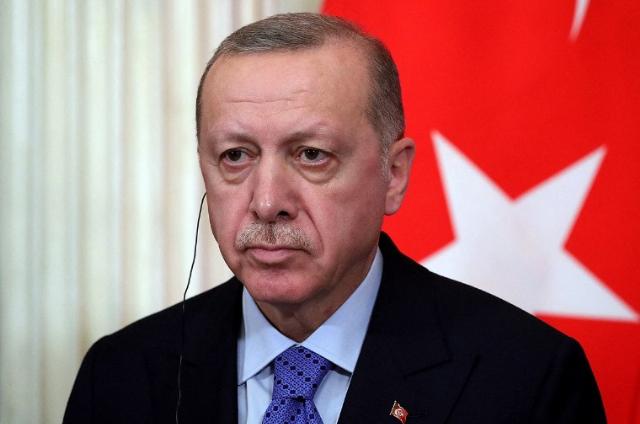
Image: www.kremlin.ru via Wikimedia Commons, CC BY 4.0.
