Two Years of Javier Milei
Argentina’s President Javier Milei is on track to make economic history in a country shedding the trauma of socialism after decades of stagnation. Ironically, the paths of Argentina and Germany may soon intersect.
Javier Milei has now been in office for two years. It is an economically fascinating experiment. The man from Buenos Aires, internationally notorious for his dramatic chainsaw imagery, is conducting a libertarian experiment on a living country.
Milei is implementing what he long advocated during his campaign: the oversized state sector, with its vampiric bureaucracy, extracts the lifeblood of the private economy; socialism is, for him, a societal disease. Looking at European climate socialism, one must admit he has a point -- without exception.
Credibility is Political Currency
Milei turned words into action -- a politician who keeps his promises, something that today in Germany seems more fairy tale than reality. He reduced the federal bureaucracy under his presidential control. Ministries were eliminated without replacement, over 50,000 public sector employees were fired -- Milei imposed abrupt, short-term but necessary social pain to escape the growth trap.
At the same time, he consolidated the country’s perennial deficit budget, which had become a kind of self-service socialist poison kitchen under Peronist rule. Early in his presidency, he achieved a primary surplus, which this year is expected to reach around 0.3% of GDP. This builds confidence in bond markets and signals to international investors: we pursue credible policies and keep our word. Argentina is open for investment.
Radical Consolidation and Falling Inflation
Milei also gradually brought inflation under control, from about 212% to below 25% in two years. There is still work to be done, but his market-oriented reforms, deregulation, and massive private sector investments -- up a remarkable 30% this year from a low base -- will further stabilize prices.
Here lies the key to Milei’s “small miracle”: unleashing private investment goes hand in hand with reducing the state share. In just two years, he cut it by seven percentage points -- to well below 40% -- liberating private capital markets from state competition. Growth rates above 5% are the deserved reward. Businesses are returning, especially in machinery and construction, creating a boom. The harsh public sector cuts were compensated by private sector job creation.
Milei maintains a stable reform path, balances social policy with his reforms, and relies on genuine private-sector growth. The state, in his view, must step aside -- to make room for the capital market, a new entrepreneurial image, and fresh private sector dynamism. His recent midterm election success, securing a strong majority in both parliamentary chambers, increases the odds that this market-oriented experiment will succeed step by step.
European Coldness Toward the Chainsaw
In Germany and Europe more broadly, Milei has never been warmly received. His market revolt directly confronts the green-socialist mainstream and today’s 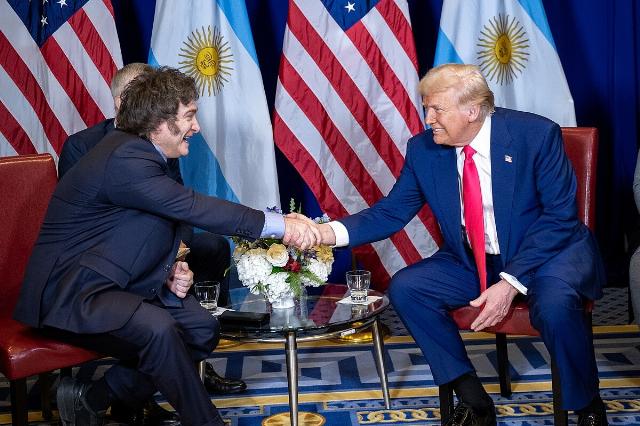 prevailing political ethics. Whether the provocative chainsaw image would be accepted by Germans is doubtful.
Likely fewer than ten percent of Germans truly understand the importance of decentralized markets and fundamentally free economies in repairing the damage green socialists -- and all consensus parties -- have caused in recent decades.
That Milei’s example is spreading in South America, with Chilean politician José Antonio Kast pursuing a similar agenda, shows how far Europe has slid into climate-socialist infantilism. While other regions adapt and change course during crises, Europe -- especially Germany -- tries to solve a self-inflicted crisis with the very methods that caused it.
German Statists and the Elite Problem
More regulation, constant interventions -- heating laws, EV subsidies, higher CO2 taxes -- reflect a fundamental mistrust of free markets. Friedrich Merz exemplifies this, labeling Milei’s policies “ruinous for Argentina” on German TV last year. Milei supposedly tramples people, said Merz, a staunch statist and loyal follower of Angela Merkel’s climate-socialist agenda.
Merz typifies Germany’s political elite: economically uneducated, historically naive, and firm believers in a strong state -- often because that state underwrites their own incomes. Today’s career politicians fail in the real world, advancing only via party mechanisms that reward loyalty over competence. How else could someone like Lars Klingbeil rise so high?
Javier Milei, by contrast, is both theorist and practitioner -- a political type nearly unimaginable in today’s Germany, where discourse revolves around control, censorship, and regulation. Milei’s Argentina proves that radical, painful, but growth-oriented reform is possible. This is the real provocation to Europe.
Geopolitics, Capital Markets, and New Alliances
Milei’s antagonism places him in political tension with old European financial power. Argentina narrowly survived a currency attack weeks ago, thanks to swift U.S. assistance -- likely originating from London financial circles. Major capital powers now wage geopolitical battles through bond and forex markets. Newly visible alliances show that adherence to American principles of free markets, free speech, and entrepreneurship brings Washington’s protection.
It is hard to imagine Milei’s free-market Argentina finding sustainable trade agreements with Mercosur partners who cling to hidden protectionism and Kafkaesque climate regulation.
Ironically, Argentina -- once one of the richest nations pre-Peronist disaster, now in the lower leagues -- is returning to its former glory, while Germans and other formerly market-oriented European states return to their intellectual roots: abolish the free market, embrace Marx, hail the bloated superstate whose promises inevitably fail due to socialism’s contradictions.
The coming years of Milei’s presidency will likely remain under American protection, guided by faith in free markets’ healing and dynamizing power. What emerges is more than a reform program -- it is a political triumph that holds a mirror to European climate socialists, showing them the ugly face of their own resentment.
Image: White House