Restoring Meaning to American Citizenship
Yesterday (December 5), the U.S. Supreme Court agreed to review on the merits one of the federal district court injunctions issued against President Trump’s Executive Order ending Birthright Citizenship. This is an important constitutional case where our group, Gun Owners of America, has filed several amicus briefs this year opposing Birthright Citizenship, and some may not understand why gun owners have a strong interest in this case.
For many decades, our federal government has assumed that anyone born in the country is a citizen based on a peculiar doctrine known as “Birthright Citizenship.” President Trump was the first President to challenge this assumption by issuing an Executive Order entitled “Protecting the Meaning and Value of American Citizenship.” Predictably, that Order drove the left crazy, and numerous “open borders” groups rushed into various federal district court and obtained injunctions from leftist judges against the Executive Order. Quite obviously, the courts where cases were filed were carefully chosen by the open-borders crowd to get favorable rulings. Over 100 such injunctions have been issued against President Trump—not all in this case--during the first six months of his Administration, although the Supreme Court has stayed many of them.
The issue that now will be decided by the Supreme Court is: should every person born on U.S. soil, even if born to parents from other countries who owe no allegiance to the United States, be automatically entitled to the full benefits of U.S. citizenship?
What interest do Second Amendment rights organizations have in asking the Court to review a case that deals with immigration and birthright citizenship? The answer is simple, and goes to the heart of who, precisely, constitutes “the People” whose “right to keep and bear arms” is protected by the Second Amendment.
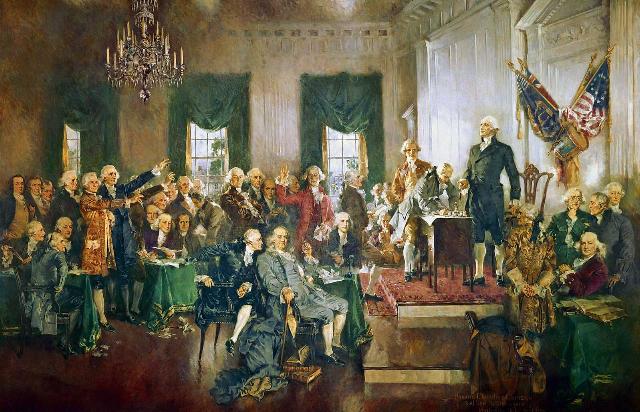
Graphic: Scene at the Signing of the Constitution of the United States. Wikimedia Commons. Howard Chandler Christy. Public Domain.

A nation is defined by those who pledge loyalty to it, not by those who happen to be traveling through or are illegally present. It certainly does not include women who cross borders for the sole purpose of obtaining a different citizenship for their child. Citizenship must reflect genuine allegiance and lasting connection, or it becomes a benefit without a corresponding obligation. And the rights uniquely reserved by the framers of our Constitution for citizens — particularly “the People’s” right to keep and bear arms — are weakened when they apply to aliens, particularly illegal aliens.
The Trump Executive Order simply reaffirms a principle that was once widely understood but has been steadily obscured: citizenship is not an accident of geography, but a mutual relationship with benefits and burdens. It reflects a solemn bond of allegiance. The Executive Order directs federal agencies not to treat as U.S. citizens those born here to parents who are neither American citizens nor lawful permanent residents. This policy aligns precisely with the text and original understanding of the Fourteenth Amendment.
The Fourteenth Amendment states: “All persons born or naturalized in the United States, and subject to the jurisdiction thereof, are citizens of the United States.” That second phrase, “subject to the jurisdiction thereof,” is not a throwaway clause. It was deliberately inserted to exclude from automatic citizenship those who owe allegiance to another country.
Opponents of the Executive Order assume that this phrase excludes only two narrow classes of persons — children of foreign diplomats and children of invading armies. A reexamination of the Fourteenth Amendment’s text and its framers’ words shows that this assumption is false.
When Congress debated the Fourteenth Amendment in 1866, Senator Jacob Howard explained it “will not, of course, include persons born in the United States who are foreigners, aliens … but will include every other class of persons.” Senator Lyman Trumbull explained that “subject to the jurisdiction” meant “not owing allegiance to anybody else.” Their intent was clear: the amendment was meant to ensure citizenship for the children of freed slaves, not to create a perpetual magnet for illegal immigration or birth tourism. And the relevant statute tracks the Fourteenth Amendment; it does not change it.
Over the decades, that original understanding was gradually eroded by administrative habit and judicial drift. The lower courts, in their haste to enjoin anything President Trump tried to do, ignored that history. They relied almost exclusively on an old Supreme Court case, Wong Kim Ark (1898), involving the U.S.-born child of lawful, permanently domiciled Chinese immigrants. That case did not address, let alone decide, the status of children born to those here illegally or temporarily. Extending that decision to such situations is judicial invention, not interpretation.
Birthright citizenship has become one of the greatest incentives for illegal immigration, effectively allowing foreign nationals to gain a foothold in the country through their children. Foreign nationals from across the world, including Turkey, China, Nigeria, and Mexico, pay thousands to travel here to give birth on U.S. soil, then securing American passports for their newborns, access to federal benefits, and later legal status and voting rights for the child’s parents and extended family.
Unlike the United States’ current practice, nearly all developed countries base citizenship on the principle that a child inherits the citizenship of their parents. That standard ensures citizenship is rooted in allegiance and belonging, not mere physical presence.
Our Founders understood this distinction. The British system of jus soli, the “law of the soil,” treated everyone born on English soil as a subject of the Crown. Americans rejected that feudal concept in 1776. The Declaration of Independence declared Americans “Absolved from all Allegiance to the British Crown.” Citizenship in the Republic would rest on consent and mutual duty, not accident of birth.
The Fourteenth Amendment reaffirmed that understanding. The phrase “subject to the jurisdiction thereof” means full, undivided allegiance, not mere subjection to local laws. A foreign tourist, of course, must obey U.S. laws, and is likewise afforded certain protections, such as from crime. But that does not make them a citizen. The distinction is vital, especially when considering rights uniquely reserved for citizens, including the Second Amendment.
As the GOA-supported brief makes clear, restoring the proper understanding of the Fourteenth Amendment is not about exclusion of or hostility to immigrants. It is about preserving the integrity of citizenship itself, which is the foundation of our national community and the context that sustains, among other rights, the Second Amendment. Citizenship is a mutual covenant: the citizen pledges loyalty and defense of the country, and the nation pledges protection and representation. That bond cannot exist without allegiance.
For too long, Washington, D.C. has treated citizenship as a bureaucratic transaction rather than a sacred trust. The Supreme Court now has the opportunity to correct that mistake and reaffirm that being an American is not merely a matter of birth location but of belonging. In doing so, it will also strengthen the citizen-based protections that make the Second Amendment meaningful.
President Trump’s Executive Order does not change the Constitution; it revitalizes it. It honors the intent of the Fourteenth Amendment’s framers and restores clarity to our national identity. The Supreme Court should take the case, overturn the misguided lower-court rulings, and finally restore the true and historic meaning of the requirement “subject to the jurisdiction thereof.”
John Velleco, is the Executive Vice President of Gun Owners of America. [email protected]