The Supreme Court Just Ruled to Protect Women's Sports
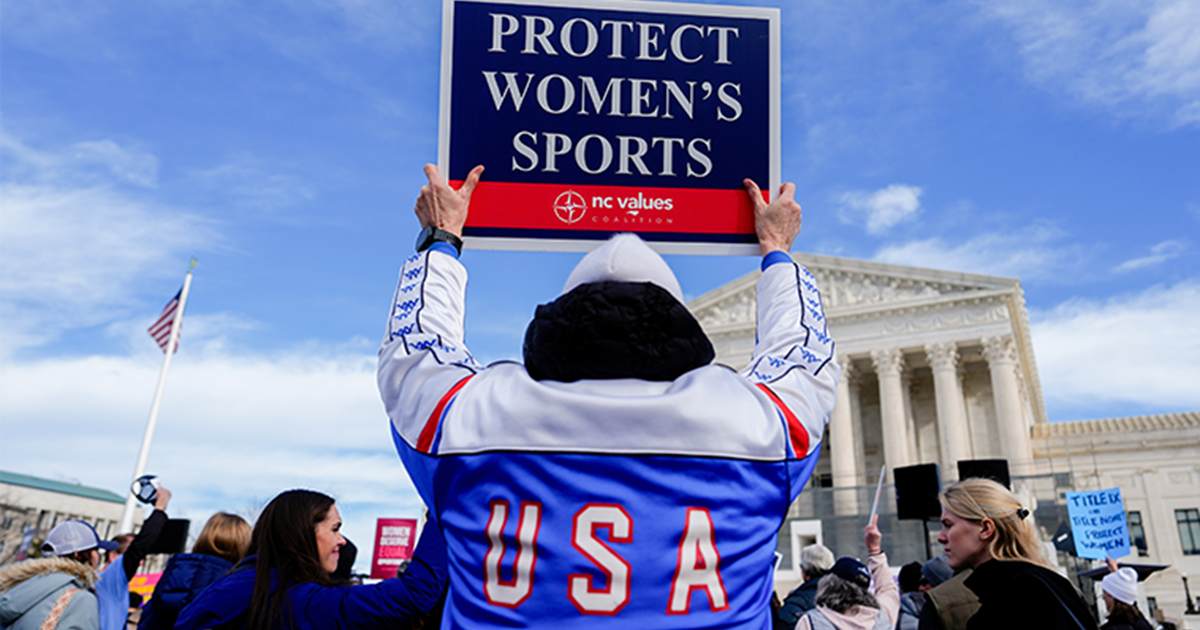
On January 13, the Supreme Court heard two cases — Little v. Hecox and West Virginia v. B.P.J. — that both deal with the same issue, namely state laws that prohibit males from participating in women's and girls' sports even if they identify as transgender.
Advertisement
Little v. Hecox is the case out of Idaho, stemming from a 2020 law called the Fairness in Women's Sports Act (HB 500). That act bars 'trans women' and 'trans girls' from female athletic teams in public K-12 schools and colleges. Lindsay Hlcox, a male, sued after being barred from joining Boise State University's women's cross-country and track teams. Helcox claimed the legislation violates the Equal Protection Clause and Title IX.
West Virginia v. B.P.J. is a similar case. Following West Virginia's enactment of the Save Women's Sports Act (HB 3293), which requires public school and college teams to be designated based on biological sex. It bars males from girls' and women's teams in secondary schools and colleges. The mother of Becky Pepper-Jackson, a male, sued on his behalf on similar grounds.
The questions before the Court dealt with whether or not Title IX prohibits states from designating girls' and boys' sports teams based on biological sex and whether such legislation violates the Equal Protection Clause.
Today, the Supreme Court ruled 6-3 in favor of women and girls.
The majority opinion, penned by Justice Kavanaugh, noted that “The court holds that schools can determine eligibility for women's and girls' sports teams based on biological sex.”
RecommendedAdvertisement
The first opinions are in the transgender athlete cases. In B.P.J., the court holds Title IX allows schools to provide separate women’s and men’s teams defined by biological sex, and WV has permissibly maintained female sports for biological females.https://t.co/PGDJDZG5nW
— SCOTUSblog (@SCOTUSblog) June 30, 2026
The Court found that West Virginia and Idaho did not violate the Constitution’s Equal Protection Clause by banning male ‘trans athletes’ from participating in girls’ sports.
...West Virginia and Idaho did not violate the Constitution's equal protection clause by maintaining female sports teams for biological females...
— Jonathan Turley (@JonathanTurley) June 30, 2026
This is a huge win for women and girls across the country.
BREAKING: The Supreme Court just ruled that schools may block biological men from competing in girls' sports teams.
Justice Kavanaugh delivered the opinion. pic.twitter.com/7rMyrSsN2m
— Townhall.com (@townhallcom) June 30, 2026
As Justice Alito pointed out during oral arguments in 2024, rights cannot be granted based on a characteristic that isn't immutable. Gender identity, by its very definition, is not an immutable characteristic.
This landmark decision affirmed that women and girls possess the fundamental right to fair athletic competition grounded in biological reality. By upholding Idaho’s and West Virginia’s laws, the Court ruled that Title IX permits separate women’s and men’s sports teams defined by biological sex and that such distinctions do not violate the Equal Protection Clause. Justice Kavanaugh’s majority opinion delivers a clear and decisive victory for female athletes, protecting the integrity of women’s sports against the erasure sought by gender ideology. This ruling reaffirms that sex-based categories in athletics are not discrimination—they are essential fairness—and marks a powerful restoration of common sense, science, and the hard-won rights of women and girls across America. Today is a major win for women and girls in America, and yet another blow to the transgender activists who seek to erase them.
Advertisement
Editor's Note: Do you enjoy Townhall's conservative reporting that takes on the radical left and woke media? Support our work so that we can continue to bring you the truth.
Join Townhall VIP and use promo code FIGHT to receive 60% off your membership.