Who Are We in Their Presence?
A recent find in Gaza sends chills up one’s spine.
Chanukah this year starts with candle lighting Sunday night. Like clockwork, the Antiquities Authority or the City of David announces just before the holiday each year some archaeological find related to the period of Chanukah. We have found coins with the image of the Greek-Syrian leader Antiochus! We have found oil lamps with images of the menorah from the Temple on them! This year did not disappoint: the City of David described a wall from the Hasmonean period that would have seen the war between the Maccabees and the Greek-Syrians, and the miracle of the olive oil.
Advertisement
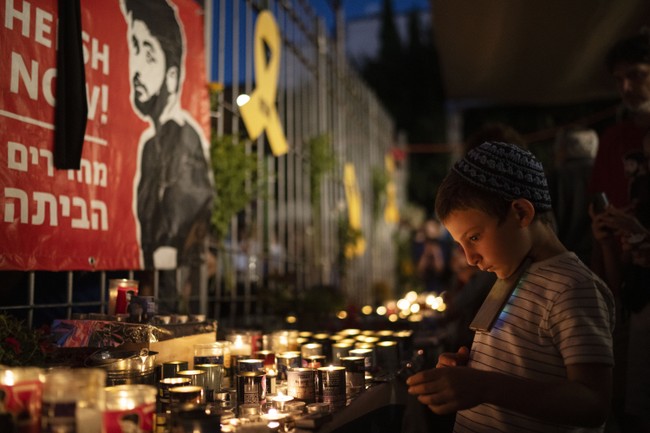
While the new wall seems impressive, a different find recently described has had a much greater impact. The announcement was made by the IDF and included a very short video of six hostages who were murdered in cold blood by Hamas terrorists just prior to the arrival of Israeli soldiers to their position. They had been starved and kept in the dark for months. The video shows the hostages, and in part, they are lighting—in Hamas tunnels—Chanukah candles. They have a very hard time getting a lighter to light a candle, but they say the blessings and together sing the most famous song of the holiday. They had been ripped from the Nova music festival. Some of them, like American Hersh Goldberg-Polin, had been seriously injured. They had all suffered the deprivations of Hamas. When Eden Yerushalmi’s body was recovered, she weighed just 79 pounds. Yet, even in the darkness of the tunnels and the darkness of a 7th-century barbarian terror group, they found the strength to light Chanukah candles—and sing! We light our menorahs comfortably outdoors or on our dining room tables. We eat traditional potato pancakes or sufganiyot (donuts). What we take for granted, they did with faith and in the face of adversity. Some of them were religious, while most were not. Yet, who are we and how do we stand before such brave Jews, who not only rejected Islam that was dangled before them, but found their strength in the Festival of Light?
RecommendedAdvertisement
The entire video found by the IDF was around two minutes, with the part about Chanukah running 11 seconds. The six had arranged a makeshift menorah, which they lit and over which they blessed and sang. The images immediately reminded me of stories from Auschwitz, where religious Jews did their best to keep commandments, under pain of death. I have read stories of a single prayer book for the High Holidays that was hidden so that the Nazis could not find that which they considered to be contraband. There was a story of Jews in the camp who were not sure if they were required to fast on Yom Kippur. Their poor health, lousy food, and difficult work seemed to suggest that they did not need to fast but had to eat so as to have strength, as the Nazis killed anyone who did not do his job or fell behind going to and from the factories. The day before Yom Kippur, religious contraband was discovered in the barracks, and the camp commander decreed that the Jews would not be given food the next day. The Jewish slaves took it as a sign from Heaven that, in fact, they did need to fast.
If one were to be up in the booth and analyzing the six emaciated hostages as they celebrated Chanukah and did their best to survive in captivity, he would conclude that something is wrong. Many of the returned hostages spoke of how their captors pushed Islam on them and promised more food and improved conditions if only they would convert. None did. For the Young Six, the smart play would have been to renounce Judaism, which was ultimately the cause of their capture and pain, and embrace the Koran and thus start to get more food and improve their likelihood of survival. They did not take that path. I remember when I was in Alaska and witnessed the salmon fighting to go upstream in order to spawn and die. Our tour guide told us that the last thing a mother salmon does is bite into a branch, so that when the eggs hatch, her body will be there as a source of food for the next generation of lox. Hersh Goldberg-Polin and his friends did everything against the stream. They turned down the terrorists’ offer of Islam and stuck to their Judaism. Under the pressure of a living hell, they did not abandon their faith but rather found comfort in it. I don’t know if the year before these six lit candles or celebrated Chanukah in their homes. But I did see that when they were under pressure and the threat of death, they found their strength in the faith of their fathers. I stand in awe of their courage in the face of hatred and death.
Advertisement
They say that there are no atheists in a foxhole. Oftentimes, people turn to God in times of great distress. As I have previously written, many of the hostages described keeping the Sabbath or starting to make blessings over food. When I saw a six-part series covering one class of sailors vying to join the SEALs, I realized that the purpose of the sleep deprivation, cold water swimming, endless runs, and the like was to find out what these people were made of. Only under pressure do we often discover our real selves or our hidden capabilities. One hostage described her pre-Gaza life as being one of fear of others. When they were being led off to the tunnels, another captive began to panic that they would go in but never come out. The introvert realized that she needed to lead, so she joked that if they were already in Gaza, they might as well see the sights. She became a leader among the frightened youth grabbed from the music festival. When she was released, she went to live with her boyfriend’s mother, who obviously was terrified as to the fate of her son. The latter came out under President Trump’s deal, and the two are set to marry.
The trait of finding strength in distress is by no means solely Jewish but has been displayed by great men and women throughout the generations. How many stories do we have of soldiers who found strength and courage that they did not know they had when the hour demanded the same? Yes, some cut and run, but often we see the most sublime in mankind when the chips are down, and the situation appears to be desperate or even hopeless. One can read endless stories from the Battle of the Bulge, which seemed lost. The American fighters never gave up, even with huge losses and a lack of supplies. Patton’s troops were amazed to see the Fighting 101 hold on to their positions in Bastogne as they began to push the Nazis back toward Germany.
Advertisement
There was a very big rabbi who was saved from the clutches of the Nazi killing machine. He made his way to Jerusalem, where he lived for some years. Later, he moved to Brooklyn. As many Jews had become accustomed to seeking out his advice, some asked with whom they should discuss important matters. “If you see anyone with a number tattooed on his arm from the camps, ask him your questions.” I can only hope that our upcoming lighting of the Chanukah lights for eight nights somehow comes close to the lighting of the six young Jews in the hell of Gazan tunnels. What we do with joy, they did with determination and faith.
Editor’s Note: Do you enjoy Townhall’s conservative reporting and opinion? Support our work by joining Townhall VIP! Use the promo code FIGHT to get 60% off your VIP membership!