BREAKING: SCOTUS rules states can keep men out of women’s sports
The cases were brought by challengers to those state allowances in West Virginia and Idaho.
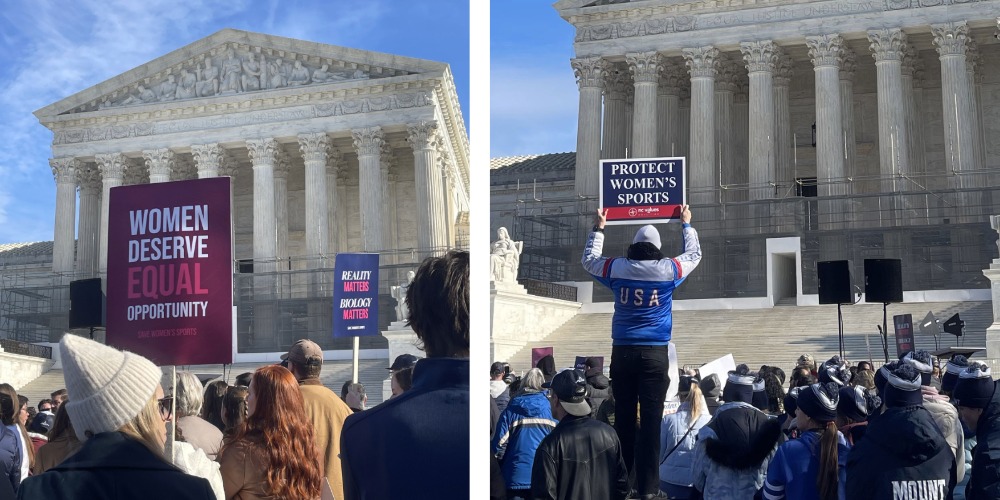
The cases were brought by challengers to those state allowances in West Virginia and Idaho.
The Supreme Court handed down a ruling on Tuesday addressing the practice in many states of allowing boys who claim to be girls and men who claim to be women to play in girls' and women's sports. The cases, which were combined for the court's ruling, were brought by challengers to those state allowances in West Virginia and Idaho.
The court ruled that Title IX allows schools to separate sports based on biological sex. The court also held that "West Virginia and Idaho did not violate the Equal Protection Clause of the Fourteenth Amendment by maintaining female sports teams for biological females."
Delivering the opinion for the court, Justice Brett Kavanaugh wrote, “Separate sports teams for biological males and biological females are reasonable: Given the inherent physical differences between the sexes, allowing only biological females to play on women’s and girls’ teams can reduce the risk of physical injury and ensure fair competition."
"True, some might prefer a different rule allowing biological males who identify as female to participate on women’s and girls’ sports teams, at least in certain circumstances. But it was surely “reasonable” for HEW in 1975 to draw a biological line—a line where biological males play only on male sports teams and only biological females play on female sports teams. Even in recent years, 27 States, the NCAA, the USOPC, and the IOC have all drawn the same line."
Kavanaugh wrote that allowing biological males to play on female sports teams "can put women and girls at significant risk of injuries. The safety risks are particularly severe in contact sports." Regarding competitive fairness, he weote, "allowing biological males to play on women’s and girls’ sports teams can put female athletes at a serious disadvantage. That is because sports are generally zero sum. Allowing a biological male athlete to compete on a girls’ team necessarily displaces or disadvantages a female athlete—replacing her on the roster, knocking her out of the starting lineup, reducing her playing time, depriving her of a medal, and the like."
"That hard reality of sports cannot be ignored or swept under the rug. On the contrary, that reality must and does inform interpretation of the term “reasonable” in the Javits Amendment."
Maine State Rep. Laurel Libby, Executive Director of Lead Maine, said in a statement following the ruling, “The US Supreme Court has made it clear that states have every right to preserve separate female athletic competitions, and they should. Today’s decision is a victory for common sense, for fairness, and for every girl who has worked hard to earn her place on the field, the court, or the podium.
"This decision affirms the constitutional backing of an obvious truth: Neither Title IX nor the Equal Protection Clause requires any state to allow biological males to compete in female categories," she added. "Twenty-seven states have already acted to protect girls' and women's sports. Today's ruling clears away any excuse for inaction and strengthens the case for protecting girls' sports. It’s time for Maine, and other states like it, to follow the law, protect girls’ sports, and ensure every young woman has the opportunity to compete on a fair, safe, and level playing field."
The two cases involve two states that enacted laws to protect women’s and girls’ sports from biological male athletes, barring male competitors from entering female divisions. The Idaho law at the center of the Little v Hecox case was the first of its kind to be enacted in 2020, and blocks biological male athletes from competing in women’s and girls’ sports at all age levels in public schools. The West Virginia law at the center of the West Virginia v BPJ case was enacted in 2021, and blocks biological males from competing on women’s sports teams in public secondary schools and colleges.
The Idaho case was brought forward by Lindsay Hecox, a trans-identified male, who attempted to try out for the women’s track and cross-country teams at Boise State University in Idaho. The West Virginia case was brought forward on behalf of BPJ, a 15-year-old trans-identified male in high school, when it was revealed that the law in the state would bar BOJ from competing on girls’ middle school sports teams.
Arguments for both cases were held in January, during which the justices appeared to side with the states. Representing Hecox, attorney Kathleen Hartnett argued that the law "draws a sex-based line by categorically excluding all students with the biological sex of male from women’s teams. Sex classifications like that are closely scrutinized under the equal protection clause to ensure they rest on evidence, not supposition."
Hartnett argued that her client had "mitigated" the advantage he would have over females "because she has suppressed her testosterone for over a year and taken estrogen." She said that because of this, Hecox has "no sex-based biological advantage as compared to birth females."
ACLU attorney Josh Block urged during arguments in the West Virginia case that the Supreme Court not make its decision "based on the definition of sex argument. We are not disputing in this case that West Virginia can have its definition of sex. Our argument is it’s using this definition to inflict discrimination and deny equal athletic opportunity."
The definition of sex argument came up in both cases, with Justice Samuel Alito pressing Hartnett on the definition of "boy" and "girl." Hartnett agreed when asked if a school "may have separate teams for a category of students classified as boys and a category of students classified as girls." Alito questioned how the court could determine "whether there’s discrimination based on the basis of sex without knowing what sex means for equal protection purposes."
Trump wrote in response to the ruling, "BIG WIN: The United States Supreme Court just RULED AGAINST MEN PLAYING IN WOMEN’S SPORTS. Wow! That takes that ridiculous situation off the table!!!"
SCOTUS rules states can keep men out of women's sports by The Post Millennial