Outrage Over Texas Teaching The Bible Is Anti-Intellectual
Three graduate students sat around a table with the great historian Forrest McDonald. In the twilight of his career, he no longer taught anyone that he didn’t himself choose. That mostly meant only a handful of master’s and doctoral level students. I was fortunate to be one of them. In a 2016 obituary, the New York Times called him the “historian who punctured liberal notions,” and no notion, liberal or otherwise, did he take more glee in puncturing than poor scholarship. On this occasion, McDonald, who wasn’t particularly religious, began our discussion by holding up a copy of Barbara Tuchman’s bestseller A Distant Mirror, a history of the fourteenth century, and read aloud this passage from her forward:
“While I recognize [Christianity’s] presence [in the Middle Ages], it requires a more religious bent than mine to identify with it.”
McDonald closed the book demonstratively and tossed it on the table.
“And with that,” he declared, “read no further and throw it in the trash. Tuchman casually informs the reader in the opening pages that she hasn’t bothered to understand the mindset of the period about which she has presumed to write a history. Since the Christian faith is unimportant to her, she dismisses it as unimportant to her subject. What insight can she possibly offer about the motivations of the people of that time? Tuchman is admitting that she has no authority to write such a book.”1
This brings us to Texas.
Last week, the Texas State Board of Education (SBOE) approved a mandatory k-12 reading list that includes, among many other things, parts of the Bible. Predictably, the cultural bloodletters rode to the scene like a Texas posse to a hanging:
“Bible lessons should be taught on Sundays,” said SBOE member and Democrat Tiffany Clark. “Not all of us believe the same.”
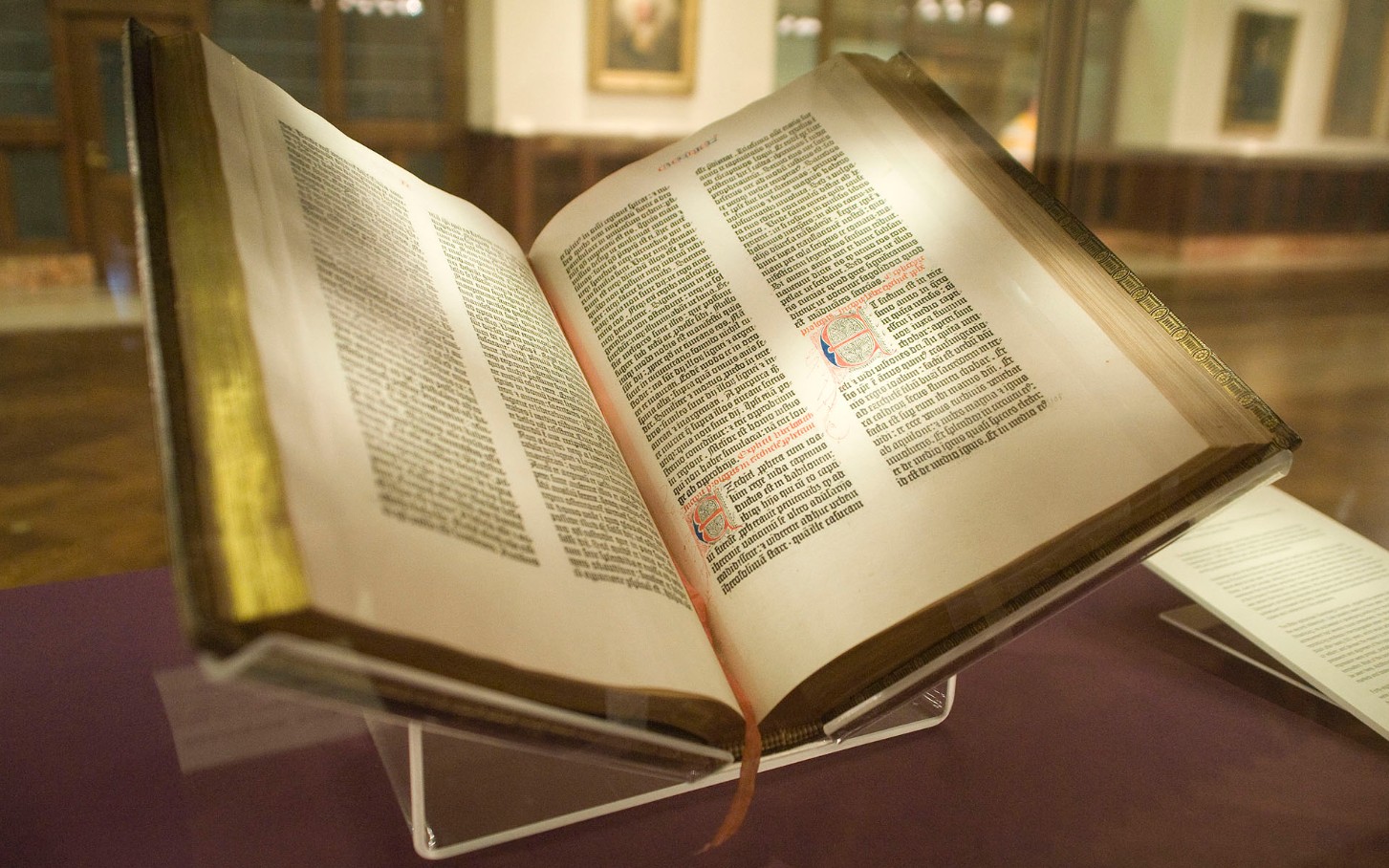
One might reasonably say that drag queen story hour has no place in the curriculum, but there is no record of Ms. Clark protesting when Texas public schools hosted them. Apparently, twerking trannies are deemed high art while the Bible is banned literature. But given the obvious agenda here, it makes sense. If you have one, you are very unlikely to have the other. And Ms. Clark’s implicit charge that the SBOE is proposing the Bible be taught as a source of spiritual guidance and inspiration in public schools as in a church on Sunday is dishonest. As she well knows, it is included in the curriculum, like every other reading on the list, as a critical piece of classical literature. Which it is.
One suspects that what Ms. Clark really means is the Bible is the only religious text on the list that anyone takes seriously, and therein lies critics’ real objection to its inclusion. After all, the curriculum (appropriately) contains several religious texts of Greek and Roman mythology; Aesop’s Fables and Pericles’ Funeral Oration, both of which have strong undertones of Greek religious traditions; Beowulf is full of paganism; Hawthorne, whose beliefs were a syncretic blend of Buddhism and Hinduism; and, of course, the Old Testament (Tanakh), a text that is claimed by both Christians and Jews.2 While this is for her a reason not to include the Bible, it is precisely why it should be included. A Texas student won’t find too many temples to Zeus or Odin, but he will see churches as numerous as oil rigs dotting the Lone Star State’s landscape. If he is to know why they are there and the nature of their influence upon his culture, it must start with a reading of the book which inspired them.
The complaint of Annie Laurie Gaylor, Co-President of the Freedom from Religion Foundation, ran along a similar vein:
A mandatory public school reading list should never function as a bible lesson. Texas is telling public school students that the Bible is the most important book they will read in their English classes.
It will come as a surprise to Ms. Gaylor that it is the most important book they will ever read in an English class or any other, and that remains true even if one (however foolishly) rejects its history, miracles, gigantic claims, wisdom, spiritual guidance, poetry, and prophecy, and that is because so many millions who shaped Western civilization, and the United States in particular, did not and do not reject it. The hysterical response to the SBOE’s decision to include the Bible in the k-12 curriculum is more than anti-God, it is anti-intellectual.
Back to Forrest McDonald.
His point about Tuchman’s A Distant Mirror wasn’t lost on me. It was drilled into me as McDonald guided my thesis and saw to its publication (my first), reminding me the entire way that there are no shortcuts to excellent scholarship and a purely secular mindset is seldom useful in untangling the mysteries of the past. Sensing a gap in his own education, late in life he studied Latin and read the Bible so that he might better understand the ancients. Indeed, Augustine, Anselm, Aquinas, Chaucer, Shakespeare, Milton, Donne, Dickens, Dostoevsky, Tolstoy, Eliot, O’Connor, and a host of others are virtually unintelligible without a working knowledge of the Bible. Imagine trying to understand A Christmas Carol (also on the SBOE reading list) or merely the title of Faulkner’s great novel Absalom, Absalom! without that in your intellectual toolbox.
And this principle applies to every notable skeptic the West has nurtured since at least the fall of the Roman Empire. Only a Christian culture could have produced the likes of Hume, Rousseau, Gibbon, Marx, Nietzsche, Russell, or Sartre. Overlooked in the discussion is that the SBOE reading list includes more than a few fierce critics of Christianity: The Transcendentalists, Mark Twain, Helen Keller (for a time, a communist), George Orwell (an atheist and socialist), and Langston Hughes. It was a Christian culture that gave all of them their moral sensibilities, and it was the Bible, whether they ever read it or not, against which they were reacting.
In other words, the Bible is the prequel to everything.
I recall a fascinating conversation with Indian scholar and social reformer Vishal Mangalwadi while we were speaking at a conference together in St. Louis. Over a late dinner, Mangalwadi, author of The Book that Made Your World: How the Bible Created the Soul of Western Civilization, explained how the central premise of the Declaration of Independence – “We hold these truths to be self-evident, that all men are created equal, that they are endowed by their Creator with certain unalienable Rights, that among these are Life, Liberty and the pursuit of Happiness” – is incoherent nonsense to anyone outside of the Christian West. Using his own country as an example, Mangalwadi pointed out that Indian society is predicated on the very opposite idea: there is nothing self-evidential about the equality of man. Indeed, there are massive physical, material, intellectual, and social inequalities. The only way a sentence like that makes any sense at all is if you are appealing to those who share your Christian assumptions that human equality is spiritual in nature and rights flow from a Creator.
As a graduate student teaching Western civilization at the university level and later in an elite (and decidedly leftist) preparatory school, I required my students to read those sections of the Bible that have most profoundly influenced the West: the creation story in Genesis chapters 1 – 2; the Ten Commandments in Exodus 20; the Sermon on the Mount in Matthew chapters 5 – 7; and the trial, crucifixion, and resurrection story in John chapters 19 – 21. After just such an assignment, one student, an exceptionally intelligent Chinese boy, said to a friend as he entered the class: “Did you read this? It says this guy came back from the dead!”
I was dumbstruck. I realized in that moment the size of my task. While that degree of biblical illiteracy was rare, it was nonetheless a clear indication of a problem almost all of them shared. If they were to have any hope of understanding later discussions of the fall of the Roman Empire, the so-called Dark Ages, the Renaissance, the Reformation, the rise of capitalism and science, the First and Second Great Awakenings, the abolitionists, the civil rights movement, American exceptionalism, and so on, they needed some knowledge of the Bible. When the blue hair mafia at the preparatory school challenged my use of the Bible in my course, I defended the decision by pointing out that it had defined the West more than the rest of the Western literary canon combined. The headmaster, an agnostic, but also a classically educated liberal of the old school, accepted the argument as both true and valid. Debate over.
“Carry on, Mr. Taunton.”
The great irony in all of this is that the arguments Clark, Gaylor, and the above faculty members employed for the exclusion of the Bible in Texas’s public-school curriculum and in my classroom, flawed though they are, appeal to a standard of fairness that only finds meaning in a Christian context. The point isn’t that any of these people are Christians (Clark claims to be); it is, rather, that they have absorbed just enough of a Christian ethos to make broken use of its logic. And so it is with all leftist appeals to “equality,” “diversity,” and “tolerance.”
In his book Civilization: The West and the Rest, Niall Ferguson, Senior Fellow at Stanford University’s Hoover Institute, quotes an unnamed Chinese scholar saying, “The heart of your culture is your religion: Christianity. That is why the West has been so dynamic. Christianity is the reason for your success.”
Ferguson goes on to argue that the decline of the West can, in part, be attributed to the decline of a robust Christian presence in Western culture. His point is largely an economic one, but the inference that Christianity has served as the intellectual foundation of the West is unmistakable.
I’m reminded of a debate I moderated at the Oxford Museum of Natural History between Oxford University Professors Richard Dawkins and John Lennox. At one point, Dawkins, an atheist biologist and, as we shall see, not much of a historian, asserted that Christianity played no role in the rise of science. Lennox, a philosopher of science and mathematician, quipped that the very building in which they sat debating the subject was built with funds from the Bible Society. Dawkins scoffed.
But he was wrong.
Construction of the museum had been initiated by Oxford University Regius Professor of Medicine Sir Henry Acland, a devout Christian, with funds from the sale of Bibles. Acland wanted students to begin to “unravel the complex mechanisms and prescient intentions of the Maker of all.”
Dawkins, like Clark and Gaylor, blinded by his own hatred of a book he does not understand, failed to recognize that it made the very science he studied, indeed, the very outlines of his own intellectual processes, possible. As Kepler remarked, “Science is the process of thinking God’s thoughts after him.”
The Bible is the prequel to everything.
Larry Alex Taunton is a freelance columnist with contributions to The Federalist, Daily Wire, USA Today, Fox News, First Things, The Atlantic, The New York Post, CNN, Daily Caller, and The American Spectator. He is also the author of "The Faith of Christopher Hitchens," "The Grace Effect," and "Around the World in (More Than) 80 Days: Discovering What Makes America Great and Why We Must Fight to Save It." You can subscribe to the “Ideas Have Consequences” podcast at Join.larrytaunton.com and find him on Twitter @larrytaunton.