Does 'Independence Hall' Sell Our Constitution Short?
Is America’s first and arguably greatest building misnamed?
That thought occurred on a trip last week to Philadelphia. In a first-floor room of a building constructed to serve as Pennsylvania’s State House, two groups of 18th-century leaders made two momentous decisions: the first, a quarter-millennium ago this week, to declare independence from Great Britain and establish a distinct American nation; and the second, 11 years later, to create a governing system for the United States.
The building is near-universally known as Independence Hall. But does the focus on independence give short shrift to the development of representative democracy that occurred in the very same building?
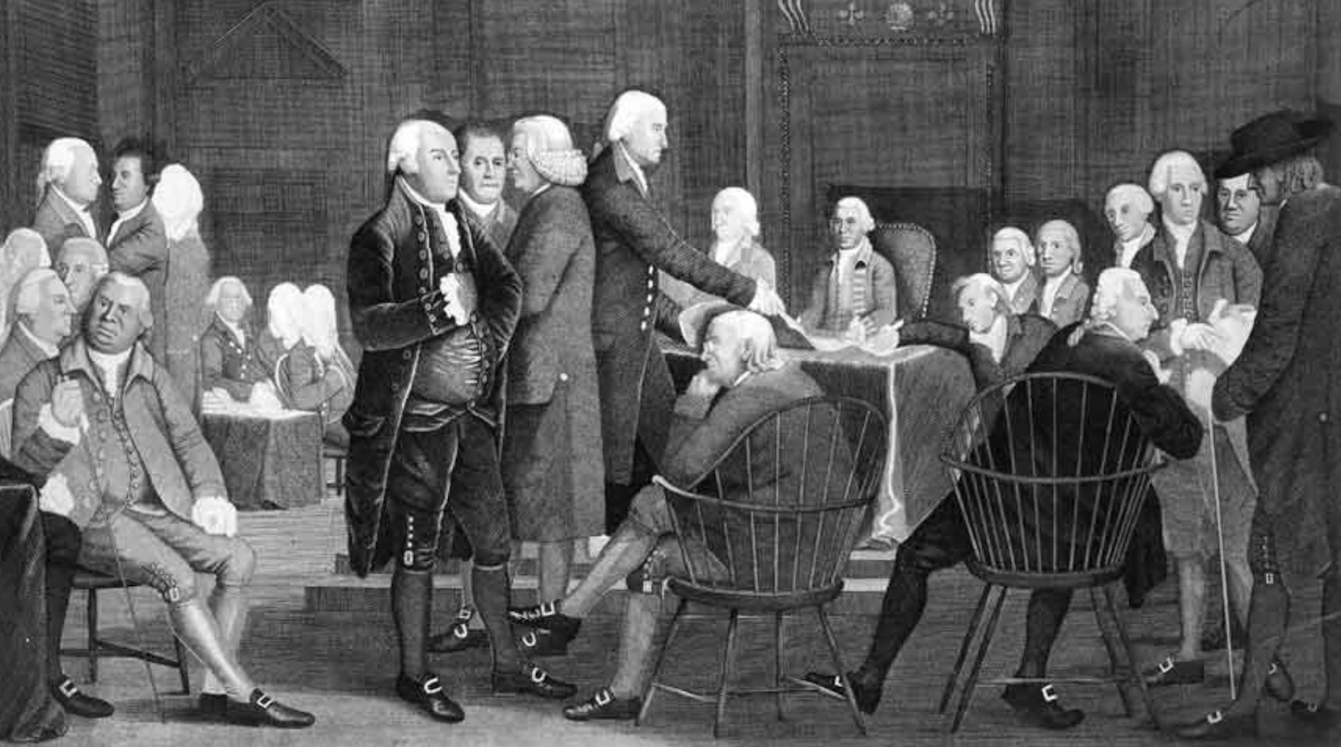
Historical RepresentationAs a ranger explained, the National Park Service struggles with questions of historical accuracy for this most venerated building. The first floor Assembly Room features 13 tables representing the 13 colonies at the time of the Second Continental Congress that began in 1775 — northern colonies to the north, southern colonies to the south.
But the room’s most famous object and its only original artifact, the Rising Sun Chair, used by George Washington while presiding over the Constitutional Convention in 1787, didn’t exist at the time Congress declared independence. The Pennsylvania Legislature commissioned the chair from John Fowell in 1779, after British troops had used the State House for their own purposes during their occupation of Philadelphia in 1777-78. And Rhode Island never sent delegates to the Constitutional Convention, meaning an accurate portrayal of Assembly Hall circa 1787 would feature 12 state delegation tables, not 13. The end result that visitors see is something between the best approximation and a historical mash-up of two important events.
Biblical MetaphorBut of these two important events, which was of greater consequence? Former Harvard professor Harvey Mansfield noted in The Wall Street Journal recently that Lincoln thought the Declaration of Independence the more important document. Borrowing an analogy used in the book of Proverbs, the Great Emancipator called the two an apple of gold (i.e., the Declaration) in a frame of silver (the Constitution).
In Lincoln’s view, the Constitution framed the central principle behind the Declaration of Independence: that all men are created equal. He believed the United States could not have won the Revolution — or, as he put it, “secured our free government and consequent prosperity” — without the principles of the declaration animating the fight for independence. With independence secured only through the principles of the declaration, Lincoln reasoned, the Constitution put those principles into practice.
Counterfactual ScenariosThe converse argument relies on a different vein of counterfactual thinking. Specifically, one could argue that without the practical realities the Constitution brought into existence, the principle and vision of the Declaration of Independence might have stood unfulfilled. Without a stronger central government, the 13 states could easily have spun outward into disunion and chaos. Indeed, to some, the Philadelphia Convention represented the last chance to preserve the American experiment.
If one believes that the governing framework created by the Constitution saved the fledging nation from plummeting into the abyss, it becomes easier to prioritize the latter document over the former. After all, Jefferson and the Continental Congress could speak all they like about “self-evident truths” of human equality and natural rights, but without a functioning government to secure those rights, who would listen? And if the 13 American states had become disunited in the years after the Revolution, would people the world over still look to self-government as a beacon of hope for mankind?
Having considered the greatness of the Declaration of Independence and Constitution at least since the time of Lincoln, historians and scholars will continue to debate this chicken-and-egg problem for centuries more. Two things seem clear, however. Eleven years from now, citizens should give the 250th anniversary of our Constitution as much prominence as the events we commemorate this week. And on both occasions, we should give thanks for a generation of colonial leaders who gave us, within the span of a few short years, two documents that redefined governance the world over — proof that lightning can indeed strike twice.
Pennsylvania’s Old State House is open daily, with advance tickets for tours available for a $1 reservation fee here. From July 1 through July 4, the building will be open for visitors on a first-come, first-served basis only, with no advance tickets; expect heavy attendance and potentially long lines. For more information, visit the National Park Service website.
Chris Jacobs is founder and CEO of Juniper Research Group and author of the book "The Case Against Single Payer." He is on Twitter: @chrisjacobsHC.