How Mass Migration Destroyed Sweden's Scandinavian Utopia
Not so long ago, Sweden used to be leftists’ favorite example of effective government: It had a generous welfare system, boasted a highly educated population, and just seemed a little classier and cleaner than most parts of the United States. True, it thenn had a small, homogenous population of law-abiding, productive citizens, but most admirers conveniently ignored this key detail.
In more recent years, far fewer people mention Sweden. If anyone mentions the county, it is usually to cite their soaring crime rates and terrorist attacks and the obvious connection with Sweden’s large number of unassimilated migrants from the Third World. Not only does this situation now threaten the livelihood for native Swedes, but also their reputable public entitlement system.
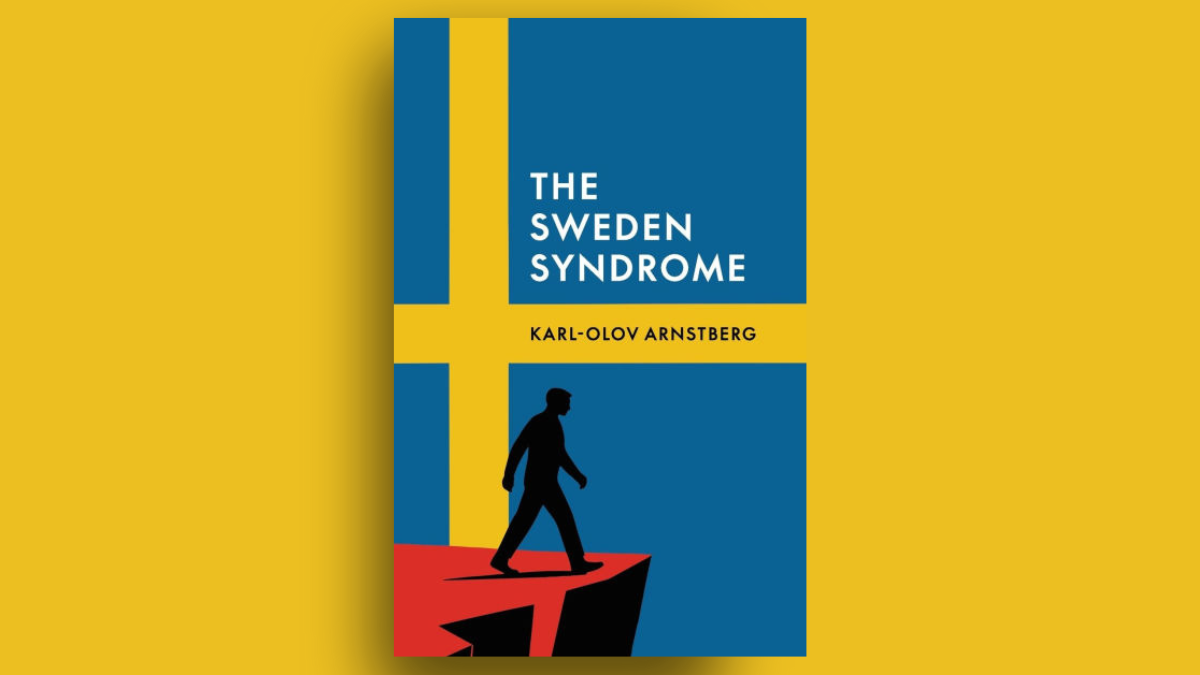
Indeed, as Swedish sociologist and writer Karl-Olov Arnstberg explains in his new book The Sweden Syndrome: How Elites Commit National Self-Destruction, the leadership in his country aggressively flushed away their many advantages by pursuing every bad leftist idea possible. What was once the pride of North European socialist technocracy is now being ruined with incompetent and corrupt politicians, a broken justice system, and a growing contingent of barbaric foreigners burdening their host nation in countless ways.
The book begins with a foreword from the online essayist John Carter, who recalls seeing a group of Arab young men harassing white Swedish girls on a bus in Uppsala. Because of the prevailing social norms of their country, both the girls and white male bystanders simply took the abuse in silence. He follows this by describing the familiar blight and decay that one now sees all around Swedish cities and the quiet exasperation of native Swedes lamenting what has become of their country.
With this context set, Arnstberg explains how his great country has come to this. In his view, the problem is not so much a specific policy position or ideology, but a whole pattern of positions and ideologies that make up what he calls “the Sweden Syndrome.” Evidently, this illness is contagious since it has spread to the rest of the West along with blue-state America, destroying everything in its path.
In Arnstberg’s view, patient zero of the Sweden Syndrome first appeared in the 1970s with Swedish sociologist David Schwarz, who introduced the idea of making Sweden a “multicultural nation.” While Americans may shrug at this notion, for Swedes, this was an exciting new idea that apparently had little downside. As Arnstberg puts it, “the time was simply ripe for [Schwarz’s] ideas.”
Building on this vision of a multicultural Sweden, Social Democrat (not to be confused with the populist Sweden Democrats) politician Jonas Widgren actively pushed for greater levels of migration into Sweden. Along with Schwarz, Widgren imagined most immigrants coming into Sweden would come from the neighboring Christian countries for economic reasons, not from distant Muslim countries escaping poverty and persecution. Thus, when assessing the potential effect of mass immigration on the economy, pro-immigration advocates regularly used data “essentially related to Nordic and European labour migration, which had largely ceased [by 1980].”
Although basic common sense would caution against importing Muslims from the Third World in large numbers, Swedish politicians doubled down and made the policy official by asserting, “All human beings are born free and equal in value and rights.” As Arnstberg notes, substituting the word “value” for “dignity” makes all the difference. When immigrants and natives have equal value, then they are thereby entitled to the same civil rights and social welfare programs. As such, under this framing, the refugee from Afghanistan who can’t speak Swedish and lives on welfare is just as Swedish as the white Swedish guy who works at IKEA’s corporate office and pays for that welfare.
Worse still, calling out this absurd equivalence automatically invites accusations of bigotry. Such critics imply that some Swedes have more moral value than other Swedes. Naturally, the Swedish media do their utmost to reinforce complete acceptance of all immigrants, no matter what problems they present. As such, Swedish journalists will go out of their way to obscure the identity of immigrant criminals, even going as far as to give them different names that sound less foreign, like “Anders” and “Dennis.”
Midway through the book, Arnstberg pivots away from immigration and takes aim at the militant leftist feminism also ruining his country. In itself, there is nothing wrong with criticizing a movement that has morphed from equal rights into female chauvinism and the institutional discrimination of men (see my remarks on the importance of “the longhouse” meme here), but it tends to stick out from his main discussion of multiculturalism.
Mostly, Arnstberg seems to include this discussion to point out how feminized Swedish society and particularly its elite class has become. Among other things, this has compromised their ability to take any real stance against admitting more refugees: “There is a curious contradiction between how vicious and hateful feminists can be towards other women and their own men and how generous and forgiving they can be towards those whom they see as harmed by society — the ‘unfortunate children.’” In terms of policy, this has culture-wide consequences, leading the emasculation of men (whom Arnstberg calls “nice wimps”) and the increasing disinterest of both sexes in marrying and having children.
Not surprisingly, the subsequent birth dearth has made it all the more tempting to bring in more immigrants. Never mind that immigrants (and their children) in Sweden take more from public assistance than they contribute to it, and thus become a significant drain on the economy.
In order to expedite their transformation of the country into a true multicultural nation, Swedish elites have also taken extensive measures to thoroughly indoctrinate the populace. Along with listing some of the useless, yet expensive, government programs designed to “amplify the voices” of various immigrant groups, Arnstberg focuses on one instance in which the Swedish Museum of Far Eastern Antiquities is purposely hollowed out and converted into what cultural journalist Ola Wong calls “an irrelevant PR agency for happy-clappy multiculturalism.”
Of course, Arnstberg’s indictment would not be complete without recounting the shameless undermining of law and order. While the media dutifully covers up for the criminal proclivities of migrants, the courts do their part by tipping the scales in their favor, letting these criminals off with laughably light punishments while throwing the book at native Swedes who express alarm that this is happening.
Beyond the usual hypocrisy, Arnstberg remarks how the crimes immigrants commit are often done with the explicit intention of humiliating ethnic Swedes, who represent the great majority of the victims. He recounts several instances of Swedish youths being beaten, raped, and emotionally traumatized simply for the color of their skin, while their attackers are continually given a free pass to continue their rampage even after they gloat about it. As Social Democrat politician Morgan Johansson observed, “The problem has grown so large that it affects a whole generation of Swedish teenagers, young men and women who constantly have to consider the fact that they can be beaten and robbed because they are Swedish by origin.”
Altogether, The Sweden Syndrome shows a country once famed for its orderliness, civility, and prosperity brought low by leftist ideas. As with many other countries in the West, Sweden increasingly resembles an anarcho-tyranny state where political authorities punish productive, law-abiding citizens and reward the barbaric and corrupt, all with the aim of strengthening their hold on the country. On the final page, Arnstberg predicts that “in a decade or so, we may have civil war-like conditions in Sweden.”
So, knowing this, how should one avoid such a calamity? This is where the book falls somewhat short. Arnsterg offers a detailed diagnosis of the Sweden Syndrome, but he never bothers with any prognosis that could treat it. Should Swedes vote for the Sweden Democrats instead of the Social Democrats? Should they protest in the streets of Stockholm? Should they mount a coup against the current government and take violent action against non-Western immigrants and deport them en masse? If a “civil war” actually erupts, what would the two sides be?
That said, it must be understood that the first step to solving any large problem is to simply identify it, and for this, Arnstberg deserves enormous credit. Writing about this subject and expressing a negative view of multiculturalism has come at great personal cost: the loss of his university position, friends, and even his wife. He is a voice crying out in a leftist-made wilderness, and his warnings should be heeded.
Tragically, the ones who will likely respond to the crisis he describes won’t be his fellow Swedes, but conservative populists in red-state America who still have the wherewithal and righteous fury to finally push back against this insanity.
Auguste Meyrat is an English teacher and freelance writer in the Dallas area. He is the founding editor of The Everyman, a senior contributor to The Federalist, and has written for essays for The American Mind, The Stream, Religion and Liberty, The Blaze, and elsewhere. He is also the host of "The Everyman Commentary Podcast." Follow him on X.