New York Legalizes Doctors Prescribing Death
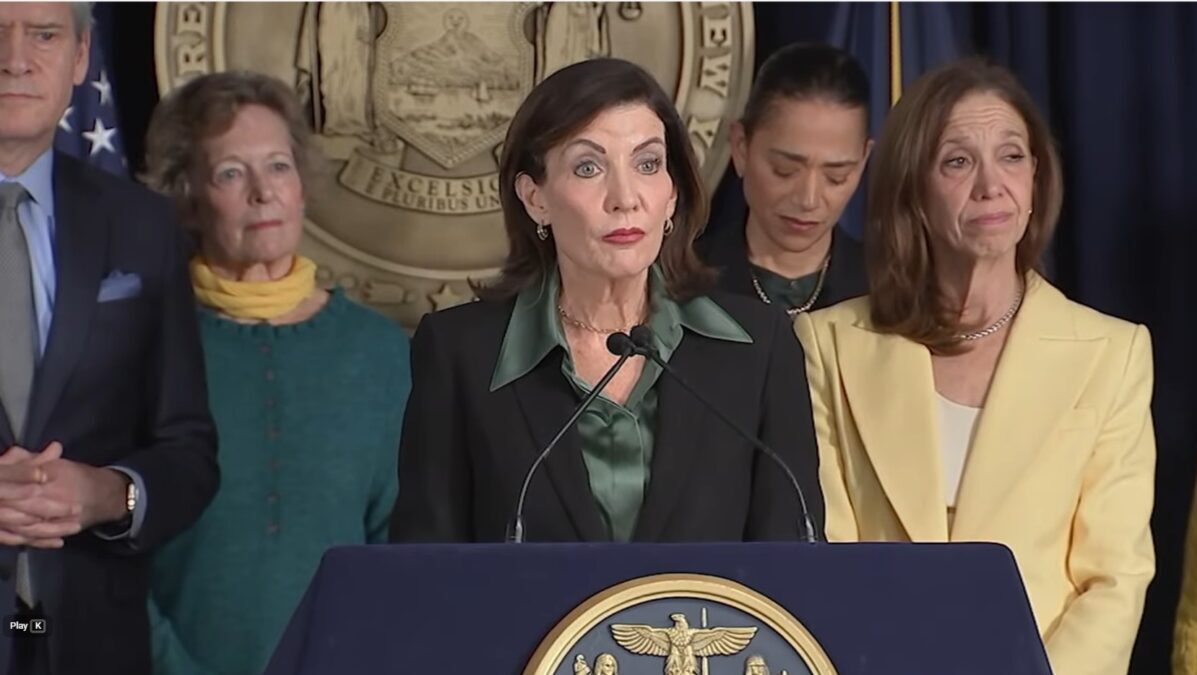
New York Gov. Kathy Hochul announced in an op-ed last week that she will sign a bill legalizing medical assisted suicide for adults with a terminal illness.
Hochul says she is passing the Medical Aid in Dying Act due to the “genuine and deeply held belief that government must respect the rights and will of the people it serves.” To qualify, an adult must be “mentally competent” and have a “prognosis of six months or less to live,” the bill states.
The bill also makes it clear that anyone who makes the request for medical assisted suicide must not be considered “suicidal” and taking medication to intentionally end one’s life should not be considered a “suicide.”
This move lets New York join the club of 12 states and the District of Columbia that preach suicide as a form of “medical aid in dying.”
Although the act will allow “individual doctors and religiously affiliated health facilities” to decline offering suicide as a form of treatment to those who are suicidal, doctors must “promptly” transfer requesting clients to a health care provider who is “willing to permit the prescribing, dispensing, ordering or self-administering” of suicide medication.
“I heard stories of a parent or spouse pleading for an end to the suffering,” Hochul, whose own mom died from ALS, writes. “I am all too familiar with the pain of seeing someone you love suffer and feeling powerless to stop it.”
I have never had any form of terminal illness, but I watched my mom fight cancer for five years and die. It’s no easy thing to watch and I can conclude it’s even harder to fight. Yet, that doesn’t mean we should let our government allow the terminally ill to kill themselves as a form of so-called “healthcare.”
Prognoses Can Be WrongThe entire framing of the bill adopts suicide into society as a form of medical treatment, putting suicide as a remedy option and medical professionals as death prescribers.
The prognosis of a life span that acts as a qualifier for medical suicide is a theory or an educated “prediction” that is never 100 percent guaranteed correct.
Take J.J. Hanson, an anti-physician assisted suicide activist who died from terminal brain cancer. At the time of his prognosis, he was given four months to live. Yet, “the punctual activist was 3 years, 3 months, and 18 days late for an appointment” that allowed him to meet his newborn who doctors said he’d never get to meet.
Contradicting DutiesHochul also writes that “a psychologist or psychiatrist” must assess the patient to ensure they are “capable of making the decision and not under duress.” Licensed therapists and medical professions are required by law to report when a client expresses intentions of suicide due to suicide being a clear sign of distress.
Medical professionals have a duty to utilize the strengths-based approach that encourages resilience and confidence in ability, especially when it comes to client mental health and suicidal ideation.
These professions have an ethical responsibility to ensure the health and well-being of those they serve. This bill completely contradicts those duties and responsibilities.
The New York bill also requires patients to sign their request to die and makes it clear that medical professions “shall not be subject to” liability for prescribing or refusing to prescribe suicide as medicine.
California’s Climbing NumbersWhen California first started prescribing death in 2016, 111 individuals died by medically assisted suicide. By 2024, that number increased 800 percent, to 1,032 people, with the highest demographics being white females in their 80s with malignant neoplasms. And the numbers will continue to climb.
Adopting suicide as a medical intervention for the terminal ill will inevitably lead to suicide being prescribed for those diagnosed with depression. More than 49,000 people died by suicide in 2023, according to the CDC. These people who want to end their life need help and support, not bills that encourage them to kill themselves.
At the end of the day, a person can choose to take their own life. Yet, when the government steps in to allow healthcare workers to use suicide as a dignified medical form of care instead of helping them save lives and improve their overall health, it is a grave disservice to its citizens.
Having a terminal illness is already a life-shattering experience that is physically, emotionally, mentally, and financially arduous. The experience becomes even worse when medical professionals are not ethical, compassionate, and committed to advocate for solutions. Clients need a medical team they can trust who is committed to improving their overall physical and mental health. Opening the door to medical assisted suicide, one bill at a time, will only poison the profession, society, and take more lives.
Abigail Nichols is a correspondent for The Federalist. She was previously the opinion editor for the University of South Florida's student newspaper, The Oracle. She is now working as the business manager at the University of North Florida's student-run media outlet, Spinnaker Media, while obtaining a master's degree in social work.