Strokes of Genius: Van Gogh's Paintings May Have a Mathematical Fingerprint
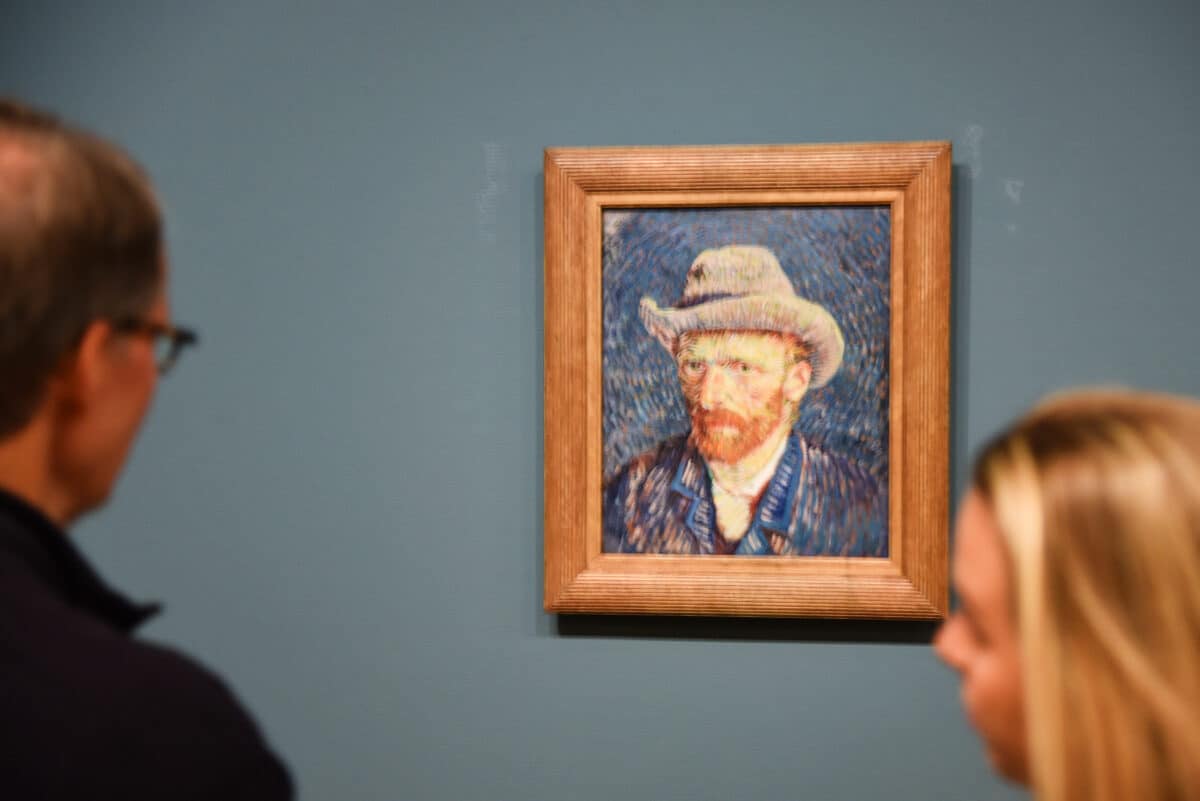
Amsterdam, Netherlands. January 2023. Visitors admiring a self portrait of Vincent van Gogh. (Credit: © Bert - stock.adobe.com)
A Suspected Van Gogh Forgery Failed a Math Test. A Rediscovered Masterpiece Passed. In A NutshellEvery time Vincent van Gogh dragged a loaded brush across a canvas, he left behind more than paint. He left a physical signature, a pattern of ridges, valleys, and textures shaped by the pressure of his hand, the weight of his stroke, and the thickness of his paint. Now a team of French researchers has found a way to read that signature mathematically, and when they ran a suspected forgery through the same test, its surface pattern looked nothing like the authenticated works.
Published in the journal Surface Topography: Metrology and Properties, the study by Francois Berkmans, Ludovic Nys, and Maxence Bigerelle at the University Polytechnique Hauts-de-France uses a property called fractal dimension to measure the surface texture of paintings. Borrowed from industrial engineering, where it is used to analyze manufactured parts, this surface-measurement approach had rarely been tried in art authentication. Applied to Van Gogh, it reached the same conclusions experts had already drawn about both a long-disputed forgery and a recently authenticated canvas, but arrived there through a mathematical analysis of the paintings’ photographed surfaces, without examining the works in person.
Van Gogh’s Brushwork Showed a Consistent Pattern in This StudyFractal dimension is a numerical measure of surface irregularity. A smooth wall scores low; a heavily textured surface scores higher. Van Gogh’s impasto style, his thick, built-up layers of paint applied in short, swirling strokes, puts him well toward the high end of that scale.
To calculate it, researchers converted high-resolution painting photographs to grayscale, using pixel brightness as a stand-in for surface height. That produced a 3D-like topographic map of each canvas. A grid-based algorithm then divided the surface into progressively smaller sections, measuring how the texture changed at different scales, to produce a single number per painting.
Scores were generated twice per work: once across the whole canvas and once within a zoomed-in area of individual brushwork. Running both gave the team a fuller picture of how each individual brushstroke contributed to the painting’s composition as a whole.
Using a reference group of eight institutionally authenticated Van Gogh paintings, including ‘Wheatfield with Crows,’ ‘The Starry Night,’ and ‘The Bridge on Langlois,’ researchers built a statistical baseline for comparison. For whole paintings, scores averaged about 2.73; for the zoomed-in brushwork areas, they averaged about 2.76. Van Gogh, it turns out, painted with a measurable consistency, specific enough to use as a benchmark against which two contested works could be tested.
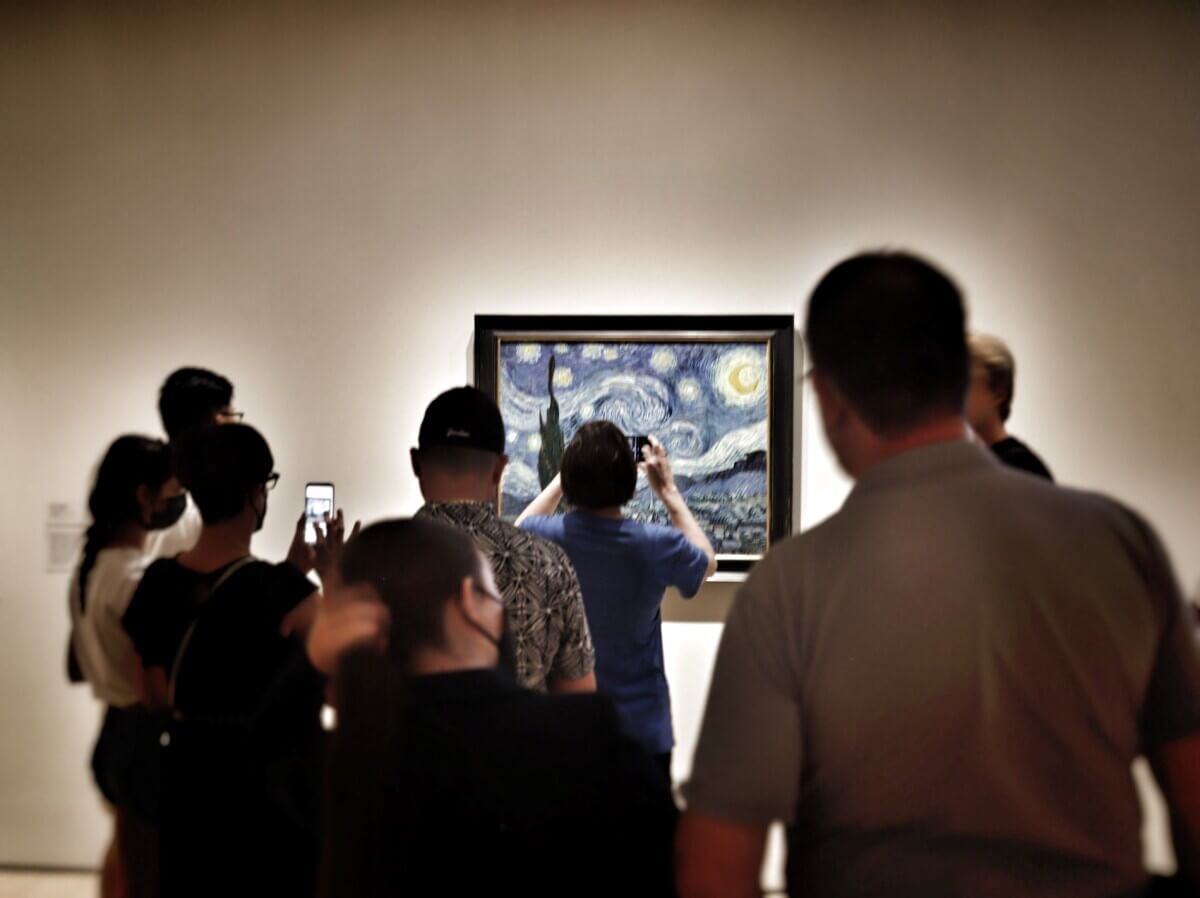 French researchers used fractal math to analyze Van Gogh’s brushwork — and a suspected forgery looked nothing like the real thing. (Photo by Bernd ???? Dittrich on Unsplash)
Van Gogh Forgery ‘The Plowmen’ Gets Caught by the Numbers
French researchers used fractal math to analyze Van Gogh’s brushwork — and a suspected forgery looked nothing like the real thing. (Photo by Bernd ???? Dittrich on Unsplash)
Van Gogh Forgery ‘The Plowmen’ Gets Caught by the Numbers
‘The Plowmen’ is a small oil-on-wood panel discovered in Paris in the 1990s, bearing the signature “Vincent.” Its authenticity was disputed in the French press in the early 2000s before the Van Gogh Museum rejected it outright. Run through the same fractal analysis applied to the reference works, it scored so far outside Van Gogh’s established range that researchers found the probability of it belonging there to be statistically negligible.
‘Sunset at Montmajour’ told a different story. Van Gogh described the landscape, depicting oak trees near Arles, in a letter dated July 4, 1888. Purchased in 1908 and forgotten in an attic, it spent decades under doubt before the Van Gogh Museum authenticated it in 2013 using pigment analysis, canvas examination, and his correspondence. Its fractal score fell comfortably inside the reference range, consistent with the museum’s findings.
Math Can Also Tell Van Gogh Apart From Other ArtistsFor a wider test, the team applied the same method to eight paintings by David Klöcker Ehrenstrahl, a 17th-century Baroque court painter known for smooth, polished portraiture, about as different from Van Gogh stylistically as a painter could be.
Scores for the two artists separated clearly. Van Gogh’s textured canvases averaged 2.75; Ehrenstrahl’s smooth, controlled surfaces averaged 2.60. Statistical testing put the probability of that gap occurring by chance at just over one in a thousand. With only eight paintings per artist, broader validation will be needed, but the separation was sharp enough to suggest the method can distinguish very different painters from image-derived surface texture alone.
Knowing where the approach falls short matters just as much. It does not examine pigments, provenance, or underdrawings. Varnish layers, conservation work, and cracking can all distort the paint surface and skew results. Paintings made with smooth glazing techniques, common in Renaissance art, produce too little texture for reliable analysis. At this stage, the tool works best as a screening aid, a first pass before more expensive forensic work begins.
Authentication has always demanded multiple lines of evidence. No single test closes a case on its own. Fractal analysis adds a concrete score that could become a repeatable part of that process once image capture and analysis are better standardized, capturing not what Van Gogh intended to create, but exactly how his hand moved to put it on canvas.
Paper Notes LimitationsThe study works from high-resolution photographs rather than direct physical scans of the paint surface, meaning height values are approximations based on pixel brightness rather than true measurements. Lighting conditions, camera settings, white balance, and digital compression can all affect results. Paint aging also introduces complications: fine cracks, prior restorations, and varnish buildup can change the physical surface in ways the fractal calculation cannot account for. The sample size is small, with eight authenticated reference paintings per comparison, and the authors explicitly note that larger corpora with stricter controls over image acquisition are needed before the method can be reliably generalized. A single fractal parameter may not capture the full range of characteristics distinguishing one artist from another; the researchers suggest future work should extend toward multifractal or multi-parameter descriptions.
Funding and DisclosuresThis research was conducted without any specific grant from funding agencies in the public, commercial, or not-for-profit sectors. No conflicts of interest were declared. Images used in the study were drawn from royalty-free sources including Wikipedia/Wikimedia under Creative Commons license, the Art Institute of Chicago, and the Metropolitan Museum of Art.
Publication DetailsAuthors: Francois Berkmans, Ludovic Nys, and Maxence Bigerelle, University Polytechnique Hauts-de-France, Valenciennes, France. | Title: “Preserving Van Gogh’s painterly heritage: topographical and fractal insights in authentication” | Journal: Surface Topography: Metrology and Properties, Volume 14 (2026), Article 025016 | Published: June 11, 2026 | DOI: https://doi.org/10.1088/2051-672X/ae7136