Study: Pacific Islanders Appear To Have Most Ancient Human DNA On Earth
Papua new guinea. Credit: Jelilah Kum on Unsplash
Ancient DNA Hidden in Pacific Islanders Reveals Three Separate Encounters With a Mystery Ancestor In A NutshellPeople living in Near Oceania, a region spanning New Guinea, surrounding island chains, and the main Solomon Islands, carry more ancient, pre-modern human DNA than any other population on Earth. New research has found that their ancestors inherited genetic material from three distinct Denisovan-like groups, extinct relatives of modern humans, across tens of thousands of years of prehistory. Some of that ancient inheritance appears to influence gene activity today, particularly in immune-related pathways.
While much of the world’s human population was spreading and connecting, the early settlers of Near Oceania arrived roughly 42,000 years ago and largely stayed put, cut off at the far edge of the inhabited world for tens of thousands of years. That long separation left deep marks in their DNA, including stretches of genetic code inherited from archaic human relatives that scientists are only now beginning to map. These populations have been dramatically underrepresented in major genetics studies, meaning these discoveries were hiding in plain sight for decades.
An international team, publishing in the journal Science, sequenced the complete genomes of 177 individuals from 12 diverse Near Oceanic populations and compared them with 1,284 genomes from populations around the world.
Sepik Islanders Carry 25 Times More Denisovan DNA Than East AsiansOceanic genomes carried roughly two and a half times more ancient inherited sequence overall than European genomes. For Denisovan DNA specifically, Near Oceanic individuals carried 14 times more than East Asian people. One group, the Sepik of New Guinea, carried 25 times more Denisovan DNA than East Asians.
In total, the researchers reconstructed ancient inherited sequence covering more than 70% of what they could analyze of the archaic human genome, nearly 1.9 billion units of genetic code. Of that, 831.9 million units came from Denisovan lineages, almost three times more than prior research had identified. More than 505 million units of archaic sequence had never been documented before this study.
By examining fine-grained patterns of Denisovan DNA across modern genomes, the team identified signatures pointing to three distinct Denisovan-like groups that contributed DNA to the ancestors of Near Oceanians at different points. The authors note that more work is needed to clarify exactly when and how each of those events unfolded.
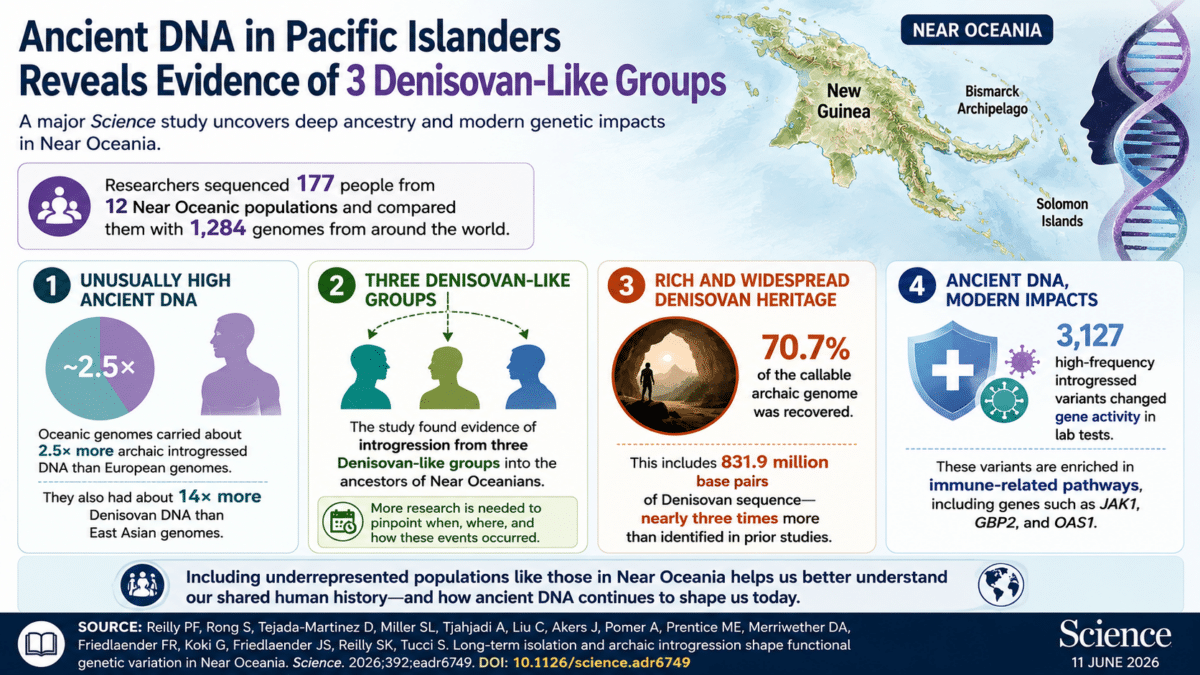 Pacific Islanders carry the most ancient human DNA on Earth, including traces from three Denisovan-like groups, new research finds. (Image by StudyFinds)
Long Isolation Pushed These Populations Down a Genetically Distinct Path
Pacific Islanders carry the most ancient human DNA on Earth, including traces from three Denisovan-like groups, new research finds. (Image by StudyFinds)
Long Isolation Pushed These Populations Down a Genetically Distinct Path
Spending tens of thousands of years at the far edge of the inhabited world does something to a population’s DNA. Random genetic drift, the process by which chance alone reshapes the genetic makeup of a small, isolated group over many generations, has left some Near Oceanic communities dramatically different from everyone else on Earth.
Several populations, including the Baining groups of New Britain and communities in the Solomon Islands, show signs of severe population bottlenecks, meaning their numbers fell sharply at some point in history. Population modeling pointed to a strong bottleneck between 10,000 and 20,000 years ago in some groups, and a separate signal of slowed growth around 30,000 years ago in others.
Ancient Genes From a Vanished Ancestor Still Appear to Influence ImmunitySome of the ancient inherited DNA is not simply a historical relic. Several variants appear to have been actively favored by natural selection. Researchers scanned for those signals and found numerous candidates concentrated in immune-related genes.
Among the most notable was TRPS1, a gene involved in bone development, skull and facial structure, and hair. A version inherited from Denisovans appears at high frequencies, approaching 75% in some groups, across Oceanic and nearby island populations. Previous work identified selection on TRPS1 in central African rainforest hunter-gatherers and highland Ecuadorians, suggesting that different human populations may have experienced selection on the same gene under similar environmental pressures near the Equator.
To test whether ancient variants were actually changing how genes behave, the team inserted more than 22,000 variants into immune cells and measured whether they altered gene activity. They identified 3,127 variants that genuinely changed gene behavior, concentrated in pathways the authors note may be linked to malaria susceptibility.
Among those genes were JAK1, GBP2, and OAS1, all involved in antiviral and antimicrobial immune responses. A Neanderthal-derived version of OAS1 has drawn attention for a possible link to COVID-19 outcomes in Europeans and East Asians. This study found a separate, Denisovan-derived version of OAS1 unique to Oceanic populations, one with its own distinct set of variants that can also affect gene activity, though whether it influences COVID-19 risk or any other specific disease outcome remains untested.
Across these immune genes, different populations showed selection at different members of the same pathway, pointing to multiple independent events of local adaptation rather than a single shared response. For a region long overlooked by genetic science, Near Oceania is turning out to be one of the most important places on Earth for understanding what it means to be human.
Disclaimer: This article is based on a peer-reviewed study and is intended for informational purposes. Genetic findings about populations reflect group-level statistical patterns and should not be applied to individuals. Research into archaic DNA and immune function is ongoing, and many findings discussed here have not yet been connected to specific real-world health outcomes.
Paper Notes LimitationsAccording to the authors, further work is needed to understand the precise timing, mode, and geographic context of the multiple Denisovan introgression events identified. Functional analyses using the massively parallel reporter assay were conducted in two specific laboratory cell lines, K562 and Jurkat, which may not fully capture the range of biological effects these variants have in living human tissues. Many of the identified adaptive variants influence multiple biological systems simultaneously, making it difficult to isolate which specific environmental pressures drove selection on any particular variant. Future work, including precision genome engineering and organoid studies, will be necessary to tease apart those drivers. Additionally, the underrepresentation of Near Oceanic individuals in existing biobanks such as the UK Biobank and BioBank Japan limited the researchers’ ability to connect the ancient variants they identified to present-day health outcomes.
Funding and DisclosuresResearch was supported by the National Institute of General Medical Sciences and the National Human Genome Research Institute of the National Institutes of Health under award numbers R35GM147565, R00HG010669, R01HG012872, and 1S10OD030363-01A1, as well as the Theresa Seessel Fund and the Biological Sciences Fund of Yale University. All authors declare no competing interests.
Publication DetailsPublished in Science (Volume 392, article eadr6749) on June 11, 2026. Paper title: “Long-term isolation and archaic introgression shape functional genetic variation in Near Oceania.” Authors: Patrick F. Reilly, Stephen Rong, Daniela Tejada-Martinez, Samantha L. Miller, Audrey Tjahjadi, Chang Liu, Jared Akers, Alysa Pomer, Margaret E. Prentice, D. Andrew Merriwether, Françoise R. Friedlaender, George Koki, Jonathan S. Friedlaender, Steven K. Reilly, and Serena Tucci (corresponding author, Yale University). DOI: 10.1126/science.adr6749.