Karen, Chad Are The Most-Judged First Names in America
(© Michael Flippo - stock.adobe.com)
Millions of Americans Admit They’re Living With a Name They’d Rather Ditch, Survey Shows In a NutshellBefore a handshake, a resume, or a face, many Americans have already made up their minds. A single name is enough.
New survey data finds that roughly 1 in 5 Americans admit to judging a person based on their first name alone, a label chosen for them by someone else before they had any say in it. And if that name happens to be Karen, the social tax is steeper than for almost any other name in the country.
A poll of 2,000 Americans, conducted online in June 2026 by Talker Research, found that 18% of respondents said they make assumptions about a person based entirely on their first name. Karen drew more negative mentions than any other name in the survey, by a wide margin. Chad came in a distant second, with Donald, John, and Damien appearing frequently among the names most likely to trigger a negative reaction when heard for the first time.
Judged by First Name: Karen Leads a Loaded ListAmong all respondents, Karen drew far more negative mentions than any other name, a finding that captures in numbers just how loaded the name has become. Of all first names that respondents flagged as carrying negative connotations, Karen outpaced every runner-up by a wide margin, reflecting a degree of name-based association that most other names on the list can’t approach.
Chad, long a fixture in internet culture as a symbol of exaggerated male confidence, placed second. Donald and Damien each carry recognizable associations (one political, one drawn from decades of horror cinema), though the survey did not ask respondents to explain their choices, so these are reasonable editorial inferences, not survey findings. John, more neutral on the surface, still made the list, likely owing to its sheer ubiquity.
None of these people asked to be named what they were named. That’s the central friction in name-based judgment: it attaches itself to a person before they’ve had any chance to make an impression on their own terms. A name is handed down at birth, and years later it can arrive in a conversation carrying associations that were never earned and never chosen.
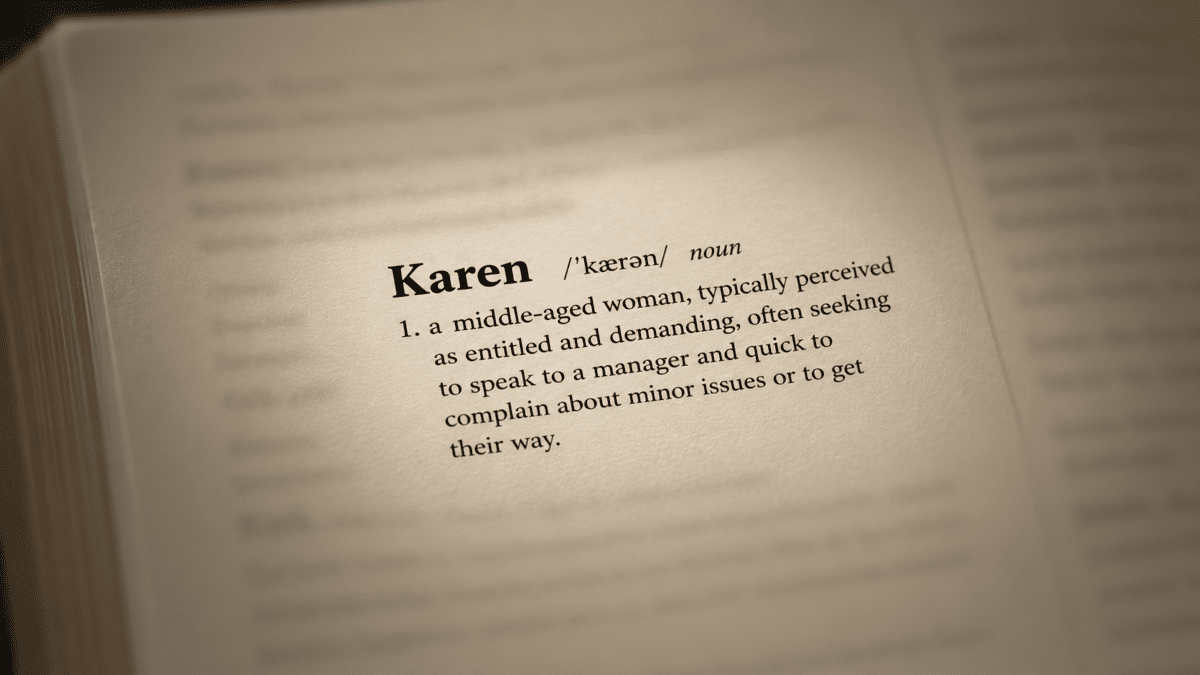 Unfortunately, the name “Karen” now comes with an unfair stereotype. (Image by StudyFinds)
Gen Z Is Most Likely to Judge by First Name
Unfortunately, the name “Karen” now comes with an unfair stereotype. (Image by StudyFinds)
Gen Z Is Most Likely to Judge by First Name
Generationally, the tendency to judge by name skews younger. Gen Z respondents were the most likely to make snap assumptions from a first name alone, with 29% saying they do so. Millennials came in close behind at 21%.
That finding carries a certain irony. Gen Z is widely associated with progressive social values and a rejection of surface-level bias, though the survey itself didn’t measure respondents’ values. What it did find is that this generation is faster than any other to form an opinion from a name before any interaction takes place.
To be fair, the survey captures the behavior, not the reasoning behind it. People may form impressions of names for any number of reasons: a personal history with someone who shared the name, cultural associations accumulated over time, or simply patterns absorbed from social platforms where certain names carry a heavy connotational load. Whether name-based judgment is rooted in something conscious or something far more reflexive is a question the data doesn’t answer. What it does confirm is that the behavior is most prevalent among the youngest adults in the sample.
1 in 5 Americans Would Rather Go by Something ElseName-based judgment doesn’t only flow outward. For many Americans, it turns inward as well.
According to the survey, 42% of Americans don’t feel they embody the spirit of their own first name. Older generations report the weakest connection: only 31% of Gen Xers and 29% of baby boomers said they identify strongly with their name. Younger respondents fared better, with 44% of Gen Z and 40% of millennials saying their first name feels like a genuine fit.
Still, even among those who feel relatively comfortable with their name, a meaningful share has soured on it altogether. One in five Americans said they wish they could change their first name. Gen Z leads that count too, with 32% saying they’d make the swap if given the chance.
When asked what they’d replace their name with, many reached for the classic end of the spectrum: Jessica was the top choice, followed by Amira, Caroline, Lisa, and Natalie. Others went in a far more creative direction. Among the unconventional alternatives that appeared in the data were “SirCartier,” “Furnace,” “Sapling,” “Legacy,” and “Cipher.” “Purple Shay,” “Indigo,” and “Kha’Leah” also made the list. Whatever those choices say about the people who’d pick them, they say it without hedging.
Name-Based Judgment Starts Before Anyone Walks in the RoomRunning through all of this is an uncomfortable fact: names do work before their bearers do. Before a voicemail plays back, before a LinkedIn profile loads, before anyone steps through a door, the name has already landed, and for some names, it lands badly.
A Karen born in the late 1960s or early 1970s, when the name was among the most popular in the country, has spent the past decade watching it become a cultural shorthand she never signed up for. A Chad carries different freight. A Donald or a Damien trails associations that were built up elsewhere, by other people, in other contexts, and then projected onto whoever happens to share the name.
None of that is fair, and most people probably know it on some level. Yet the survey finds that 18% judge anyway. Whether that number is an honest admission or merely the floor of a much larger behavior is something the data cannot settle. What it does settle is this: in a country where nearly half the population doesn’t fully identify with the name they were given, and one in five would change it if they could, America has a complicated relationship with the words it puts on people before they can speak for themselves.
Survey Notes MethodologyTalker Research conducted an online survey of 2,000 Americans between June 11 and June 17, 2026. The survey was self-administered via an online questionnaire. Respondents were asked about name-based judgment, their personal connection to their own first name, and whether they would choose a different name. Generational breakdowns were reported for Gen Z, millennials, Gen X, and baby boomers. A link to the full questionnaire and complete methodology are available through AAPOR’s Transparency Initiative on the Talker Research Process and Methodology page.
Funding and DisclosuresThis research was conducted and published by Talker Research, a market research and content firm. No independent funding source or external sponsor was disclosed. Talker Research produces survey-based content distributed through Talker News.