Crew-11 to undock from ISS with astronaut who suffered medical issue
CAPE CANAVERAL SPACE FORCE STATION — NASA’s Crew-11 will be undocking from the International Space Station in the facility’s first medical evacuation after an astronaut suffered a medical episode.
What You Need To KnowThe members of Crew-11 — NASA astronauts Cmdr. Zena Cardman and pilot Michael Fincke, along with mission specialists Japan Aerospace Exploration Agency (JAXA) astronaut Kimiya Yui and Roscosmos cosmonaut Oleg Platonov — will get into SpaceX’s Dragon capsule named Endeavour and undock from the space station’s Harmony module at 5 p.m. ET, Wednesday.
Before they climbed in, Fincke posted on his LinkedIn page on Sunday that “… we are all OK. Everyone on board is stable, safe, and well cared for.”
He also commented on the medical evacuation.
“This was a deliberate decision to allow the right medical evaluations to happen on the ground, where the full range of diagnostic capability exists. It’s the right call, even if it’s a bit bittersweet,” he wrote, later adding, “What stands out most to me is how clearly NASA cares about its people. Flight surgeons, engineers, managers, and support teams came together quickly and professionally to chart the best path forward.”
Endeavour will be fully autonomous from the moment it undocks to the splashdown, which is expected to happen at 3:40 a.m. ET, Thursday, in the Pacific Ocean, off the coast of California.
Though, the crew can take control of the capsule if something should come up.
When the quartet enters Earth’s atmosphere, there will be a series of parachute deployments that will slow the Dragon down from an orbital speed of about 17,500 mph (2,816 kph) to 350 mph (563 kph) to about 16 mph (25 kph) when it should softly land in the ocean.
While the crew will remain safe inside, the outside of Dragon will face temperatures of 3,500 degrees Fahrenheit (1,927 degrees Celsius) once it hits Earth’s atmosphere. The spacecraft’s special shielding and the air conditioning system will keep the crew safe and cool.
It is not known exactly where Endeavour’s splashdown will be, but it will be off California’s coast.
Depending on where the Dragon will be flying over, some people may hear a sonic boom.
Learn all about sonic booms here.
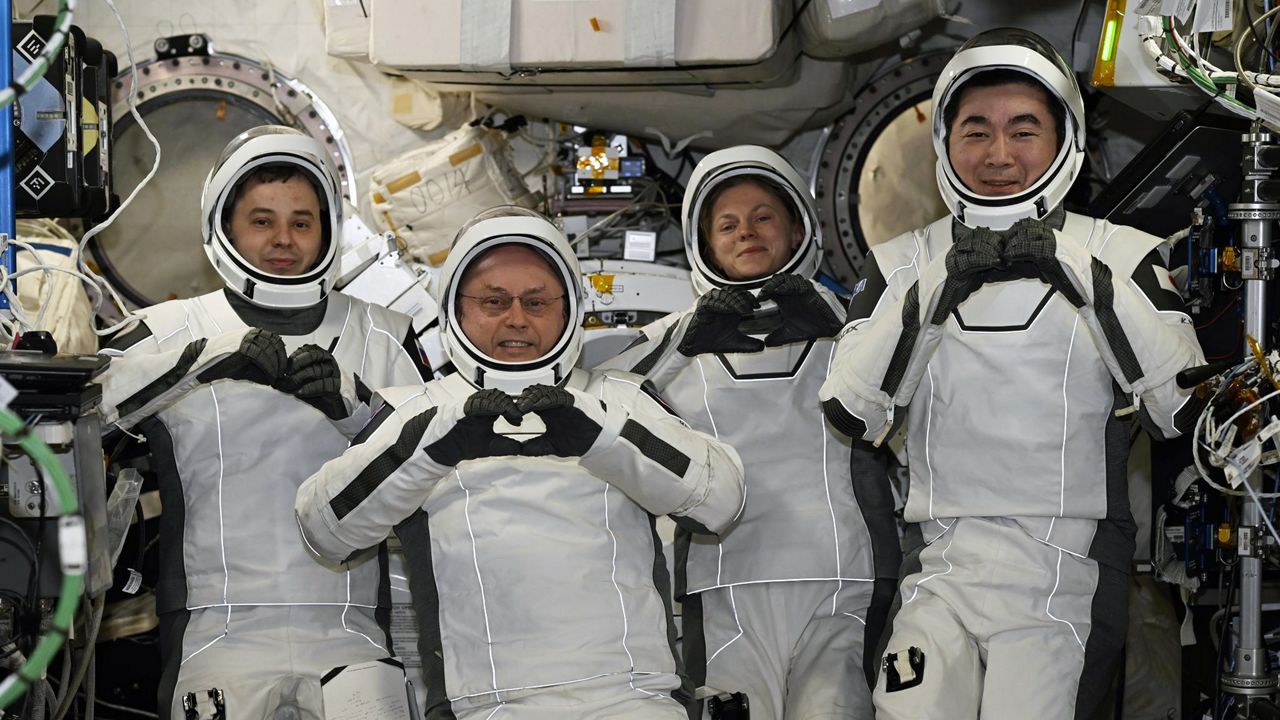
The Crew-11 members take a moment to strike a pose. Mission specialist Roscosmos cosmonaut Oleg Platonov, left, NASA pilot Michael Fincke, NASA Cmdr. Zena Cardman, and Japan Aerospace Exploration Agency (JAXA) mission specialist Kimiya Yui. (NASA pilot Michael Fincke)
Why Crew-11’s mission was cut shortNot much is known about the situation, except that last week, one of the Crew-11 members suffered a medical episode, but has since been stable, said NASA Administrator Jared Isaacman during a press conference.
During the press conference, NASA officials said that while this is the first time the International Space Station has had a medical evacuation, they would not call this an emergency de-orbit, which would have taken hours to return to Earth.
| Height: 26.7 feet tall |
| Diameter: 13 feet fall |
| Number of engines: 8 |
| Parachutes: 2 drogue + 4 main = 6 parachutes |
| Passengers: Up to 7 people |
The medical issue was serious enough to cancel a planned spacewalk that was set for the morning of Thursday, Jan. 8.
During a six-and-a-half-hour spacewalk, Fincke and Cardman were supposed to install a modification kit and cables for a future rollout of a solar array.
The Crew-11 team was supposed to stay on board the International Space Station until February, when they would be relieved of duty by Crew-12.
Crew-12’s launch might be moved up weeks earlier, but no official date has been given. Originally, that mission’s launch was set for February.
All four members of Crew-11 spent about five months on the space station. They were launched on a Falcon 9 rocket in August 2025.