Trump Is Right on Rigged Elections – The American Spectator | USA News and Politics
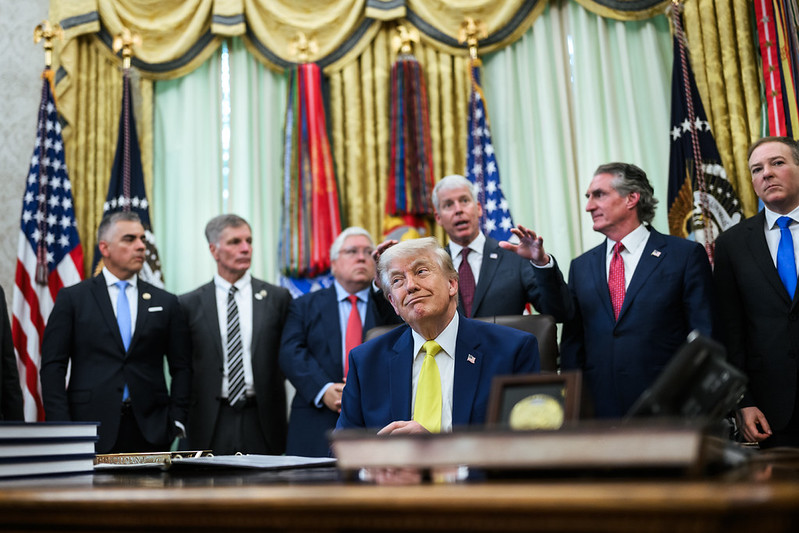
President Trump is in the news for discussing voter fraud and rigged elections.
The media, predictably, is poo-pooing his charges.
When in fact the media of today has zero historical knowledge of the history of rigged elections in America. And worse, can’t be bothered to do their homework.
From “Landslide Lyndon” to Mayor Daley’s Chicago in the 1960 presidential election — and more —America, alas, has a long history of rigged elections.
It simply isn’t in the interest of the liberal media to investigate Trump’s charges in detail — and discover he is right.
In today’s world, as President Trump has charged that rigged elections favor Democrats, the response has been an indignant denial in the media, as here with Reuters. (RELATED: Reminder: Voter Fraud Needs Our Attention)
The problem? The problem is that, alas, in spite of today’s media wishing to ignore history, various American elections have in fact been rigged. Let’s go to the history books, shall we?
America’s 36th president, one Lyndon B. Johnson, made his political career in Texas as, first, a congressman and then a United States senator. In 1960, he lost a short-lived presidential bid at the Democratic National Convention to Senator John F. Kennedy, who promptly picked LBJ as his vice presidential running mate. Famously, LBJ became president when JFK, campaigning with LBJ in Dallas, Texas, was assassinated in a motorcade, launching LBJ’s presidential term.
But this issue today is about President Trump’s charge of rigging elections — and in fact, there is a history of this in America.
When a young LBJ ran for the United States Senate in Texas in 1948, it was in a political scene where the competition was all from Democrats. LBJ, the young up-and-comer, was doing battle with older, establishment Democrats.
Decades later, to be precise, 75 years later in 2023, with LBJ long gone from the political scene and, indeed, passed away, the Associated Press headlined: “AP WAS THERE: Uncovering Lyndon B Johnson’s stolen election.”
The AP story reported this, with bold print for emphasis supplied:
ALICE, Texas (AP) — In 1977, Associated Press reporter James W. Mangan’s exclusive interview with a South Texas election judge who detailed certifying false votes for Lyndon B. Johnson nearly three decades earlier made headlines across the country.
With the win by an 87-vote margin in the 1948 Democratic primary runoff, Johnson, then a congressman, easily defeated his Republican opponent to take a seat in the U.S. Senate, and he eventually ascended to the presidency.
Mangan spent three years pursuing the story, which pulled back the curtain on the victory that had drawn suspicions ever since election officials in rural Jim Wells County announced the discovery of uncounted votes in ballot box known as Box 13.
Headlines across the U.S. that accompanied the story included: “Polling Official: Phony Votes Stole ’48 Runoff for LBJ”; “LBJ’s election to Senate ‘stolen’”; “Texan Claims Fix in LBJ Election.”
Jump ahead to another election, this one the 1960 presidential election between Democrat Senator John F. Kennedy (with LBJ as his VP running mate) and GOP nominee Vice President Richard Nixon. The election was close and came down to the contested states of Illinois and Johnson’s Texas. In Illinois, the politics were dominated by Democrat Chicago Mayor Richard Daley. And in Texas, of course, by LBJ himself.
In 1967, Nixon biographers Earl Mazo and Stephen Hess, in their book Nixon: A Political Portrait, would write of the 1960 election:
In a post-election report following the Kennedy-Nixon race, Richard Wilson, the veteran Washington correspondent and columnist, wrote in Look magazine: “For the first time, many thousands of Americans suddenly realized that elections can be stolen. They only half-believed it before 1960, as part of our historical lore…. Many, many thousands of voters and civic-minded in several leading states no longer take the easygoing attitude toward election frauds.” The article was entitled “How to Steal an Election.”
The New York Herald Tribune had reached a similar conclusion earlier, on the basis of investigation by its national political correspondent.”
Mazo went on to write that a week after the 1960 election he went to Austin for a lecture at the University of Texas, and while there talked with old friends in the Texas media. Mazo wrote:
“They wanted to know, damnit, why you ‘self-righteous’ and ‘overpaid’ national political correspondents were ignoring what went on in their state.”
Mazo continued in amazing detail, listing specific instances of flat-out fraud in Chicago. He documented a Democrat precinct captain who voted twice, another who was handing out money outside the polling place. Another reported 43 persons had voted, but the records showed 121 votes had been cast. He went on to report that in “Ward 4, Precinct 6”:
…all judges in this precinct are really from the Democratic organization. One judge, who was classified as a Republican, told a voter to whom she was giving assistance that he must vote Democratic, even though he clearly stated that he wished to vote Republican.
Now.
Yes, of course. This was a long time ago. But voter fraud is a human activity — and human beings don’t always change. In the case of election fraud, it can still go on. And for the obvious reason that human beings are human beings and human nature does not always change.
Which brings us to President Trump’s current charge of rigged elections and crooked “networks.” His exchange with NBC’s Kristin Welker was particularly amazing. One can only wonder if Welker would ever spend the kind of time and focus on the discovery of detail that Mazo and Hess spent in their book covering the 1960 election. It seems fairly obvious that the answer is a thunderous no. It simply isn’t in the interest of the liberal media to investigate Trump’s charges in detail — and discover he is right.
So.
Will today’s media buckle down and do the hard work of studying the history of rigged elections? Whether in a 1948 LBJ Senate race, the JFK-Nixon 1960 race, or any other election where Republicans have raised the issue? Like, say, Trump’s current charges about California?
Don’t wait up.
And you wonder why President Trump distrusts the media?
READ MORE from Jeffrey Lord: