Here’s What's Wrong With the Shelved 60 Minutes story 'Inside CECOT.'
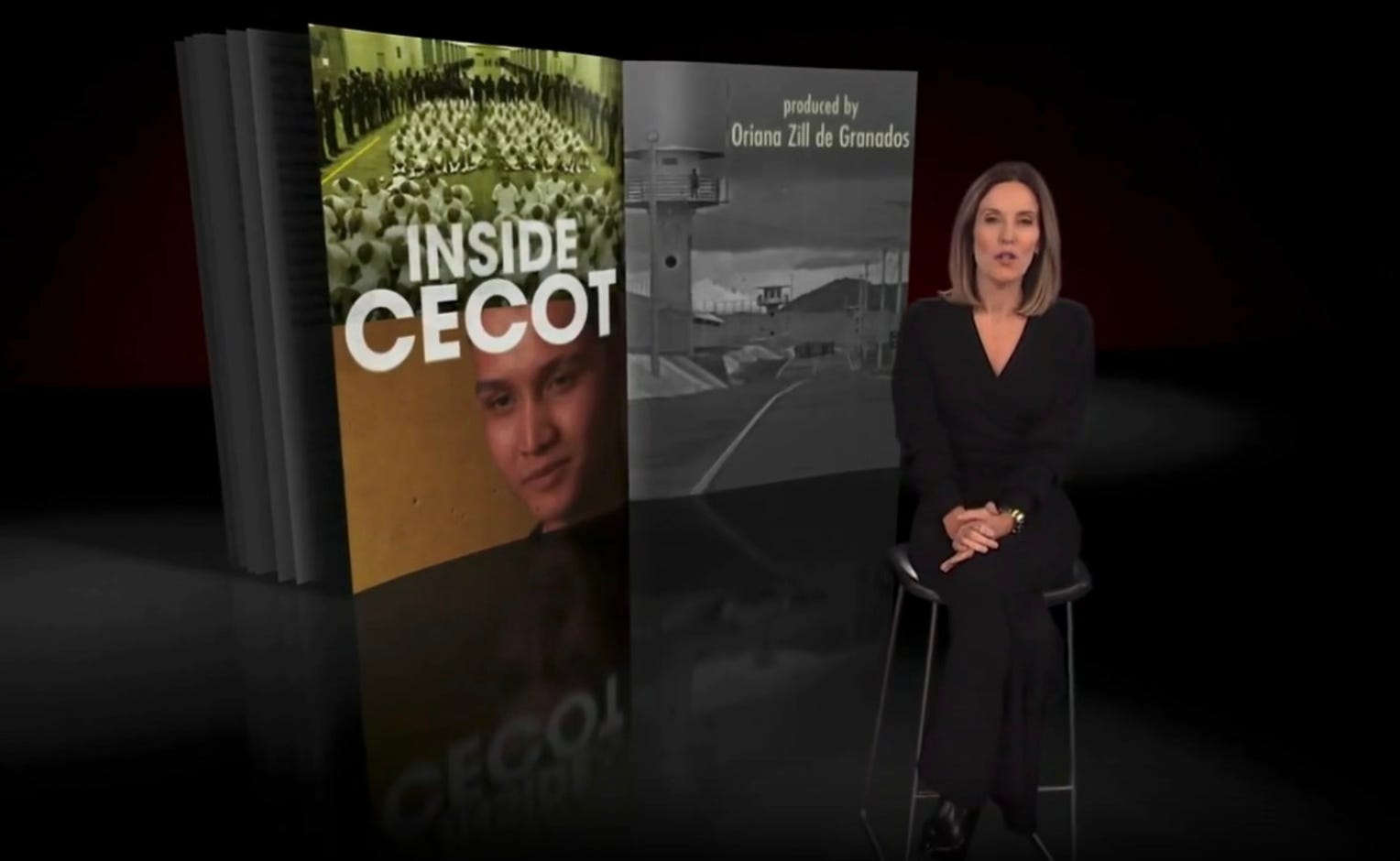
I viewed the version of the 60 Minutes report “Inside CECOT” that was distributed to Canada’s Global TV app and circulated online, then pulled due to copyright claims. Based on my viewing of that version, here’s my critique.
Bari Weiss was correct: the story wasn’t ready for air.
Read on for details.

By way of background, the 60 Minutes segment titled “Inside CECOT,” reported by correspondent Sharyn Alfonsi, was originally scheduled to air on CBS on December 21. But editor-in-chief Bari Weiss abruptly pulled it just hours before broadcast saying that more work needed to be done.
The report investigated El Salvador’s notorious Terrorism Confinement Center (CECOT), a massive maximum-security mega-prison built in 2022 under President Nayib Bukele as part of his aggressive anti-gang crackdown.
The prison is known for harsh conditions including allegations of torture, no outdoor access, and overcrowding.
The 60 Minutes report focused on the Trump administration’s deportation of over 250 mostly Venezuelan men to CECOT under a paid agreement with El Salvador, invoking wartime powers to shortcut normal due process. The 60 Minutes reporter interviewed two men who claim to have served time in CECOT but were released. They described enduring months of physical, sexual, and psychological abuse.
CBS editor-in-chief Bari Weiss postponed the segment, citing the need for additional reporting and stating it did not sufficiently advance prior coverage.
Alfonsi and her supporters allege Weiss’s decision was politically motivated.
After watching the report as edited, here’s my feedback on why it wasn’t ready for prime time.
Considering the subject matter, the story needed to explain:
How 60 Minutes located the two alleged former CECOT inmates interviewed. If the two men were brought to 60 Minutes by the human rights group featured, that needed to be disclosed.
How 60 Minutes confirmed, firsthand, that the men were CECOT inmates. If 60 Minutes did not confirm this critical fact, firsthand, that needed to be disclosed, as well as what assurances the reporter felt she had that the men are who they were presented themselves to be.
Other shortfalls that needed to be addressed or admitted in the story:
The bulk of the story was based on the word of an illegal immigrant with no stated independent verification of his key claims. It’s akin to taking the word of an alleged murderer that he’s innocent and a good guy who’s being unfairly persecuted for no reason. Maybe it’s true, but certainly the claims deserve to be treated with a dose of rational skepticism. In the 60 Minutes report: they were not.
60 Minutes characterized the main interviewee as a good guy with no criminal background or gang affiliation, based on his own word and the supposed absence of his name in a gang database.
However, there’s no way for 60 Minutes to guarantee that a foreigner who entered the US illegally had no criminal background elsewhere. There is no way for a reporter to confirm somebody is not a gang member, even if he’s not in a database.
If the reporter felt she had confirmed this, she needed to state how she had done so. There was an extensive discussion of tattoos, which felt like a red herring, as if the reporter were trying too hard in the absence of evidence to point to other facts, as if they provided proof.
60 Minutes didn’t seem to question the main interviewee’s claim that US officials arbitrarily singled him out among millions of illegal immigrants and treated him as a gang member for no reason. This doesn’t make sense and, if true, required a bit more exposition. Or, the reporter needed to acknowledge she didn’t confirm the interviewee’s claims about what US officials told him, and the circumstances surrounding his deportation.
The interviewees’ claims about their captivity require a similar suspension of disbelief: they seem to claim they’re just good, innocent guys, but that for no reason, the CECOT officials singled them out among thousands to put in the isolation room and beat every half hour (or constantly for hours, depending upon which inmate was describing the experience). Maybe it’s true, but the claims are part of a long list under the heading of “could not be confirmed.” Yet they were treated in the report as if they were indisputable.
The weird reliance on the alleged former inmate’s word extended to the visit of Homeland Security Chief Kristi Noem. Alfonsi asks the man if Noem spoke with any detainees when she was on site, and he claims she did not. But what makes the reporter believe this inmate would be in a position to know whether Noem spoke to inmates? Did he accompany her on the entire tour? Is he omniscient? Could he somehow see her acts and interactions at all times among thousands of inmates? Absent an explanation, he seems to be a poor source on these points, but the reporter treated him as if he were an authority.
Additionally, the question of whether Noem talked to inmates seems off-point. The story didn’t allege that Noem had claimed to talk to inmates in the first place. And if she didn’t talk to inmates, it doesn’t get to the heart of the torture claims at hand.
The reporter presented several facts as “gotchas” that didn’t come off as any type of “gotcha.” If these facts were, indeed, proof of some mistreatment, it was not explained well enough in the story.
One example was the supposed “gotcha” over Homeland Security Chief Noem recording a social media video with inmates in the background whom 60 Minutes said were Salvadorans, not Venezuelans. There was no explanation as to why 60 Minutes thought this was somehow proof of torture or mistreatment. It’s no secret that Salvadorans are held in the El Salvadoran prison. And there was no mention in the story that Noem had represented the men as being from Venezuela. So why was it presented as a “gotcha” moment, or proof of anything, that the men seen were supposedly Salvadoran?
Another supposed “gotcha” was over the lights being on 24/7 inside CECOT. Yet by 60 Minutes’ own admission, the head of the prison had acknowledged, on camera, that the lights are on 24/7.
The report also failed to balance its reporting on this practice, taking the position that persistent lighting is intended as torture. The story should have acknowledged that it’s not unusual for high-security units, solitary confinement areas, and supermax facilities, to keep lights on 24/7 (or use constant illumination) primarily for security and operational reasons. This is so that there is constant visibility in the high risk setting to conduct frequent welfare checks; perform headcounts; and better monitor for suicides, assaults, escapes, or contraband. Although the practice is widely criticized by human rights groups, some courts have upheld the practice as having a “legitimate penological interest.”
Additionally, 60 Minutes didn’t explain or perhaps didn’t understand the poor condition of Salvadoran prisons prior to President Bukele’s crackdown on crime and gangs, and his prison reforms. El Salvador’s prisons were historically considered among the most dangerous in the world, largely run by MS-13 and rival gang members, with murders, crime, and drugs rampant on the inside. Bukele’s popular reforms have transformed them into safer, more secure facilities.
When 60 Minutes could not confirm the important details of the inmates’ stories, it treated confirmation of unimportant or widely-known details as if that were proof of the important allegations. One example is the lights being on 24/7. Another is that CECOT has an isolation room (well known and previously reported). Student “investigators” who appeared on 60 Minutes confirmed the layout of the prison and the existence of an isolation room. Yet none of this was new or unknown, and none of that got to the heart of the torture allegations.
For balance, absent direct response from the Trump administration, the story needed to pull generously from already on-the-record comments from Trump officials justifying or defending the move to send illegal immigrants from Venezuela to CECOT. Also for balance, the report needed to acknowledge some of the horrendous crimes committed in the US by illegal immigrants, and acknowledge the wide popularity of the Trump administration’s approach to illegal immigration and illegal immigrant crime.
The report was poorly structured. It began with an alleged former inmate describing how officials at CECOT told them they would never see the light of day again, and never leave the prison. Yet, here he was talking to 60 Minutes just a few month later, obviously a free man seeing the light of day and no longer in prison, and appearing none worse for the wear. This apparent discrepancy needed to be explained off the top, if the report were going to choose to use that particular sound bite near the beginning of the piece.
There seemed to be no investigation (or at least investigative details) confirmed on the part of 60 Minutes. Nor did the student investigators the report used on camera confirm torture or mistreatment allegations.
In summary the story came off as a slanted, with an agenda and no proof. It’s not wrong to address and report on the serious allegations, but without proof, 60 Minutes needed to do a much better job balancing the story; and explaining how they found the men, and verified their identities and experiences, or admitting, explicitly, that they could not.
If I ran 60 Minutes, the only way I would present a story like this right now, which seems incredibly tone-deaf, would be with the shortfalls addressed and if there were also a story on illegal immigrant crime victims in the US as part of the same hour.
CBS’s Weiss should have flagged the story sooner, rather than at the last minute, to give time to fix the flaws. If she’s going to step in editorially—and she has a legitimate argument at this stage to conduct close reviews of any controversial stories—she should review all such pieces earlier in the process and better describe and justify what’s expected from a balance and journalistic standpoint.
Sharyl’s Substack is a reader-supported publication. To receive new posts and support my work, consider becoming a free or paid subscriber.