FBI Hands RICO Charges to Dominican Fentanyl Gangsters Who Trafficked Fentanyl, Firearms in Maine
 Source: Department of Justice
Let there be no more arguments about Maine’s fentanyl epidemic: The market is run by transnational criminal organizations based in the Dominican Republic.
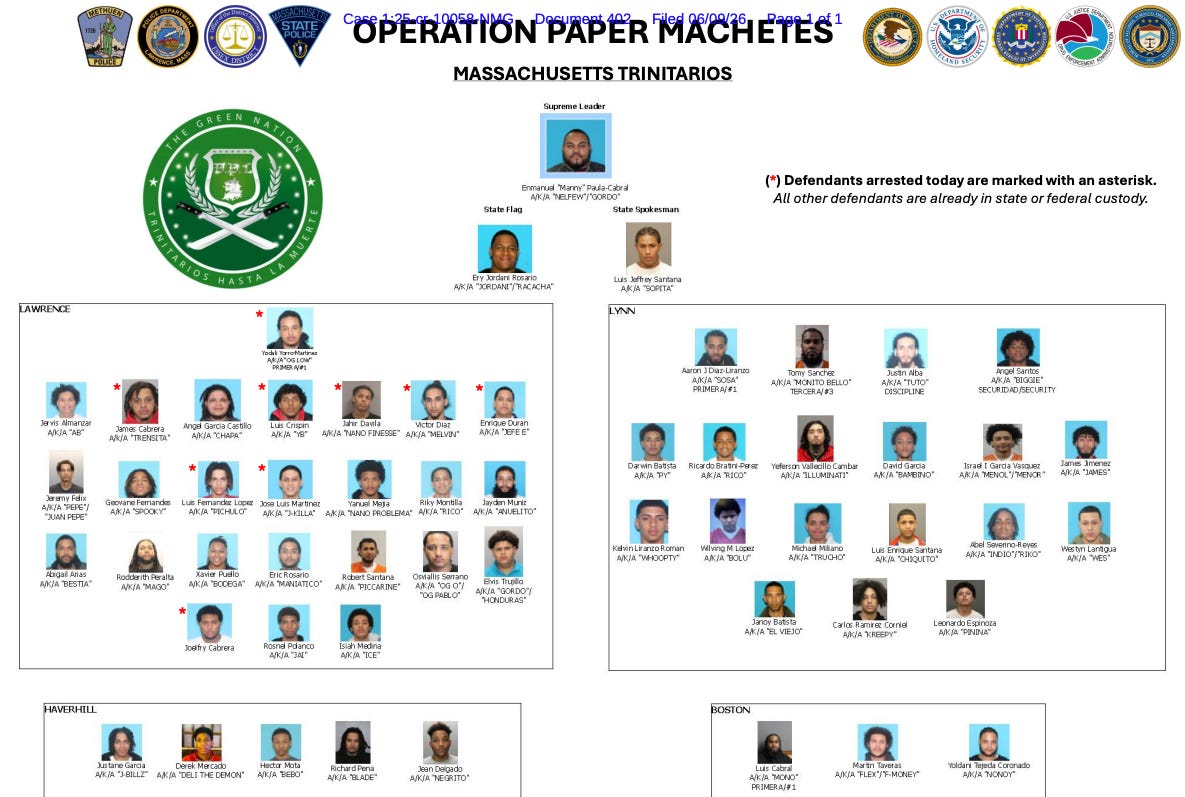
According to a superseding indictment and a 465-page affidavit filed last week in Massachusetts District Court, the Lawrence, Mass.-based Trinitarios gang ran an elaborate, hierarchical drug-trafficking and firearms-trafficking organization that exploited Maine to sell narcotics and obtain guns.
According to the Department of Justice, the twenty-six alleged leaders, members, and associates of the Trinitarios — a transnational, Dominican-rooted street gang with a well-known foothold in Mass. — conspired to run street drugs all over New England.
These 26 bring the grand total of arrests stemming from the long-running organized crime probe to 56, making the enforcement action comparable to any the FBI ever carried out against the infamous Whitey Bulger and the Winter Hill Gang.
The Dominican gangsters are, the DOJ says, tied to five murders and nineteen attempted murders. At least seven of the individuals named in DOJ affidavits and indictments were Dominican illegal aliens.
Lawrence, Haverhill, and Boston play a large role in the narrative, but the affidavit makes clear that Maine is the New England state where Dominican transnational criminals control, run, and profit from the synthetic opiate markets as well as cocaine and methamphetamine.
The gang favored Maine not only for its small per capita number of cops and its drug-addicted customer-base, but also because of the product it could bring back to Massachusetts: guns.
According to the U.S. Attorney’s Office in Massachusetts, the sprawling RICO case involved the DOJ’s District of Maine, the Maine Attorney General’s Office, the Maine State Police, the Maine Drug Enforcement Agency, and several local and county law enforcement agencies in Maine.
The story a Homeland Security Investigations special agent lays out, in the gang’s own recorded words, explains exactly how a criminal enterprise headquartered in the Merrimack Valley turned rural Maine into a sales territory.
The document is likely the most detailed look ever provided to the public about the reality of transnational organized criminal groups trafficking fentanyl throughout New England.
It should be required reading for anyone who wants to comment on the opioid epidemic in Maine — and potential solutions.
Read: Superseding Indictment Shows Dominican Gangs Run Maine Fentanyl
Subscribe to The Robinson Report for New England news…
“Stop the pipeline of drugs heading north”Prosecutors say the Massachusetts “State Supreme” — the gang’s top in-state authority — is responsible not only for the chapters in Massachusetts and the Manchester, New Hampshire chapter, but also for the Trinitarios operating in Maine, “where the gang operates a lucrative drug trade.”
The investigation is called Operation Paper Machetes. Phase one, “Lime-Light,” took down the Lynn chapter in February 2025. Phase two, “Never-Green,” is the one unsealed this month. According to the affidavit, one of its four stated goals was to “stop the pipeline of drugs heading north and firearms coming south.”
The structure makes Maine not just a place to find drug-addicted customers, but a destination for murderous illegal alien gang bangers to get their hands on firearms.
The clearest window into how it worked comes from Yordali Yorro — “OG Low,” the alleged leader of the Lawrence chapter, whom investigators assess was effectively running the whole Massachusetts operation after the 2025 arrests.
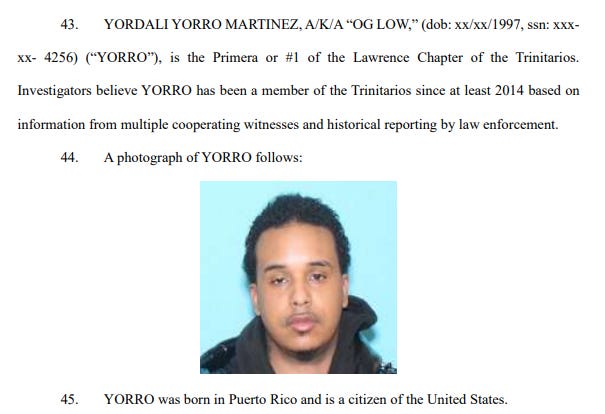
Yorro is described as a Puerto Rican-born U.S. citizen.
The affidavit includes a transcript from a 2024 recording literally called “Recording of Trip to Bring Drugs to Maine” in which Yorro narrates the business model with the casual fluency of a man describing his commute.
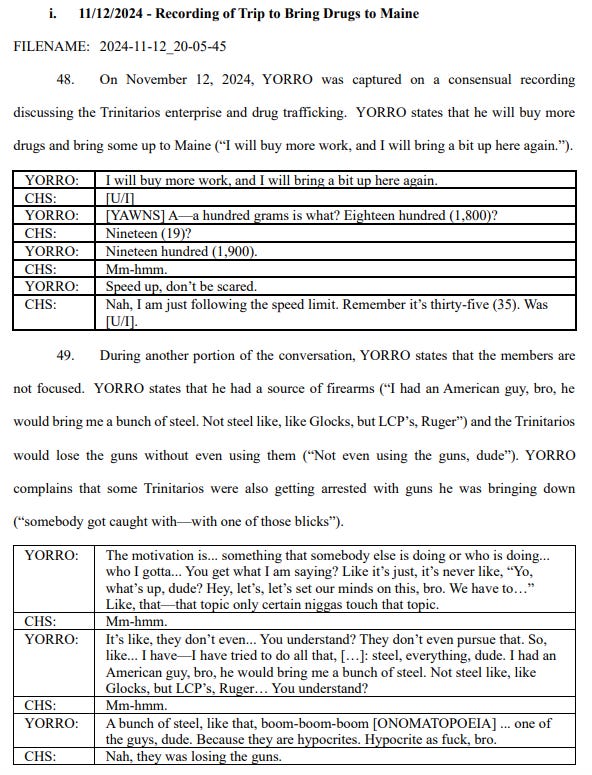
At one point in the transcript, Yorro describes the free and easy life his employees in Maine have while they sling deadly narcotics throughout the state — a problem he characterizes as a corporate leadership issue. He then explains the cold economics of dealing drugs in Vacationland.
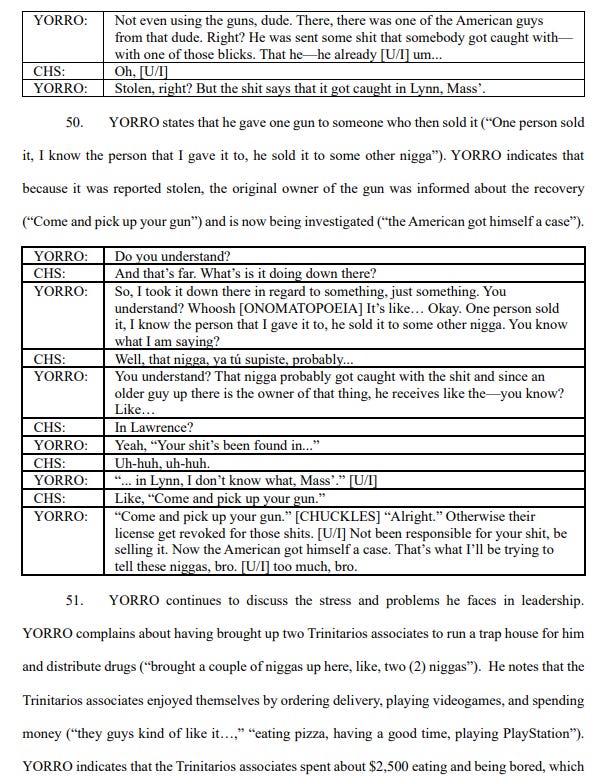
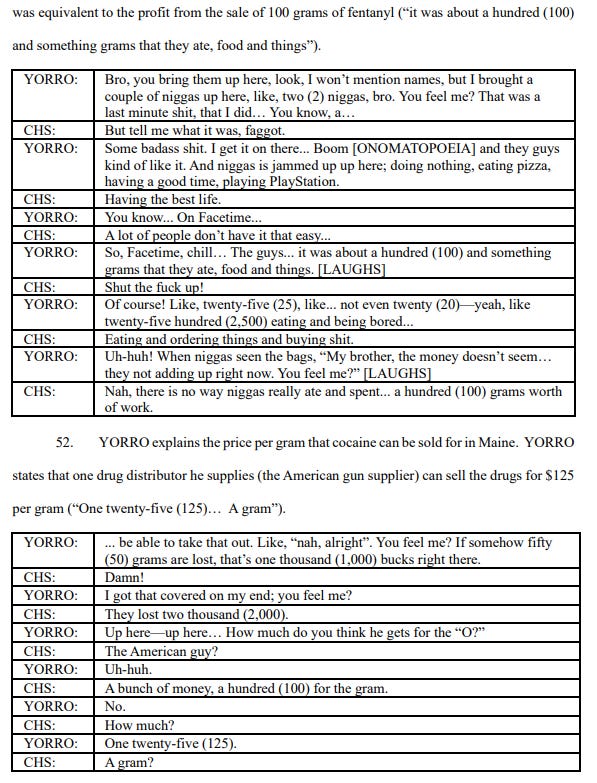
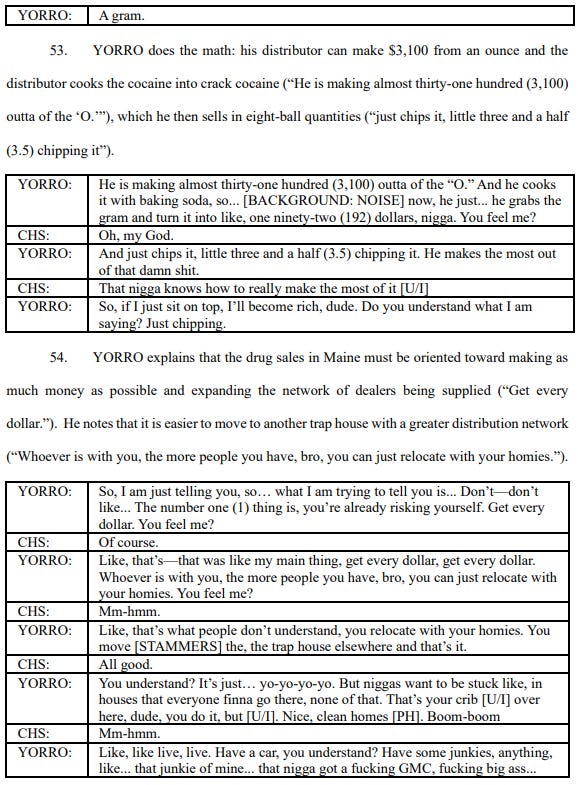
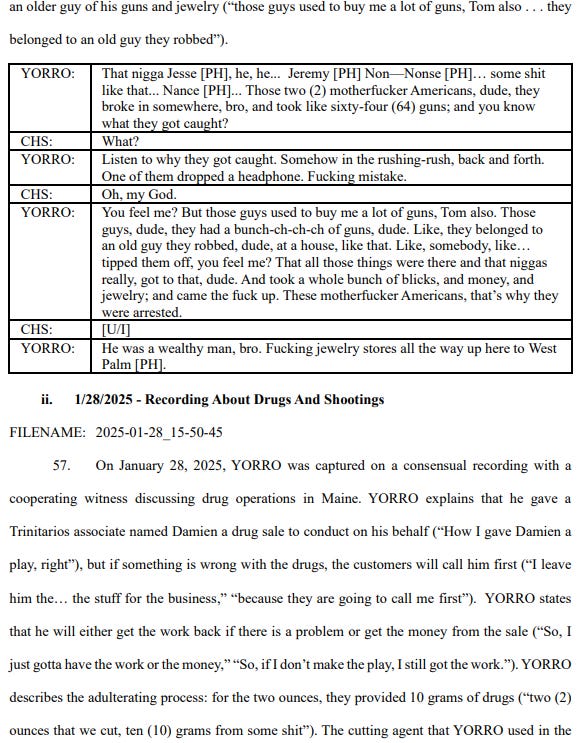
Yorro talks about buying “work” and bringing it “up here.” He prices cocaine at $125 a gram for the Maine buyer — well above Massachusetts street rates — and walks through cooking it into crack to squeeze roughly $3,100 out of a single ounce. He describes setting up two associates in a Maine trap house to move product, and complains that the pair burned through the equivalent of more than a hundred grams of fentanyl in DoorDash and PlayStation time while they sat around being bored. He calls Maine “hunting ground.” He muses about how cheap guns are up here — a .22 for $320, AR-platform rifles for $500 or $600 — and recounts how a couple of his contacts broke into a gun store and made off with 64 firearms.
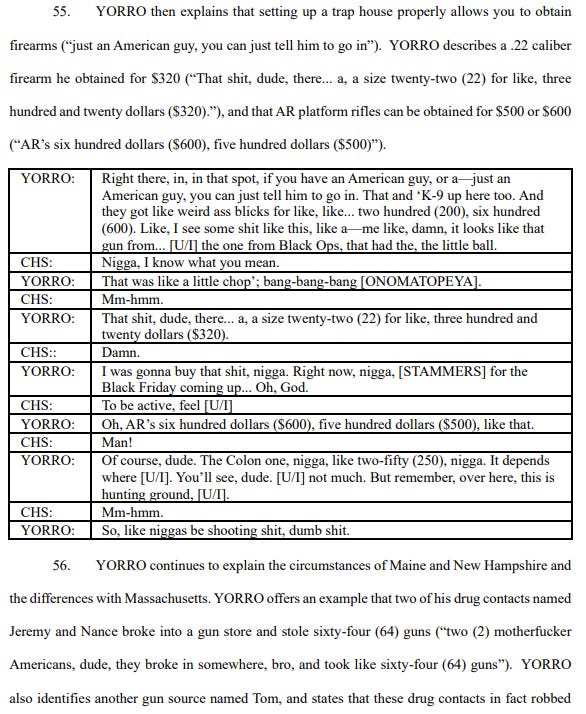
The senior member James Cabrera — “Trensita” — fills in the logistics.
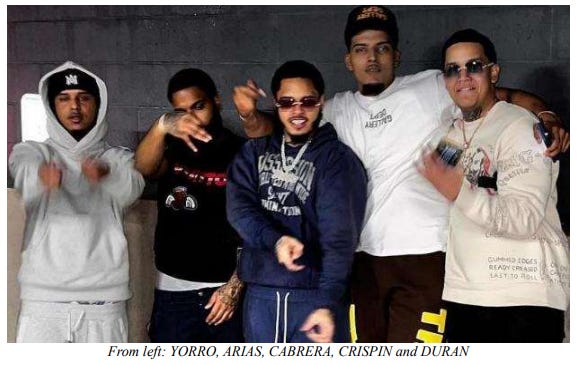
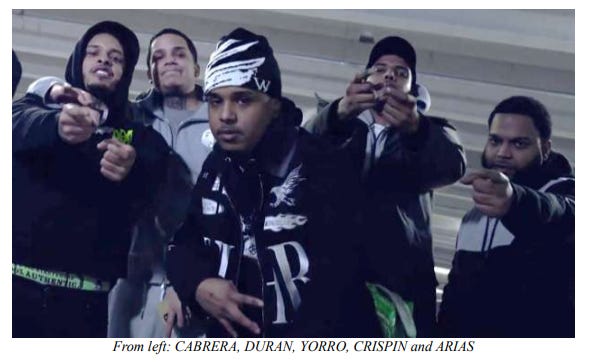
In recordings the affidavit ties explicitly to Maine drug trafficking, Cabrera describes hauling a kilogram and a half of cocaine and some 700 grams of fentanyl north on a single run, and using unlicensed runners for the five-and-a-half-hour drive.
One runner, “Joppy,” made the round trip alone in a rental car with no license, drove roughly eleven or twelve hours in a night, and got paid $1,000. Cabrera’s own stated plan: send eight ounces up at a time and “head up north, speed limit” the whole way. It is the freight operation of a man who has done the math on rural interstate enforcement and likes his odds.
Jervis Almanzar, “JB,” a Lawrence chapter member born in 2004, was charged in the U.S. District Court for the District of Maine back in December 2023. He pleaded guilty in August 2024 to two counts of distributing 40 grams or more of fentanyl, and in January 2025 he was sentenced to 60 months in federal prison, where he sits now.
According to the court record in that case, Almanzar sold a cooperating witness in Maine roughly 300 grams of fentanyl.
A trap house in Piscataquis, a shooting in Paris, a police incident in RumfordThe Piscataquis County Sheriff’s Department got a thank-you in the DOJ press release for a reason. The affidavit references a separate federal case, United States v. Puello & Jenkins, built around drugs and two firearms recovered from a trap house in Maine.
Xavier Puello — “Bodega,” another charged Lawrence member — is named in both that case and this month’s superseding indictment, with a dedicated section of the affidavit devoted to his drug distribution in Maine in the spring of 2025.
The gangsters fingered in the latest indictments are also directly tied to gun violence cases in Maine.
The affidavit contains another section on an April 16, 2025 shooting in Paris, Maine, and another on an August 15, 2025 police shooting in Rumford, Maine — the latter including a recording in which the Boston chapter’s alleged leader, Luis Cabral, is said to confess to the incident, along with recordings of fellow Boston member Martin Taveras.
The bigger pictureThe affidavit traces the Trinitarios to the New York prison system of the 1990s, organized around Dominican identity, a written “Magna Carta,” lime-green colors, crossed-machete iconography, and the slogan Dios, Patria, Libertad. Prosecutors describe a recruiting operation aimed at juveniles in Lawrence and Lynn high schools, with initiation “missions” that amount to shootings and beatings, and a habit of advertising the whole enterprise in music videos full of guns, cash, and gang regalia.
What this month’s filing establishes is that the organization’s reach didn’t stop at the greater Boston area. It ran a managed drug economy into Maine, armed itself partly out of Maine, and left behind a wake of gun violence and Mainers addicted to narcotics.