Charter or Sharia: How Canada’s Federal Workplace Is Being Reengineered Into a Parallel Islamic System
Canada’s federal workplace is being quietly transformed from Charter-based neutrality into sharia-aligned compliance, as a Muslim employees’ guide reframes “religious accommodation” into institutional submission, enforced conformity, and the normalization of a parallel religious legal order inside the state itself.
Charter Governance or Religious Law: Canada’s Federal Workplace at a Crossroads — by Elaine Ellinger
The Muslim Federal Employees Network has produced a guide for federal managers that goes far beyond normal religious accommodation. It introduces Islamic rules, expectations, and sensitivities into the structure of federal workplaces, and reshapes public institutions to comply with sharia-derived norms [1].
The guide instructs managers to accommodate up to three daily prayers during work hours, to provide image-free private rooms marking the qibla (direction of prayer), and to avoid handshakes or private meetings with opposite-sex employees. It tells managers to avoid alcohol-centred events, modify schedules throughout Ramadan – a moving lunar observance that shifts each year, and ensure employees receive additional leave during the final ten days. Entire workplace social norms are reorganized around Islamic expectations.
More strikingly, the guide directs employees to seek “religious literacy” only from Muslims and Muslim organizations. Logically, this might be appropriate in an Islamic country, but not in a democratic one, unless the aim is to reshape public institutions along Islamic lines – and that increasingly appears to be the case. The guide promotes anti-Islamophobia training delivered by the same groups and encourages Muslim employees to use it to make workplace “demands.” This is not neutrality. It is the institutionalization of a single religious worldview – and not necessarily one that every Muslim may wish to comply with.
Sharia, however, is enforced socially, not merely individually. The pressure to conform does not come only from institutions, but from within the Muslim collective itself. This dynamic is explicit in Islamic sources:
- Mohammed said, “And I command you with five that Allah commanded me: Listening and obeying, Jihad, Hijrah [migration], and the Jama’ah.” Tirmidhi 2863.
Reliance of the Traveller – A Classic Manual of Islamic Sacred Law (ROT): Enjoining Right & Forbidding Wrong:
- q0.2 “One should know that commanding the right and forbidding the wrong is the most important fundamental of the religion…”
- q5.9 “Force of Arms. The eighth degree is when one is unable to censure the act by oneself and requires the armed assistance of others…”
Jama’ah requires outward conformity, collective alignment, and obedience to the group. Where Muslims live as minorities, this obligation does not disappear. It is managed. As the minority expands and gains strength, so too does the pressure exerted on Muslims who do not conform.
What Management is NOT told:
When Muslims are unable to fully apply sharia, Islamic jurisprudence permits temporary concessions under darura – necessity overrides prohibition – until conditions allow fuller implementation. What the Federal Muslim Employees Network promotes in its guide is not darura, but its opposite: instead of permitting individual adaptation under non-Islamic authority, it demands full accommodation of sharia norms by the institution itself.
In doing so, the guide advances sharia and the Islamization of the country by removing the very conditions under which darura operates. The freedom to choose non-halal finance, schools, food, and clothing in a non-Islamic state is gradually eroded, not by coercion, but by institutional realignment.
Crucially, and consistent with that process, employers are never told that darura exists. They are not informed that Islamic jurisprudence already allows Muslims to adapt quietly and temporarily to non-Islamic environments when accommodation is unavailable. Instead, the workplace is treated as the entity that must bend.
Where full adherence to sharia is not possible, devout Muslims are expected either to work toward conditions in which Islamic law can be fully observed – that is, the expansion of ‘dar al-Islam’, defined as territory under Islamic political authority rather than demographic majority – or to relocate, as indicated in Koran 4:97:
- “Indeed, those whom the angels take [in death] while wronging themselves… The angels will say, ‘Was not the earth of Allah spacious [enough] for you to emigrate therein?’
The omission of darura is not an oversight. Islamic jurisprudence permits concealment and strategic disclosure in pursuit of religious objectives, particularly where Muslims operate under non-Islamic authority. The result is a one-way presentation of obligations: institutions are told what they must provide, while the doctrinal flexibility already available to Muslim employees is strategically withheld.
- “Scholars say that there is no harm in giving a misleading impression if required by an interest countenanced by Sacred Law [sharia]…”(ROT r10.3)
- Deception, such as omitting important information to leave an erroneous impression, is preferable but “it is permissible to lie when the goal is permissible… obligatory if the goal is obligatory.” “But it is religiously more precautionary in all such cases to employ words that give a misleading impression…”(ROT r8.2 )
The doctrine of darura – necessity overriding prohibition – is therefore never disclosed to employers or courts, despite being doctrinally fixed: “There is no sin upon him” when permitted (halal) options are unavailable (Koran 2:173, 6:145, 16:115).
- Aisha reported that when Mohammed ‘missed the night prayer due to pain or for any other reason, he observed twelve rak’ahs during the daytime’ (Muslim 746e).
How Conformity Is Enforced
Pressure, often invisible to outsiders, is exerted by more observant Muslims on those who would otherwise keep their beliefs private. This dynamic is now well documented on university campuses, where Muslim students who prefer quiet observance are increasingly pushed to conform to Islamic norms of dress, behaviour, and political activism – conform to the Jama’ah. What is presented externally as “religious accommodation” often functions internally as enforcement.
- Mohammed said ‘He who amongst you sees something abominable [not sharia] should modify it with the help of his hand; and if he has not strength enough to do it, then he should do it with his tongue, and if he has but still bound by employment not strength enough to do it, then he should (abhor it) from his heart, and that is the least of faith.’ (Muslim 49a)
It is therefore not the most assimilated or private Muslims who drive jihad or sharia-compliant restructuring of institutions. It is those most committed to ideological conformity, discipline, and collective obligation. The same people who insist on public observance, gender segregation, and behavioural rules are those who view resistance, enforcement, and expansion as religious duties rather than personal choices.
This distinction is routinely ignored in public discourse. Violence and coercion are treated as deviations, while conformity is framed as harmless piety. In reality, they sit on the same doctrinal continuum.
Why This Guide Must Be Rejected
In a secular democracy, government employees should not be compelled to follow sharia-derived behavioural rules, nor should public institutions be adapted to the ritual architecture of any religion. A government that treats one religious system as normative is not neutral. It is captured.
If every community in Canada demanded what this guide requires for Muslims, the federal workplace would collapse overnight. Imagine Catholics requesting scheduled pauses for the Angelus, private confession time, and chapels in every building; Jews requesting halachic-compliant kitchens, Sabbath-adjusted hours and gendered meeting rules; Sikhs requesting kirpan-adapted security procedures and ritual-purification space; or every First Nations band requesting ceremony rooms, smudging protocols and elder-supervised decision making. The system cannot function when each religious or cultural group inserts its own legal or ritual code into public administration.
This guide cannot work in a secular state and should be rejected outright. A system of public governance cannot accommodate parallel religious legal orders without destroying its own neutrality. If all groups asserted comparable demands, the federal workplace would fragment into competing jurisdictions, none of them compatible with the operation of a single public service. A government that adapts itself to Sharia norms sets a precedent that no institution in a free society can sustain.
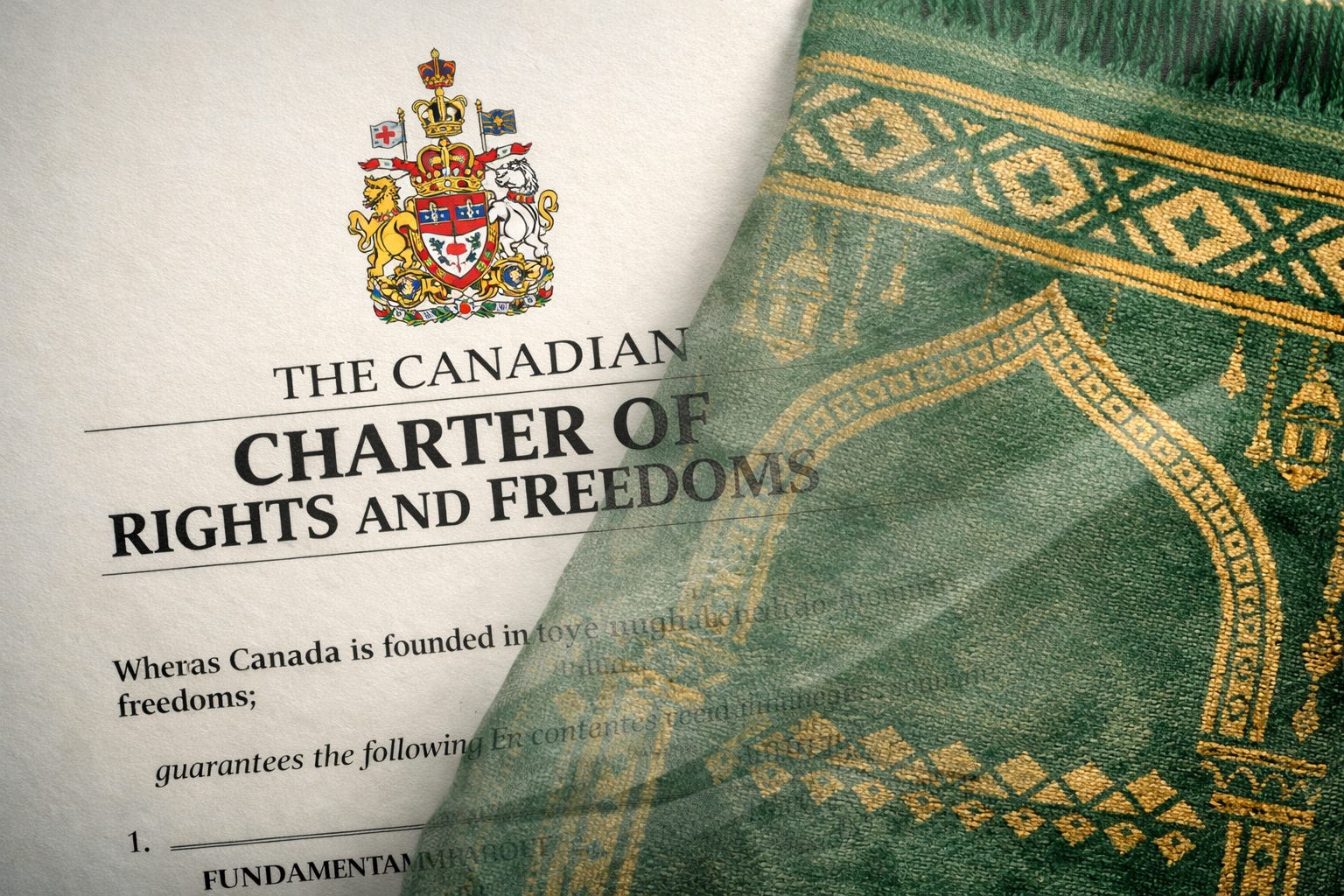
Canada must decide whether its public service operates under the Charter of Rights and Freedoms – or under the expectations of a religious network that openly describes Islam as a comprehensive way of life to which the workplace must conform.
[1] MFEN Guide: https://apex.gc.ca/wp-content/uploads/2023/11/MFENmanagersguidetosupportingMuslimemployees_BILaccessible.pdf
Elaine Ellinger‘s New Book
Purchase Elaine Ellinger’s new book, A Civilizational Reckoning: Understanding the Threat, Reclaiming the Future (Paperback, 14 September 2025), a rigorous examination of civilizational conflict, institutional capture, and the fight to reclaim democratic foundations.