What Happened in the Makerfield By-Election?
For all the hoopla and hubbub, Elon Musk’s ‘Restore Britain’ party, fronted by defenestrated Member of Parliament Rupert Lowe, did remarkably poorly last night in the Makerfield by-election (special election, for the Americans), in England.
I’ve heard their claims since the results came out. Predominantly, “Well 7% from nothing is great! Reform never did that in their first by-election!”
That’s true. But in Reform’s first by-election, they didn’t have the backing of the world’s richest man, a plethora of widely watched British YouTubers, a media keen to boost them, and – in Restore’s own words – “the biggest action day in British history.”
In fact, Reform’s first by-election (Hartlepool, May 6, 2021), they didn’t even have Nigel Farage as their party leader.
Meanwhile, just a few weeks ago, Restore Britain “leader” (more on why that’s in quotes in another article), Rupert Lowe claimed his party were getting 25% of the vote share in their canvass returns. In the end, they got less than 7 percent of the vote. In real terms, it was a humiliation, no matter what kind of spin they put on it. But they weren’t the only ones humiliated last night.
Britain’s Conservative Party, once known as the “natural party of government,” returned a paltry 997 votes. They won a by-election in Scotland. But in the big areas, in Labour’s historic heartland, they were nowhere to be found. Not once did I see a Tory candidate, campaigner, leaflet, or poster. Not one, anywhere. And I even saw a “Black Lives Matter” sign!
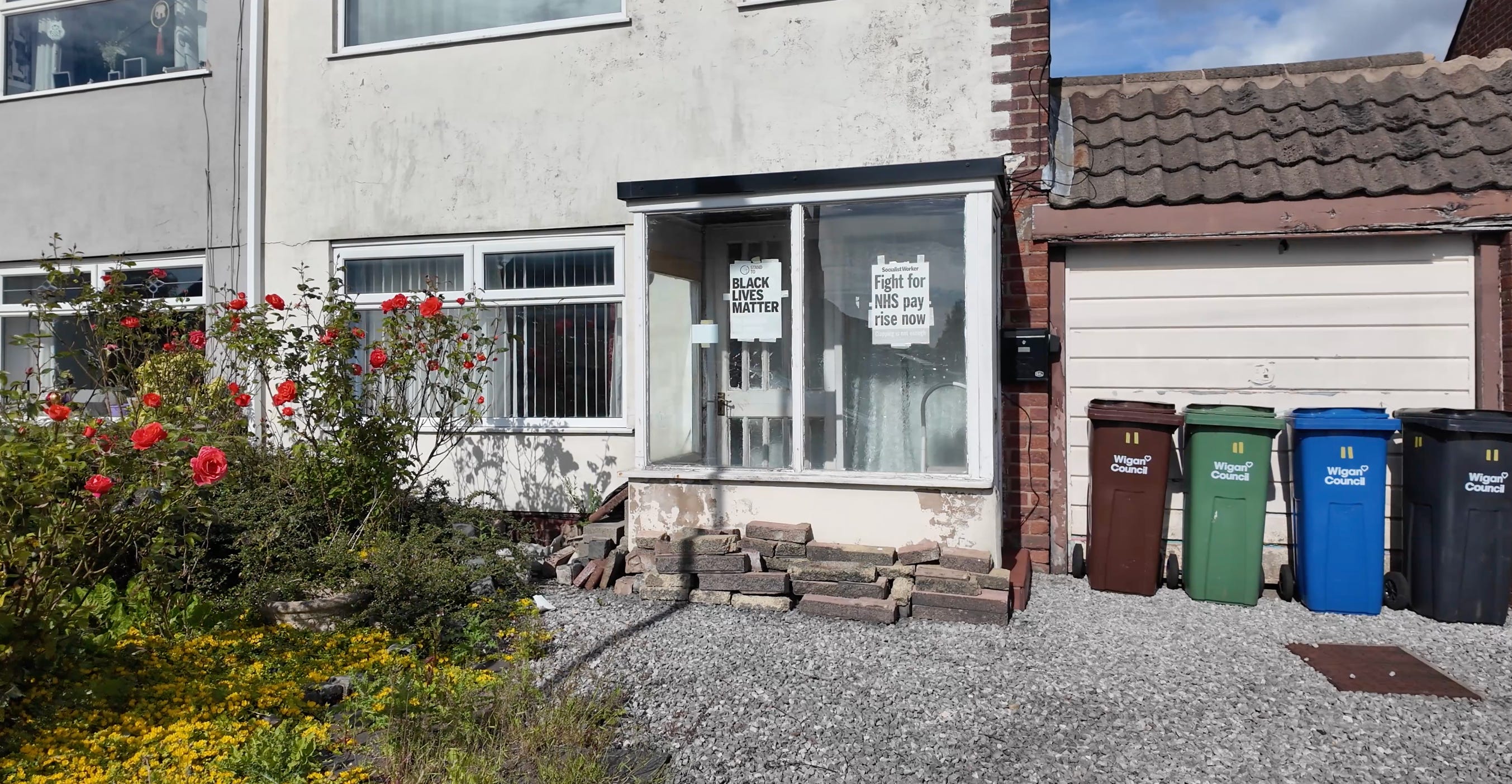 A BLM sign in Wigan, 2026 (Copyright Raheem J. Kassam)
It doesn’t end there, either.
Reform UK had a disappointing night, too, to say the least.
While local plumber and candidate Rob Kenyon put up a good fight and increased his vote share on the previous Makerfield parliamentary election, he still fell short of where pollsters predicted, and in reality fell well short of Labour’s Andy Burnham.
Why? A couple of big reasons.
Reform’s Own Petard. At the local elections in early May, Reform UK ran on the slogan: “Vote Reform, Get Starmer Out.”
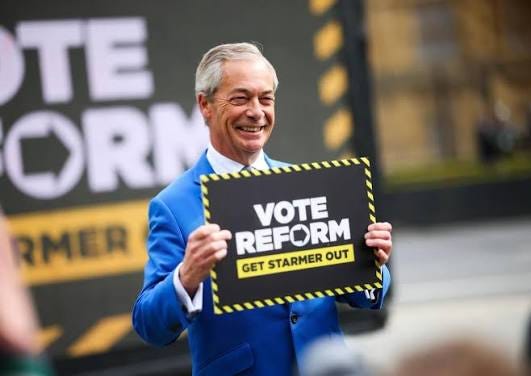 Image via Stuart Mitchell
It was such a powerful message that it spilled over into Makerfield, over a month later.
Voters clearly feared if they failed to deliver Andy Burnham to parliament, that he would not be able to challenge Sir Keir Starmer for the keys to 10 Downing Street, and that the country, therefore, would be left with Starmer in charge, or worse, one of his underlings (think Prime Minister Ed Miliband, or Wes Streeting, or Angela Rayner).
In this sense, Makerfield voters are smart. They believe these scenarios to be worse than sending Andy Burnham to Parliament. And while I’m certain these same voters are not hostile to Nigel Farage, Rob Kenyon, or Reform UK, they made a collective gamble for the future of the country.
“With Burnham at the helm, perhaps things will start to turn around.”
It’s unlikely to change very much, but it certainly bodes better than the alternative: three more years of a Starmer government.
Kenyon had little-to-no name recognition in the area. Yes, he stood last time, but he’s not exactly a household name. He was still only just introducing himself to some voters for the first time in the final days before the election. It bodes well for him next time, but the name ID factor was a huge hurdle for him, and one that local Mayor Andy Burnham – the Labour candidate – did not have to jump.
A not-so-squeaky-clean record. Voters came to know Kenyon by the first attacks on him by the national media, the Labour Party, left-wing celebrities, and outside, Soros-funded groups like Hope Not Hate. Between them, this familiar machine dug up old, off-colour social media posts made by Kenyon, and framed him as a misogynist and worse. He isn’t, for the record, but he had to defend himself more than attack at the outset of his campaign, which is, naturally, less than ideal.
Underestimating Andy. While walking through Ashton-in-Makerfield on polling day, I was approached by a 72-year-old man, as I filmed signs strewn across the Cross Keys pub that read “Vote Andy. Vote Hope.” The old boy was puzzled. “I can’t understand why people round here keep voting Labour after all these years,” he said, indicating that he had voted Reform.
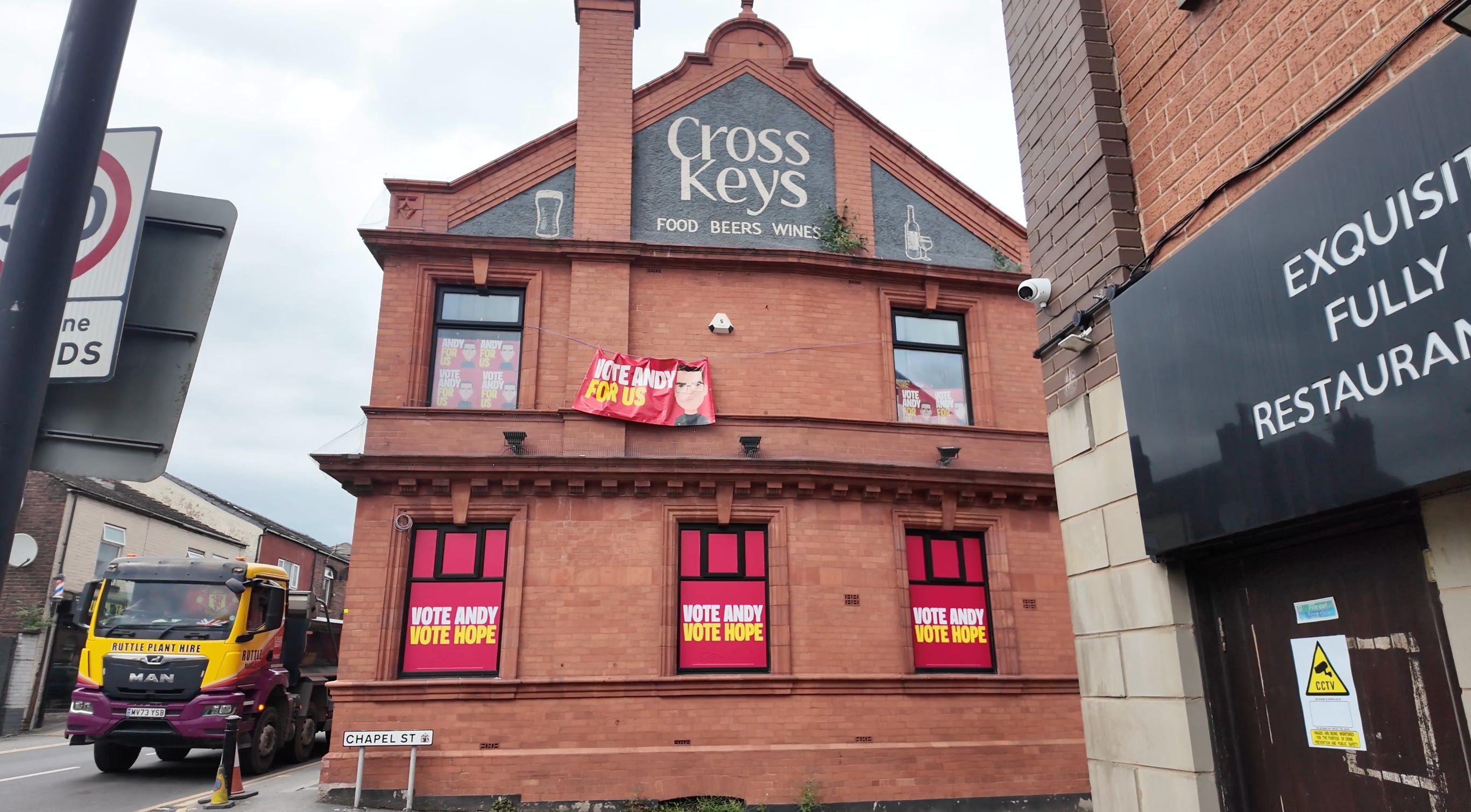 The Cross Keys Pub in Ashton-in-Makerfield (Copyright Raheem J. Kassam)
“Hope?” he quipped, “More like no hope!” He had a thick local accent and we spoke for a little bit more after that. I’ll save the rest of that story for my forthcoming YouTube video on the subject (subscribe free here). But that interaction gave me hope. Well, that and the 3-to-1 Reform vs Labour signposts all around the constituency. The problem is, we all underestimated Andy and the Labour machine. Not only were they quietly building support, not only did they dominate on the postal votes (as usual), but they also flooded the constituency with bussed-in activists and union members for a ‘get out the vote’ operation the scale of which I’ve never seen. There were over 3,000 Labour activists across the constituency on polling day, versus around 1,000 for Reform. This meant they successfully ‘knocked up’ not just their own vote, but also a swathe of undecideds.
Misreading Makerfield. This is the hurdle at which everyone except Labour fell. Makerfield might sound like “prime Reform territory” because of its demographic make-up (97% white), its cultural conservatism, and its affinity for Brexit (65% voted to leave the EU). But these are also reasons why Reform struggled to expand its vote share further than the 3000-or-so that it clearly gained from the Conservative Party. Makerfield is still very generationally partisan, and clearly most voters still feel they can drag the Labour Party back towards them. They’re not yet ready, or have not yet been convinced, to abandon decades of Labour support (there has never been a non-Labour MP in Makerfield since the constituency was established in the 1980s). The 97% white statistic is also jarring because it means the top tier issue for Reform UK – mass migration – has scarcely touched Makerfield. Voters, therefore, are more likely to have been concerned with two things: 1) Local priorities (healthcare, infrastructure, welfare, etc), and 2) that “one of theirs” aka Andy Burnham could be Prime Minister, soon. It’s a point of local pride to have the PM from your neck of the woods, no matter who it is.
Finally, it’s worth noting that Reform UK got 16,000 pledges during the campaign period, and turned out a final vote of 15,696. That means its canvass operation is rock solid. It just hit a ceiling due to the factors above.
So those are the things that happened in Makerfield. If you have any questions about my analysis, please leave it in the comment section below and I will endeavour to respond promptly.
Raheem J. Kassam, Makerfield, June 2026.