The Young Catholic Elite Poised to Take Over MAGA
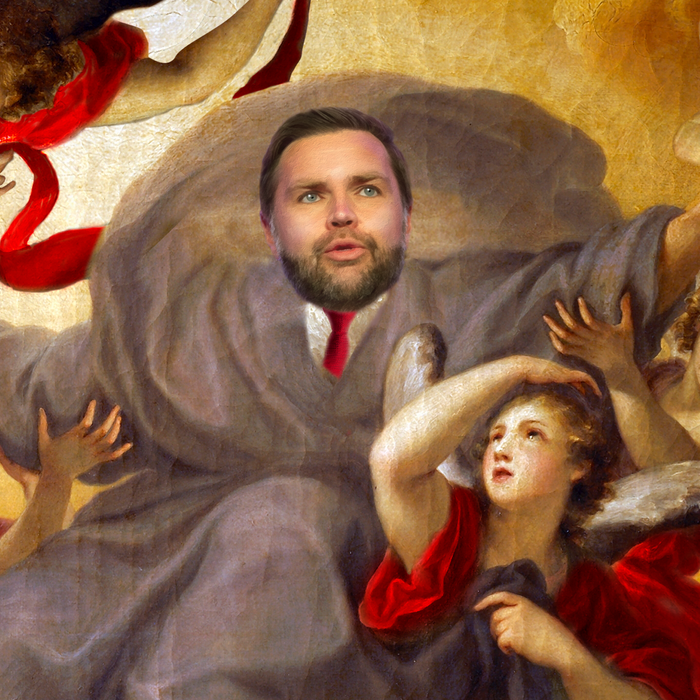
Illustration: Source images: Getty
Manage cookie preferencesOn a muggy Saturday evening in May, 30 young men and a few women, all Christian and mostly Catholic, filed into a 19th-century redbrick building on Capitol Hill, part of Hillsdale College’s Washington, D.C., campus. The occasion was the monthly meeting of the Cicero Society, a parliamentary debating club committed, according to its terse website, to “developing excellence, preserving the Western intellectual tradition, and forming young leaders” — which in Washington is usually code for conservative job placement.
Despite the oppressive humidity, tweed jackets were the outfit of choice. The young men carried themselves like people twice their age or perhaps from a different era. One even had a cane, though it was hard to tell whether this was an accessory or a necessity. The setting was equally fusty. The debate was held beneath a large painting of the signing of the Constitution. Nearby were relics from the days of the Founding Fathers: an original copy of Thomas Paine’s American Crisis No. 1, a first edition of The Federalist.
Some of the society’s formal members, several of whom are political appointees in the Trump administration, wore pins on their jackets depicting the society’s crest, a quill pen crossing a sword. Others, pinless, worked the room, hoping to make a good impression. Some would later give floor speeches responding to the evening’s resolution, the main route to being accepted as a full member. The few women present weren’t auditioning quite as strenuously, perhaps because they were less eager to be admitted to what is, in essence, a fraternity.
After cocktails, guests settled into their chairs. I was handed a laminated guide: no one to speak unless recognized by the chairman; members to refer to one another as “the gentleman” or “the lady”; approval and disapproval to be expressed through “pounding of feet and hisses,” which, the guide explained, promoted “a lively atmosphere.” The session then began with a recounting of the minutes of the previous month’s debate, “Did William F. Buckley Jr. Fail?” Buckley, the founder of National Review, is best understood here as a stand-in for the kind of overpolite, free-market conservatism the Ciceronians reject. The chairman recalled that a young man of Indian descent had earlier “confessed to the society that, in many ways, Buckley was the reason he was there.” (An internship at National Review brought him to the U.S. from Canada.)
The room hissed.
It would be easy, from this alone, to mistake Cicero for a bunch of nativist trolls. But the society is more interesting than its casual cruelties, which did not, in any case, seem to offend the Indian immigrant in question, who is one of the members. Founded in 2020 by Ivy League conservative Christians, Cicero once attracted a more mixed crowd. A woman involved with the society since its early years told me that, at its height in 2021, the gender ratio was more balanced. Then, she said, “the normal people left and the weirder people came.” Talk about Groypers and incels spooked the women. Late last year, the Harvard Crimson reported that a Harvard debate society called the John Adams Society, a feeder for Cicero, had stopped allowing women to participate altogether; Cicero has not gone that far, she told me, but some members would like it to. The rules hardened. “The people who really love Robert’s Rules started having a little too much fun,” she added. The group’s politics also shifted, becoming a magnet for young New Right devotees who felt history moving their way as Donald Trump returned to the White House. Some members, another woman involved with the society told me, are hoping for it to become a staffing network-in-waiting for a future J.D. Vance administration.
The evening’s debate was “Is Christianity Conservative?” I assumed the answer would be “Of course it is.” Conservatism is the political instinct that guards “permanent things” against the progressive urge to remake the world from scratch, to paraphrase one debater. But after several hours, the opposition carried the night with a different argument: Until Christian beliefs are fully enshrined in public policy, Christians will need to be radicals. One of the speakers on the winning side put the matter pithily: “Christian ends sometimes require progressive means.” If the existing order is decadent, corrupt, or hostile to Christian life, then conserving it is no virtue.
These young Christians are not interested in withdrawing from politics to practice their faith in private. They want to wield political power for Christian ends. And the politician who makes that Christian ambition feel most plausible is Vance, whose new memoir, Communion: Finding My Way Back to Faith, puts Catholicism at the center of his political identity. He is also widely suspected, even among some on the Catholic right, of using religion for cynical, self-serving purposes — much in the same way that Trump’s alliance with the Christian right can feel both shallow and mutually beneficial. Vance’s ambitions are where the tensions in the Catholic right — between the common good and Machiavellian interest, between its ideals and the ugly reality of power under Trump — come to a head. The question is whether Vance can synthesize those tensions into a durable political movement or if it will collapse under its contradictions.
Vance converted to Catholicism in 2019, at 35, after private instruction with the Dominican Friars in Cincinnati. He had traveled, by his own account, from the loose Evangelicalism of his Appalachian childhood through college atheism and out the other side. He takes St. Augustine as his patron saint and credits the Catholic Church with giving him a sense of purpose that Yale and a career in finance failed to. Communion tells the story of that conversion. “The interesting question that hangs over this book,” he has said, “is why I ever strayed from the path” of Christianity to begin with.
Catholicism, in his telling, offered a way to resist the status hunger of the meritocratic world he had clawed his way into. He traced his earlier atheism, in part, to “a desire for social acceptance among American elites.” His path back to belief began with a talk at Yale Law School by Peter Thiel — whose investment firm Vance later worked for and who would go on to bankroll his Senate campaign. Digging into Thiel’s worldview led him to René Girard, the French Christian philosopher who taught at Stanford in the 1980s and remains fashionable on the tech right. Girard’s mimetic theory gave Vance a name for the hall of mirrors he recognized from Yale: human beings chasing whatever they see other people chasing.
Catholic social teaching offers a language of family, labor, solidarity, limits, obligation, and the common good articulated through papal encyclicals. Its modern starting point is Rerum Novarum, Leo XIII’s 1891 encyclical on capital and labor, written after industrial capitalism had already remade European society. The encyclical defended private property while insisting that economic life had moral obligations: Workers deserve dignity, families deserve security, and the rich should not treat property as a license to ignore the poor. The text has particular force now as artificial intelligence reshapes society and because Pope Leo’s name points back to that tradition. It is also the tradition Vance reaches for when he wants to present himself as something more interesting than another pro-business Republican.
To the delight of the Ciceronians, Vance seemed to be adapting these teachings to Republican politics when he was a senator, working with economic progressives on railroad reform, insulin prices, credit-card fees, and clawbacks from bailed-out financial executives. He appeared, at least for a while, to be trying to build a populist right less obedient to capital and more attentive to labor, family, and community. When he joined Trump on the 2024 presidential ticket, he was the most visibly successful figure in a wider Washington world where Catholicism has become far more than a source of faith.
The morning after Cicero, I saw some of the same faces at Immaculate Conception, a Catholic church near Mount Vernon Square that has become one of the unofficial home parishes for young conservatives in Washington. At the end of the service, many of the same young men who had hissed at an immigrant were kneeling before the altar rail, waiting to receive Communion on the tongue. It is not a Latin Mass parish — the preferred Mass of the so-called Trad Caths — but it offers traditional styles of Mass. The parish is the hub of a young Catholic ecosystem: Bible studies, young-adult happy hours (“holy to happy hour”), and group trips to volunteer at a nursing home or pray outside Planned Parenthood.
By most measures, the Catholic Church is becoming less of a force in American life. Revelations of sexual abuse and official cover-up have taken a toll at dioceses around the country, as has the gravitational pull of secular society. Catholic-school enrollment has fallen by roughly a million students since the beginning of the century. Infant baptisms have fallen by more than half. Catholic weddings have dropped even more steeply. In most places, the story of American Catholicism is one of decline.
And yet Catholicism has never felt more powerful or politically salient in the places where American conservatism governs. Six of the nine Supreme Court justices are Catholic. So are more than a third of the members of Trump’s second-term Cabinet, including Secretary of State Marco Rubio, Secretary of Transportation Sean Duffy, CIA director John Ratcliffe, and Education Secretary Linda McMahon. Prominent non-Cabinet figures in the administration including press secretary Karoline Leavitt and border czar Tom Homan are also Catholic. And then, of course, there is Vance.
Much of the legal, institutional, and intellectual machinery behind the contemporary right is Catholic-led as well, including Leonard Leo at the Federalist Society, Tim Busch at the Napa Institute, and Kevin Roberts at the Heritage Foundation. The secretive Opus Dei network, an eternal staple of conspiracy thinking that has long connected conservative Catholics in law, politics, and finance, is thriving on many campuses. In some ways, conservative Catholic networks in Washington function like the Communist Party in China. You don’t have to be a member. But if you’re ambitious and want to get ahead in your career, it surely helps.
According to the Catholic writer and Vance-whisperer Sohrab Ahmari, Evangelical Protestantism may be more powerful as a mass political force, but Catholicism has “a deep theory of the world.” It is, he explained to me, “a total theory,” a picture of why people act and what politics is for, and so it was no accident that Catholics have supplied so much of the “intellectual firepower” of the American right. “The Church has this rich vocabulary and conceptual framework for understanding the world,” he said. “It talks about the common good. It talks about properly ordered politics.”
The Catholic energy in Washington was apparent the night before Easter, at the Easter Vigil, where newcomers receive baptism, confirmation, and the Eucharist and are formally brought into the Church. According to Cardinal Robert McElroy, the archdiocese, which covers the District of Columbia and surrounding suburbs, welcomed 1,755 people to the Church, up from 1,566 in 2025, which was already the highest figure in at least 15 years. “The number of those joining the Church this year is a record for the archdiocese,” the cardinal told 60 Minutes.
Kayla Bartsch, who was a writer for National Review and converted to Catholicism after college, described the appeal to me. She grew up in Minnesota as a member of one of the most fundamentalist Lutheran denominations in the U.S., attended a classical Catholic high school, and arrived at Yale still trying to figure out what she believed. For a while, she said, she was an “ecumenical floater,” attending Catholic Mass every week while also participating in a Protestant campus ministry.
The Yale Political Union, Bartsch told me, was “somewhat notorious for churning out Catholic converts.” The reason, she said, was not that Yale’s debating society was secretly catechizing its members. It was that secular students who had assumed religion was mostly a consolation for the incurious or ignorant encountered peers who were “brilliant, well spoken, thoughtful, and very religious.” Catholicism’s synthesis of faith and reason, she said, was the “initial magnet.” It offered not only a set of doctrines but permission to believe without checking one’s intellect at the door.
In Washington, Catholicism also gives young conservatives a social world. Bartsch, who has moved between New York and D.C., said the Catholic energy in D.C. is different because it is a company town. The average young Mass-goer at parishes like Immaculate Conception might work at a conservative think tank, in the administration, on the Hill, or at a conservative foundation. The connection is not simply belief, and not simply networking, but participation in a community where faith, friendship, dating, argument, ambition, and employment overlap.
Fittingly for a former writer at Buckley’s old magazine, Bartsch is not an edgy postliberal revolutionary. She describes herself as a constitutional conservative, “a huge fan” of the Founding, and an American exceptionalist. “I don’t want the U.S. to be more like Hungary,” she told me. But she understands why so many young conservatives are drawn to more radical religious politics, sharing their concerns about “the breakdown of the family” and “how AI and porn are threatening the development of all of our young people.” It would be “amazing,” she said, “if more Americans found God.” The question for her is how best to achieve this.
Former Trump adviser Steve Bannon, who has spent years cultivating the hard-right Catholic world, told me, “It’s pretty amazing to me that you’re seeing many more young men, but women too, drawn to what I call the rad-trad Catholics. I think that is building and building. They’re going to be a major intellectual and political force in the future.”
The Catholic resurgence on the right coincides with the emergence of Pope Leo as one of the most visible foils to Trump. Leo has spent his first year saying more or less the opposite of what the administration does. His first encyclical, Magnifica Humanitas, signed on the 135th anniversary of Rerum Novarum, did for artificial intelligence what Leo XIII had done for the factory floor, warning that AI must be “disarmed” before it can concentrate power among a handful of corporations and hollow out the dignity of work — a rebuke to the same tech-right patrons who had helped underwrite Vance’s rise. Leo drove the point home by presenting the encyclical alongside a co-founder of Anthropic, the AI company locked in its own public clash with the Trump administration over the military and surveillance use of its models. On capitalism more broadly, an earlier exhortation denounced the “dictatorship of an economy that kills” and the wealthy who live in a “bubble of comfort and luxury.” On immigration, he called the “inhuman treatment of immigrants in the United States” irreconcilable with any honest claim to be pro-life. And on war, he has been most forceful of all, condemning the U.S.–Israeli campaign against Iran as a “delusion of omnipotence” and reminding the faithful that God “does not listen to the prayers of those who wage war.” All of which has been profoundly discomfiting for Vance and other Catholic supporters of the president.
In April, in a congressional office while Fox News played in the background, an Immaculate Conception–goer and young Catholic staffer for a member of the far-right Freedom Caucus watched a familiar ritual — the antics of Donald Trump — become, for once, unfamiliar. After the pope criticized the war in Iran, Trump blasted him for being “WEAK on Crime” and “terrible for Foreign Policy.” He then posted an image of himself as Jesus Christ, bathed in the light of the Lord and healing a sick man. Christians who side instinctively with Trump, the staffer recalled, could only gasp. “It was one of the first times I saw them kind of actively root against him a little bit.”
The staffer was not eager to quit Trump. He half-jokingly described himself as a “Trump accelerationist,” willing to tolerate much of the president’s destructiveness for the sake of conservative goals. But putting his own head on the body of Christ, he said, suggested “something deeply wrong with him.” He still supported the president, but “a lot less than I did before that.”
The Church’s American hierarchy has been less forgiving. On 60 Minutes, Cardinal McElroy of Washington said the war with Iran “is not a just war,” reminding his flock that the only path allowed by Catholic teaching is to restore justice and peace. The conservative Catholics of Washington thus found themselves caught between two authorities: a president who could make or break their careers and the Church in charge of their souls. Most chose the president.
Conservative Catholics could be disgusted, embarrassed, even spiritually outraged by Trump without becoming meaningfully less attached to the political project he led. Henry Long, another young Catholic convert and think-tanker in Washington, had publicly argued against the Trump administration’s war in Iran on the grounds of Catholic “just war” doctrine. But he also explained to me that Catholicism was “directionally” aligned with MAGA against progressivism, identity politics, transgenderism, and other social liberal causes, even if on issues like war and immigration, “they’re definitely not coincident at all.”
Because there is “not really another game in town,” conservative Catholics are unlikely to abandon Trump, Long said. They might rightly recoil from his posting himself as Jesus or insulting the pope, but the Democratic Party remains, for them, impossible on abortion, gender, religious liberty, and the family. Thus their response has been what Long called a “prudential political refusal” to condemn Trump outright.
The strangest aspect of that loyalty is how little Trump has given them in return. Asked by Ross Douthat, a favorite writer among young Catholics in Washington, in June what is Christian about the administration, Vance did not point to a family policy, a pro-worker measure, or some effort to restrain war. He pointed to the tax cuts. It was a revealing answer from a politician whose Catholic politics are supposed to draw on Rerum Novarum. The encyclical does not map neatly onto any American party platform, but it is difficult to turn its concern for workers, the poor, and the moral duties of wealth into a brief for tax cuts tilted heavily toward the rich.
Nor has the administration offered conservative Catholics much on the issues where Trumpism and Catholic social conservatism are supposedly most aligned. Trump and Vance have treated abortion less as an absolute moral crusade than as an electoral liability to be managed, and the administration quietly dropped opposition to same-sex marriage from the Republican platform. Long, who is strongly anti-abortion, lamented what he calls “a kind of real laxity from the Trump administration on abortion” since Dobbs. He said the administration has done little on mifepristone and shown scant interest in pressing state restrictions. Vance has readily embraced Trump’s relatively lax position on the issue, at least by Catholic standards, whereas his opposition to the war in Iran was leaked early and is now a well-established part of his political posture within the administration.
To his admirers, Vance is the convert who might discipline Trumpism into something more durable and serious. To his skeptics, his conversion story is just too suspicious: He found in Catholicism a language for resisting elite ambition just as his own ambition was carrying him toward the most elite job in the world. When Trump attacked the pope, it was Vance who climbed out on the farthest, shakiest limb, warning that Leo should “be careful when he talks about matters of theology.” It was a remarkable inversion: the recent Catholic convert lecturing the pope. Long was forgiving about Vance’s tone, which he thought was respectful compared with Trump’s invective, but he still found the chastisement “not entirely becoming.” On the Iran war, Long was blunter. Vance once opposed the kind of “forever wars” Trump had now launched but as vice-president was having to “toe the Trump line.”
Other conservative Catholics have been hedging and waffling. The very online Bishop Robert Barron, who serves on Trump’s Religious Liberty Commission, called the president’s comments disrespectful, reminding him that it is the pope’s prerogative to articulate Catholic doctrine and the principles that govern moral life. Barron was at the White House during Holy Week after the president posted the photo of himself as Jesus. Before the post, his spiritual adviser, Paula White-Cain, drew out the comparison. “You were betrayed and arrested and falsely accused,” she said. “It’s a familiar pattern that our Lord and Savior showed us.”
But even Barron subsequently softened his rebuke, asking people to move beyond the “Pope vs. President” frame. His equivocating summed up the conservative Catholic predicament: to preserve access to power in Trumpworld, one must at all costs avoid siding with the president’s critics — even if they include the pope. If and when Vance emerges from Trump’s shadow, his faith-oriented politics will be judged against the memory of how reliably, when the president and the Church pointed in different directions, he followed the president.
In May, Vance and Barron appeared at a Trump-backed prayer rally on the National Mall alongside White-Cain, Pete Hegseth, and Robert Jeffress, a Southern Baptist pastor and televangelist who has described Catholicism as a counterfeit religion and recently said Trump understood the Bible better than Pope Leo. Nobody hissed.