The Billionaire Blowing the Whistle on Donald Trump’s Crypto Shop
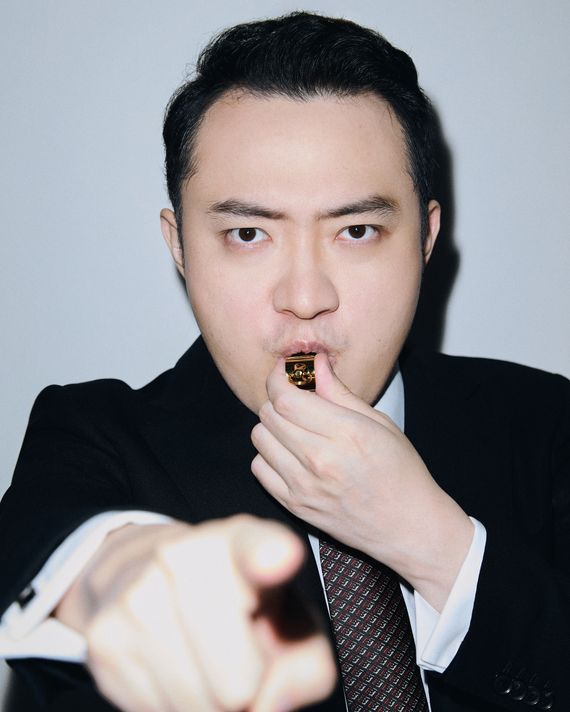
Photo: Karl Lam
Justin Sun was already one of the richest people in the world, having made his fortune in the no-rules early phase of the crypto industry, when he first met the three men from World Liberty Financial. It was October 2024, and the only thing Sun knew of the company they were hoping he would invest in was that it was being launched by then-candidate Donald Trump and his three sons.
Neither Don Jr., Eric, and Barron nor anyone else with the Trump name was on the video call that day. Instead, on the other side were World Liberty’s three top executives: an internet-marketing hustler who had spent time in jail on drug charges and been sued multiple times for fraud, a former professional pickup artist, and the son of Donald Trump’s best friend. Chase Herro, the internet marketer, was a wiry 41-year-old with sleeve tattoos, perma-stubble, and a vocabulary rich in blue-collar slang. Zak Folkman, the pickup artist, also 41, had both ears pierced and win! tattooed on one biceps in a comic-book-style speech bubble. He and Herro had previously launched a crypto platform that was hacked and drained of money, prompting accusations from at least one large investor of insider theft. The third co-founder was Zach Witkoff, the 33-year-old son of Steve Witkoff, the real-estate mogul who now serves as President Trump’s special envoy to the Middle East. Zach Witkoff had been arrested for cocaine possession leaving a Miami nightclub in 2022 and generally presented as an awkward rich kid (“If you could anthropomorphize a squirrel,” as a former World Liberty adviser put it). “My dad got shot at with the president the other day,” Witkoff said by way of introduction on the call.
Sun, who was raised in China by middle-class journalist parents and earned a master’s degree at the University of Pennsylvania, built his fortune by launching his own blockchain, Tron, which became popular in Asia as a fast and cheap way to move U.S.-dollar stablecoins. Tron’s digital coin, $TRX, with a market cap of some $31 billion, is the eighth-most-valuable cryptocurrency in the world. According to Forbes, Sun’s net worth is an estimated $8.5 billion, making him richer than George Soros and not far behind Bill Ackman. (Sun suggests he’s worth more than that; when Bloomberg estimated his wealth at $12.5 billion, Sun sued.)
In his ascendancy, Sun had not escaped the attention of the U.S. government. In March 2023, the Securities and Exchange Commission under the Biden administration charged him and his companies with fraud, alleging market manipulation and the unregistered offer and sale of securities. Sun was charged simultaneously with Lindsay Lohan, Jake Paul, Akon, and Soulja Boy, who were accused of illegally hawking Tron’s cryptocurrency without disclosing Sun paid them to do so. The SEC also accused Sun of artificially inflating the price of $TRX by making “hundreds of thousands” of essentially fake trades among his own accounts — and of lying: “Sun materially misrepresented the truth about the touting campaign to deceive investors,” according to the SEC. Later that year, Tron made headlines for reportedly being used by terrorist groups, including Hamas and Islamic Jihad, putting additional heat on Sun, who had reportedly avoided traveling to the U.S. for years out of fear he’d be arrested. (Tron later took measures to better police its platform.)
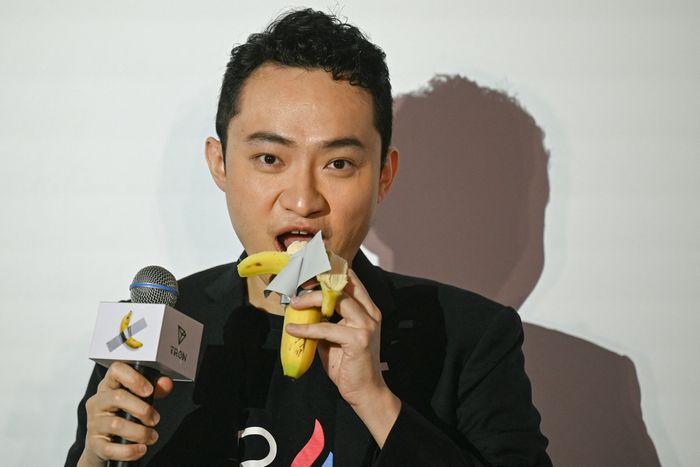
Sun eating a $6.2 million banana bought at auction from the artist Maurizio Cattelan in 2024. “It’s still fresh.” Photo: Peter Parks/AFP via Getty Images
Now, on the eve of the presidential election, the three guys on the Zoom were offering Sun an interesting investment opportunity that, should Trump win a second term, might also conveniently help relieve this legal pressure. Don Jr. and Eric Trump were all in on the project, the three World Liberty founders said on the call. In fact, the Trump family, at the time, owned 75 percent of the business. The Trumps’ passion for World Liberty, the founders told Sun, came from being “debanked,” or off-loaded as clients, by JPMorgan and Capital One in the wake of the January 6 insurrection. They were committed to pursuing a crypto alternative for their wealth — a way to control their own money through uncensurable digital wallets. Trump would preside over a financial revolution enabling regular citizens to bypass banks and invest their assets freely across decentralized crypto platforms.
World Liberty would build innovative projects that delivered on the new administration’s ambitions. “They said they were the victims of those centralized controls,” says Sun. “I believe in the vision of what was presented.” Sun, who has a libertarian streak (he became an Ayn Rand fan in graduate school), says he identified with fears of a “very big centralized power that eventually will enslave everyone.” He liked the pitch enough that he was willing to overlook the founders’ worrisome backgrounds.
In November 2024, Sun transferred $30 million to World Liberty and came aboard as an adviser, receiving billions of yet-to-launch $WLFI coins — the key token in the company’s future crypto ecosystem — in exchange. He was immediately the biggest investor in the project. Sun’s involvement also gave World Liberty a halo of safety in the eyes of many other crypto investors. In the month before Sun invested, World Liberty had brought in only $21 million from other investors, a fraction of its target. After Sun’s involvement was made public, money poured in (including another $15 million from Sun). World Liberty closed its initial sale in January 2025, having raised $300 million.
Over the next year or so, Sun would come to believe he’d made a colossal mistake. World Liberty would disappoint his expectations and those of many other investors: The decentralized crypto products it promised would largely never materialize; the money investors put in would remain mostly locked away from them; and the $WLFI cryptocurrency would crash, leaving many token holders with huge losses while the president and his partners made hundreds of millions in profits. Sun would be stripped of his tokens entirely. “Today, the thing I regret the most is not only that my money got stuck but that my name is on the project,” Sun says. “I believe many other people also got harmed.” In April 2026, he filed a lawsuit against World Liberty alleging fraud and breach of contract. When we spoke in June via Zoom, it was late in the evening in Hong Kong, where he lives. His background was a picture of the Golden Gate Bridge, but when the screen faltered, I could see he was lying down, his head on a pillow. Wearing a deep-blue crewneck T-shirt, he drank water from a carafe as he walked me through his past and his time with World Liberty. Our conversation took place under the shadow of defamation claims World Liberty had recently made against Sun, and he seemed torn between wanting to condemn the company’s actions and staying within the guardrails his lawyers had set for him. But he couldn’t hide his outrage at World Liberty — for making a mockery of the principles it was purportedly founded on and for, in his eyes, essentially stealing his money in full public view. “I never expected this to happen to me,” says Sun. “This is the worst-case scenario.”
Sun’s account, and those of others who invested in and worked for the company, depict an enterprise that was partially inspired and de facto run by Herro — a man whose career might be characterized as a high-speed succession of shameless for-profit hustles. Sun and other investors describe how World Liberty soaked up hundreds of millions in investments based on the Trumps’ involvement, then sat on the money. Outside investors, including Sun, always seemed to lose, while company insiders always won. “I thought surely these people would not do what they did with such a public profile attached,” says Sun. “Looking back, I was wrong about that. Unfortunately, as alleged in the complaint, certain operators leveraged the Trump brand to profit through fraud.”
The president’s financial disclosures reveal that, in 2025, his ventures brought in at least $2.2 billion with crypto accounting for more than half of that total. The largest individual element of that historic windfall — likely the best financial year of his life and the most profitable ever for any president — was World Liberty, which put some $800 million into Trump’s pocket. While the Trumps were hands off on day-to-day matters — and Sun is careful to say his issues are not with the Trumps directly — they were the largest owners of the company and certainly the ones who decided its shape. “No president I can think of has ever exploited the office this way for their own personal monetary gain,” says Don Fox, who served as general counsel and then acting director of the Office of Government Ethics under George W. Bush and Barack Obama. “In the post-Watergate era, nobody’s gotten wealthy off the presidency, certainly not fabulously wealthy.” Trump has also used his office to protect his investment, signing an executive order essentially instructing the SEC to go easy on crypto as soon as he was inaugurated and while World Liberty was still raising money, which, Fox adds, “is a criminal offense” for any executive-branch official except the president and the vice-president.
Trump didn’t start out a crypto booster. In 2019, he said he was “not a fan of bitcoin and other cryptocurrencies, which are not money.” Trump argued they “can facilitate unlawful behavior, including drug trade and other illegal activity.” Out of office, though, he seems to have been awakened to what crypto could do for him: It was popular with young men, a key part of his base, and the industry became an enthusiastic source of campaign contributions. He seems, too, to have recognized that it could make him much richer than he already was.
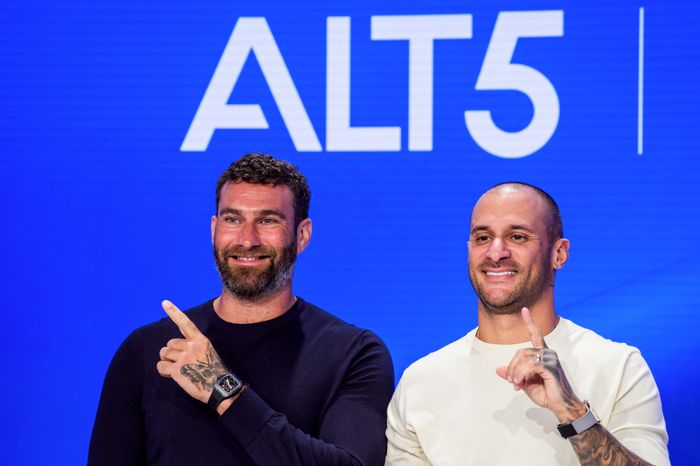
The Trump family teamed up with former pickup artist Zak Folkman, left, and self-described “dirtbag” Chase Herro to createcrypto company World Liberty Financial prior to the 2024 election. Photo: Adam Gray/Bloomberg via Getty Images
Trump’s sudden interest in crypto can be traced back to a seemingly serendipitous meeting with Chase Herro in 2023. As Herro tells the story, he bumped into Zach Witkoff that summer at the Witkoffs’ golf resort, the Shell Bay Club, near Miami, and Zach offered to drive him around the course. “Literally, on the golf cart, we just started shooting the shit,” Herro later told Fortune. They became fast friends. Zach introduced Herro to his father, Steve, and the elder Witkoff brokered a meeting between Herro and Trump.
Sitting with Trump, then in exile at Mar-a-Lago, Herro needed to prove that there was real money in crypto — and that he, seemingly a nobody, was actually absurdly rich. Herro pulled out his phone and moved some $100 million in crypto coins from one wallet to another. Trump was sold. “That turned the lights on,” says a former World Liberty adviser who has known Herro for several years. (The White House had no comment; a spokesperson for World Liberty said this “story is inaccurate” but did not specify why.) From there, Trump began courting the crypto vote and receiving generous contributions from the industry. He declared he would make the U.S. “the crypto capital of the planet” and branded himself the future “crypto president.” He officially launched World Liberty shortly before the election and his own $TRUMP meme coin (an entirely separate crypto venture) in January 2025, days prior to his inauguration. Says the former adviser, “Chase was very proud: ‘Who would have thought? Dirtbag like me.’”
Herro, roughly five-foot-ten with a slender build that he has described as the body of a 12-year-old synchronized swimmer, grew up in a suburb of Madison, Wisconsin. His family was “very poor,” he said on a podcast in early 2020: “I think when you live in poverty, you assume everybody’s poor.” He sold marijuana and was arrested at least four times before his 18th birthday on charges including theft — for a scheme in which he was caught on-camera cashing his stepfather’s checks — and drug possession. Herro’s mother once called the police on him for domestic abuse. Shortly after high school, following a drug-related arrest, Herro cut off his ankle monitor and fled to California, according to a story he’s told to friends and on podcasts.
When he got to California in the mid-aughts, Herro, who pronounces (and often spells) his name Hero, reinvented his origins. He described his mother as an ultrawealthy cheese-factory magnate and his father as a Mafia member who had been murdered in front of him, according to former roommates. (On podcasts years later, Herro said that his father had died of a heart attack and was found alone in his home and that he’d bought his mom a house, told her to “quit her job, and let her retire.”“My parents have no money,” he said on a separate podcast.) He worked at an ampm gas station in San Diego and then in construction, but he bragged about having a second home and a fancy-car collection. “None of that existed,” says a former friend. “He was like, ‘You just gotta talk about it like it’s already here.’”
A former roommate says even two decades ago he clocked Herro as a sociopath. “Literally everything is a lie,” says the former roommate. “The watches he’s wearing, the sunglasses — fake. He wouldn’t say he went to McDonald’s; he’d say, ‘I ate at Ruth’s Chris.’” (That was not the only time someone made this assessment about Herro. “If someone calls me a sociopath, I kind of, like, look over and I’m like, ‘Thanks, I think?’” Herro said on a podcast in 2020. “If you’re going to invest money in a day trader or investor, I want them to be a sociopath.”)
Herro’s fake-it-till-you-make-it strategy began to bear fruit when he discovered the then-hot world of affiliate marketing. He would create false dating profiles, pretending to be a single woman, and post them on sites like Backpage or Craigslist; when someone expressed interest in meeting in person, Herro would ask them to first sign up for a background check, enrolling them in a $40-a-month service from which he got a commission, according to the former roommate. “I remember going to his house and he’d have, like, 20 laptops out just running these bots that would post these things,” says this person. Herro sold hair-loss remedies, colon cleansers, and tactical flashlights. In 2010, after Herro launched a marijuana dispensary called Healthy Wealthy and Wise, a man who believed he’d invested $170,000 in the venture sued him for fraud, claiming the corporation never existed and Herro had deposited the funds into his personal account. (The plaintiff was awarded a default judgment with interest.) Soon, a website appeared detailing complaints against Herro under the domain name ChaseHeroScam.com. “Chase just doesn’t care who he has to step on or who he has to jump over; it was like, ‘I want to be rich,’” says the former friend. “That was it. Not even famous; just rich.”
Herro moved to a different part of San Diego County and gave his old friends a tour of his new home. “Hidden inside fake books were just stacks of cash,” says another former friend. Herro also displayed a Desert Eagle pistol — one of the largest-caliber handguns sold in the U.S. — on his nightstand. On YouTube, Herro posted videos of a warehouse full of dirt bikes and mini go-carts, paintball guns, and other toys; friends remember photos in which he was unloading a moving truck filled with fine art. He bought a 34-foot boat he named Clickbait.
In 2019, the entrepreneur Sam Bakhtiar asked Herro on a podcast to opine on fraud. “At least they’re trying to do something in life. It’s fucked up, but, like, I’ll give credit to a bank robber versus someone who sits on a fucking TV and eats potato chips all day,” he said. “Granted, is their execution wrong? Yeah, probably. But I’m not God; I’m not here to judge.”
Herro met Zak Folkman in an online “mastermind” group, where they shared tips about how to make a lot of money quickly. Folkman was a co-founder of a website called Date Hotter Girls. They quickly became business partners. “He’s a Chad,” the former World Liberty adviser says of Folkman.
Herro and Folkman launched several online communities, including one they called the Watchers, promising investment advice and selling subscriptions for thousands of dollars a year to access their network — a kind of knockoff of Tai Lopez. In 2021 at a meeting in Miami, Herro pitched his supporters on the promise of a decentralized-finance, or DeFi, crypto project. “He was almost crying as he told us how incredible it was that he put 90 percent of his net worth into DeFi and it was the most amazing financial thing he’d ever discovered,” says a member of the group. “He seemed like a genuine evangelist and very passionate about it.”
A year later, the project was worthless, but Herro showed no signs of having lost nearly all of his assets. By then, he had a fleet of about a dozen luxury vehicles, all of them white, with Montana plates, exploiting a loophole that allowed him to avoid paying taxes on the cars. Taxes overall were now such an issue for Herro that around 2021 he moved to Puerto Rico — claiming on Facebook he lived at the Ritz there — for half (plus a day) of each year, taking advantage of the popular tax haven. “It sucks; we call it just putting in time. It almost feels like going to jail,” he told a friend. “I just do it because it saves me so much money.”
When Herro met Zach Witkoff at the golf course, it probably wasn’t a coincidence. “I don’t think anything is incidental with Chase,” says the former World Liberty adviser. “It’s been crazy to watch him. It’s like the same exact thing he’s been doing for years; he’s just in different rooms with different, more powerful people,” says the former roommate. “My friends and I were just waiting for the day that Chase ends up in handcuffs. But over the years, it’s like, Holy shit — he’s doing what now? He’s in the White House? I was like, Wow, the scam artist teamed up with the biggest con man.” Says the second former friend, “It’s unbelievable this guy scammed his way to the top.”
Herro’s credentials as a crypto entrepreneur began and ended with a project he launched in April 2024, just a few months before World Liberty was formed. Called Dough Finance, it was supposed to be a DeFi blockchain platform from which Herro promised “guaranteed” profits through a process he called “looping,” according to an investor named Jonny Lopez. This involved repeatedly borrowing against crypto holdings and using the borrowed funds to buy more.
Herro’s business partner was Folkman, who got a degree from New York Law School in 2010, around the time he co-founded Date Hotter Girls under the pseudonym Zack Bauer. (On the site, he sold an e-book — still available in a package priced at $97 — that includes “a story about Zack ‘motorboating’ a girl at a dive bar” and instructions on how to “move situations toward sex ridiculously fast,” according to a promotional page.)
That spring and summer, Herro raised money from investors, including Lopez, who put in $1 million. “Bro I never do shit,” Herro texted Lopez, according to evidence later filed in court. “All handshakes and go.” Herro indicated to Lopez that Dough had “over $3 billion” in liquidity: “What you think I built some stupid toy lol.”
But days after Lopez had completed his investment, his money disappeared. Dough had been hacked; the money was gone.
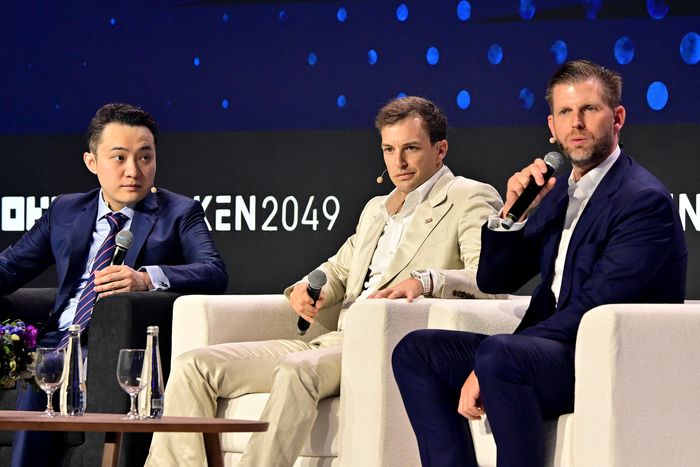
Sun in Dubai with Zach Witkoff and Eric Trump in 2025 before the big breakup. Photo: Giuseppe Cacace/AFP via Getty Images
Lopez and other investors were incredulous — and blamed Herro. According to a lawsuit filed by Lopez in 2025 accusing Herro of negligent misrepresentation and fraud, Herro “altered or manipulated Dough Finance’s code” and staged a fake governance vote as part of a plan to steal investors’ money. (Folkman is not named in the lawsuit.) “As it turns out: each and every promise and representation that Chase made to Jonny was a complete lie — a ruse by Chase to pump the liquidity on Dough Finance’s platform so that Chase could take it for himself,” Lopez alleged in the suit. When a process server attempted to serve him with the lawsuit, Herro ran. (In July 2026, Herro urged the court to dismiss the case, arguing that Dough really had been hacked.)
Suspicions around the Dough hack were rampant when Trump partnered with Herro and Folkman on World Liberty two months later. Trump officially announced World Liberty in a livestream in September 2024, and the company released a “Gold Paper” (a spin on the white papers that crypto projects typically publish) emblazoned with his portrait over a graphic of a golden paint splotch. In the paper, World Liberty said its mission was “to democratize finance” — a rip-off of trading app Robinhood’s slogan. What World Liberty seemed to promise was unprecedented in the U.S.: a government-blessed crypto project that would offer an alternative not just to crypto platforms like Coinbase or Circle but to banks themselves. Indeed, World Liberty, “inspired by the vision of Donald J. Trump,” proposed a “new strategy” that would “help to safeguard the US Dollar’s future as the global reserve currency,” the Gold Paper read, “without compromising on freedom.”
The Gold Paper was light on specifics about what World Liberty actually planned to do. Those in charge did not seem to know either. Around the time of the launch, Steve Witkoff, who was then listed as a co-founder of World Liberty along with his two sons, asked the venture capitalist Nic Carter to meet him at Pura Vida, the smoothie-and-sandwich chain, in Sunset Harbour in Miami. He wanted Carter to come onboard as an adviser but could not explain concepts fundamental to the business. “He didn’t know what crypto or DeFi was. He didn’t know what the pitch was,” recalls Carter. “I’m like, Oh, okay, so there’s no product. They’re just doing a token.” The biggest giveaway was when Witkoff explained that Trump had become interested in the crypto project because “Barron was getting active with meme coins” — but pronounced it “me-me” coins.
What was important, Witkoff explained, was that they launch World Liberty before Trump was elected president again. “They needed Trump to be involved for launch as a private citizen,” says Carter. “They had to rush it out.” Carter, who voted for Trump in the election, declined the adviser position and warned that World Liberty risked damaging the candidate at the polls, given its credibility issues. That’s when Witkoff’s tone changed. “Then he, like, flips to try to bully me,” says Carter. “‘You don’t want to be on the big guy’s bad side.’” (World Liberty describes this characterization of the conversation as “inaccurate” and says the company “never formally offered Mr. Carter any such role.”)
In those early days, World Liberty was desperate not just for big-name advisers to burnish its reputation but for start-up capital. It had set an initial fundraising goal of $289 million. Despite their affiliation with the likely next president, Herro and Folkman — World Liberty’s only executive officers and directors on initial securities filings — struggled to attract investors. By the end of October 2024, World Liberty had slashed its investment target by 90 percent to $30 million. Morten Christensen, a Dutch crypto investor living in Mexico, had been considering investing in World Liberty but decided the tepid interest from others was a bad sign. “For me, that was a red flag — Oh, never mind, they’re never going to raise enough,” he says. “In crypto, if it’s not popular, it’s not going to be popular.” Among investors, there were almost endless reasons to stay away. “Nothing about the project gave a semblance of legitimacy unless you’re delusional enough to see a Trump cash grab as legit,” says one longtime crypto investor who chose not to put in money. Elliot Omanson, a three-time Trump voter and crypto investor with a financial advisory firm in Kansas, says he was against World Liberty from the get-go. “Why would you want to create a vehicle that has all the appearances of corruption when you’re supposedly going in to fight the deep state and drain the swamp?” he says. “I hate crony capitalism more than I hate socialism or communism because it’s a corruption of my belief system.” Even the crypto venture fund Polychain Capital, which had brokered the introduction to Sun, ultimately declined to invest. “They weren’t raising any money for months. And it becomes a bit embarrassing for the Trump crew if literally the president, or the soon-to-be president at that point, isn’t able to raise any cash,” says the former World Liberty adviser.
World Liberty’s founders hoped Sun could change that. Sun — specifically his wealth — had become an object of Herro’s fascination. On Logan Paul’s podcast in early 2021, Herro was asked if he had “fuck-you money.” He hesitated, recalling seeing Sun bid at an NFT auction. “I just watched that Justin Sun guy spend $69 million on the Beeple piece,” Herro answered. “Do you know what that made me feel like?” (Sun himself, it turned out, was narrowly outbid at the end of the auction.)
Sun also had a reputation as a hustler. In creating the Tron blockchain, he simply copy-and-pasted code, without credit, from Ethereum, one of the original chains. Tron, launched in 2017, was still a massive hit. A year later, Sun and his company expanded their empire, buying BitTorrent, the site best known as a venue for sharing pirated movies and games, for $140 million in cash. In 2019, he won a lunch with Warren Buffett in a charity auction with a bid of $4.6 million. Soon, Sun was collecting works by Picasso and Warhol, which will eventually be displayed at a museum he is building in Hong Kong (tentative name: Justin Sun Museum). In 2021, he spent $28 million to secure a ticket to space on a Blue Origin rocket. That same year, he became Grenada’s ambassador to the World Trade Organization, after which he started using the title “His Excellency” on social media and at public appearances. (He continues to go by “H.E. Justin Sun” despite the fact that his diplomatic status was revoked in 2023.) Last year, Tron went public on the nasdaq, though it took a bit of a shortcut, bypassing an IPO by merging with an obscure, but publicly traded, company that makes souvenirs sold at Disney and other theme parks. And while Sun and his companies have had persistent legal controversies (and are notably litigious), he also holds the rare distinction of being one of the few original crypto founders who have never been to prison.
Staying out of prison was likely on the mind of at least a few investors in World Liberty. Making a large investment in the project was widely seen as a play to curry favor with Trump. The project was upfront about the fact that 75 percent of net revenues would go to the president’s company DT Marks DEFI LLC (of which Trump owns 70 percent and family members own the rest). It was as though World Liberty had opened up a way to give money directly to Trump. Even in the profiteering world of crypto, an arrangement so lopsided, so nakedly self-dealing, was remarkable.
‘‘It’s unbelievable this guy scammed his way to the top.’’Just five days before his initial investment of $30 million in World Liberty, Sun bought a banana duct-taped to a wall — a conceptual artwork by Maurizio Cattelan — for $6.2 million in a Sotheby’s auction. Sun says he came across the work at random in the Sotheby’s catalogue and was surprised by the attention he received afterward. “I bought that just because I feel this art is kinda cool,” he says. “I bought other art pieces much more expensive than this banana before, but none of those became famous at all.” A few days later, after Sotheby’s advised him to throw the banana away, he ate it. “Why not? It’s still fresh,” he says. “Eating a banana is very common behavior.”
Sun’s investment was big news in the financial press. CNBC’s headline was “Banana Auction Billionaire Invests in Trump’s Crypto Venture”; Bloomberg went with “Trump’s Crypto Project Was a Bust Till Justin Sun Stepped In.” Sun put in the additional $15 million after the heady round of press. By March 2025, World Liberty had raised $550 million.
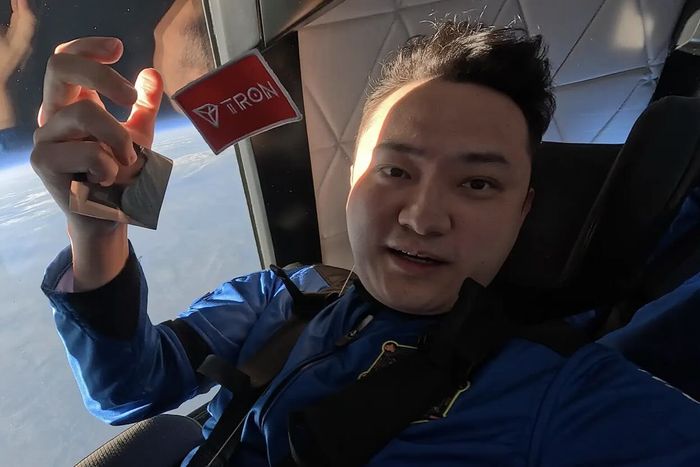
Sun in space aboard Blue Origin’s New Shepard suborbital vehicle in 2025. Photo: JustinSun Tron/YouTube
As with many crypto projects, there were two kinds of stakeholders in World Liberty. Insiders had actual equity shares in the holding company. They are owners in the traditional sense, and operating profits flow to them. In January 2025, World Liberty sold a large equity stake in the company for $500 million to a firm associated with the United Arab Emirates’“spy sheikh,” Sheikh Tahnoon bin Zayed Al Nahyan, days ahead of Trump’s inauguration. Following the sale, the Trumps retained 38 percent ownership of World Liberty. (Herro and Folkman’s company and an entity owned by the Witkoffs held smaller stakes.)
Outside investors, including Sun, received $WLFI crypto tokens. Their hope was that World Liberty’s projects and activities would raise the value of those tokens on crypto markets — that if World Liberty built a thriving crypto platform (with, for instance, innovative and potentially lucrative options for lending and borrowing $WLFI), that would create public demand, which, in turn, would drive up the price. But those links can be tenuous in crypto. $WLFI holders don’t own equity in the company or have a claim on profits — rather, they own the right to vote on some decisions for the project. ($WLFI is what is known as a governance token.) In practice, though, governance often amounts to no power at all.
World Liberty told investors that the tokens’“sole utility” was voting rights — not trading. In a statement, the World Liberty spokesperson said, “$WLFI was sold as a governance token without transfer rights initially. And those who purchased $WLFI governance tokens understood there was never any expectation of profit from the holding of $WLFI.” But to Sun and other investors, it seemed like legalese to avoid breaking securities laws. “First of all, if it’s a crypto token, it’s going to be traded on chain whether they want it or not,” says Christensen, who decided to buy the World Liberty token in the first round after Sun came onboard. “It would make no sense for members of the public to pay any money for the tokens,” Sun wrote in his lawsuit, “if the tokens offered no economic upside.”
It wasn’t long before several of the outside advisers to the project — a larger group of a dozen or so that, in addition to Sun, included a venture capitalist from Polychain, a pseudonymous cybersecurity specialist, and the head of a firm called the Crypto Lawyers — started to have concerns. The advisers had been in a Telegram group chat, but Folkman abruptly shut it down in late 2024, before they’d been able to offer their expertise to World Liberty. “They never asked for any of our advice,” says one former adviser.
‘‘World Liberty is trying to threaten me into silence.’’Months went by, and the “financial revolution” World Liberty promised never materialized. Sun says he gave the World Liberty team ideas for products it could build, but no one followed through on any of them. “I started to notice what I believed to be red flags,” Sun says now. “They seemed to be interested only in raising money, not in developing actual products.”
World Liberty did continue to raise money. In doing so, the company’s co-founders often dangled the possibility of a partnership, a deal, or a good word with the “big guy” to entice investors to put money in. It wasn’t exactly a quid pro quo. “More they were going out saying, ‘If you invest $11 million in us, we’ll invest $1 million back in your thing,’” says the former adviser.
In March 2025, World Liberty announced plans for its first real product: a stablecoin to be known as USD1. This dovetailed with the genius Act, soon to be passed by Congress, which would bring stablecoins into the country’s regulated financial system. Each issued USD1 coin — a crypto token designed to always be worth exactly $1 — would be backed by a real dollar held by World Liberty. In other words, minting 100 million USD1 coins required $100 million in funds backing the coins. The real dollars would be invested in U.S. T-bills — short-term-debt notes from the federal government that currently pay between 3.5 and 4 percent interest. As of July 2026, there were 4.2 billion outstanding USD1 coins, penciling out to roughly $150 million in annual interest income. That money is almost pure profit.
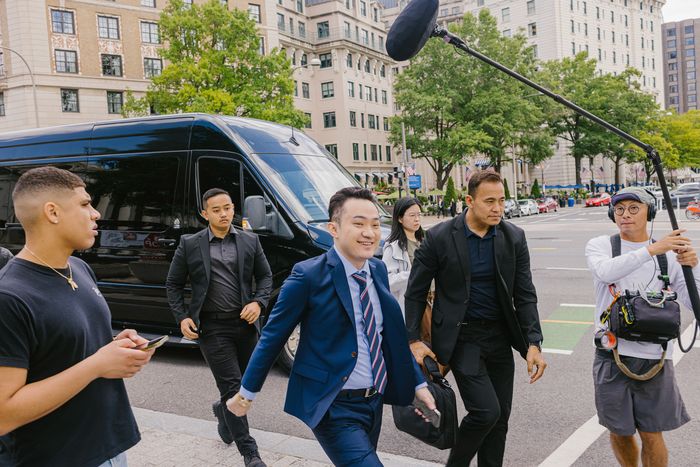
Sun heading to the White House in 2025. Photo: Jason Andrew/The New York Times/Redux
The stablecoin business was a huge boon for insiders, creating a permanent dividend for the Trumps, the Witkoffs, Herro, and Folkman (and perhaps the Emiratis, though the terms of their ownership aren’t totally clear). But the stablecoin, as World Liberty elected to build it, was unlikely to meaningfully increase the value of the $WLFI token. Outside investors were left watching in frustration.
World Liberty’s big bet on a stablecoin business made it clear to savvier $WLFI holders that there was no longer much incentive for the company to develop or launch other products, including ones that might profit regular $WLFI holders. “What’s the fucking point? Kick the can down the road. They’re making money,” says the former World Liberty adviser. Perhaps, the adviser tells me, a future Democratic administration would put an end to the scheme and a Democratic Congress would subpoena the players, but he doesn’t think that scenario is weighing heavily on the minds of the $WLFI executives. “They don’t care,” he says. “It doesn’t matter because they’ve had two-to-three years of making fat cash off the stablecoin treasury.” Meanwhile, the company still hadn’t released any $WLFI tokens, which meant the outside investors such as Sun who held them were still completely locked up.
As 2025 wore on, Sun began to feel increasingly used by World Liberty, which was continually pushing him to put in more money. World Liberty executives “engaged in a sustained and escalating campaign to pressure Mr. Sun into committing hundreds of millions of dollars to mint USD1,” his lawsuit later alleged. They approached him at industry conferences and events, badgering him to commit $200 million to the treasury backing USD1, as well as to take an equity stake in World Liberty’s holding company. Sun said “no.”“There’s never enough,” says a person familiar with the situation. “How are you going to spend all the money you raise? This company keeps raising funds without building.”
At the bitcoin conference in Las Vegas in May 2025, Zach Witkoff went to a celebratory dinner with Herro, Folkman, and other $WLFI associates at Wing Lei, a Michelin-starred Chinese restaurant at the Wynn.
While Witkoff talked about his dad and his relationship with Trump — “The president loves me” — Herro and Folkman talked business, according to a veteran of the U.S. crypto industry who was in attendance. Herro pitched the group on a plan that he said would make World Liberty, and the dinner guests, “so much money,” says this person, who remembers being unimpressed by the idea. “Chase, you just get an awful feeling from this guy right from the beginning that this guy is out there to scheme and pull a fast one,” the person says. “I wouldn’t trust him with a penny.”
Though it was never formally announced by the company, sometime around the summer of 2025, Witkoff was elevated to CEO of World Liberty. Before then, his most notable credentials, aside from jobs at his family’s firms, were speaking at the 2024 Republican National Convention and naming his firstborn son Don James Witkoff after the president. “I can’t think of a reason why he would be the CEO of a multimillion-dollar business,” says the former adviser, who adds that he believes Herro was the de facto leader. “When it comes just to raw intelligence, Chase has him beat hands down.” (“Zach Witkoff is the CEO, both in name and in reality,” said World Liberty’s spokesperson.)
Last august, World Liberty announced that the $WLFI token would begin trading on the open market on September 1, 2025 — the crypto equivalent of an IPO. Investors would finally be able to turn their tokens into real money. A few days before the debut, Sun posted photos of himself with Eric Trump in Hong Kong, both smiling and giving thumbs-up.
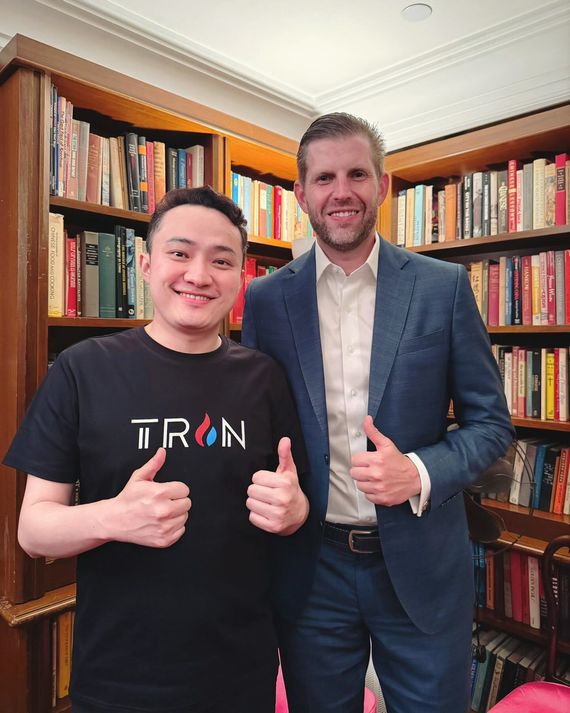
Sun with Eric Trump in 2025, shortly before $WLFI began trading publicly. Photo: Justin Sun/Instagram
But in an unexpected move, World Liberty released only 20 percent of each investor’s tokens. “Great, now we can sell some, but what about the rest?” says Christensen, who has become an unofficial spokesman for thousands of disgruntled $WLFI investors. When trading opened, many worried holders rushed to sell what they could. After a quick initial spike, $WLFI’s price went into free fall. By the end of the day, $WLFI was down 40 percent. Sun claims he didn’t sell any of his tokens, but that he moved 56 million of them — about one percent of the 4 billion he owned overall — into other crypto wallets after the price fell, “meaning the transfer could not have been the cause of the decline.”
Three days later, Sun says he woke up to find he was locked out of his entire World Liberty account. Even the 20 percent share that he should have been able to trade was gone, he alleges in his lawsuit. While his World Liberty tokens had been worth as much as $1 billion on paper, it was no longer clear that they were his. “My account got frozen completely,” he says. “I think I was in shock for a while. After all the trust and support I gave them, I couldn’t understand what happened.” It looked to Sun — who’d lost money in many a failed, hacked, or corrupt crypto project, from Mt. Gox to FTX — like a classic rug pull, cryptospeak for a scheme in which founders run off with their investors’ funds. “I was like, This is losing control, and I lost all confidence in the project.”
Sun says he soon discovered that World Liberty had powers he was unaware of and a level of control that is unusual for decentralized blockchain projects. On August 24, eight days before trading went live, the company had pushed through a change in its “smart contract” — the algorithm that automatically executes token transactions — giving World Liberty the power to freeze, and effectively seize, any investor’s tokens without warning. “In the dark of night, the company thus created a ‘blacklisting’ function that it could wield at will,” Sun would later say in his lawsuit. Or as he put it in a post on X, “This is a trap door marketed as an open door.”
Sun concluded that not only did World Liberty have no intention of returning his coins, it also planned to scapegoat him for its disastrous debut and, worse yet, try to get him in legal trouble with the Trump administration. World Liberty said in a post on X that a certain unnamed user — which many, including Sun, assumed was him — was “suspected of misappropriation of other holders’ funds.” (A representative for Sun says, “Justin would never have had the practical ability to misappropriate anyone’s funds, since he was just an investor and adviser, and was never in a position to access user funds.”) A few weeks later, around September 24, according to Sun’s lawsuit, Herro gave Sun a choice: He could publicly agree for World Liberty to “burn” (that is, destroy) his $WLFI, relinquishing his right to what was then $776 million in tokens, or World Liberty’s leadership team would call a vote among all token holders on whether to forcibly burn Sun’s holdings. Either way, Sun would never get his tokens back. Herro allegedly amped the pressure up further, threatening to report Sun to U.S. criminal authorities, claiming there were problems with the compliance documents he submitted when he first invested, according to Sun’s lawsuit, where he describes this as “extortion.”“As the claim alleges, there were repeated occasions where World Liberty, through Chase Herro, threatened to burn my tokens,” Sun says. “It was definitely not a pleasant experience.”
Even then, Sun held out hope he could patch things up without going to court. After all, he still thought highly of President Trump, who had loomed large in his life since childhood, when he’d learned English in part by watching episodes of The Apprentice in China.
But by early February 2026, many advisers to the company — minus those who had taken official positions at World Liberty — had distanced themselves from it. “I’m not aware of anybody who talks to them anymore,” says the former adviser, “after various dealings or misdealings that have occurred.” In getting involved, he had believed his expertise would help protect investors’ money. But he and other advisers were concluding that continuing to support World Liberty was a reputational liability. “I know for a fact a lot of other people had similar questions in their head: How much do I really want to be associated here and for how long?”
World Liberty had also wiped its team members off the “About” page of its website, erasing the stack of a dozen (mostly smiling) headshots — including the four Trump men, three Witkoffs, Herro, Folkman, and three other executives. Sun took the move as a tacit admission of guilt. “I think they know they are doing something wrong,” says Sun. “I think they want to hide behind names — either Trump’s name or my name.”
The Trumps, though, continued hawking their cryptocurrency as though nothing were amiss. Barron Trump, who, alongside his half-brothers, had initially been listed as one of World Liberty’s top team members (his official title: Web3 ambassador) but who had been silent on the project for months, piped up on X in late January to announce that World Liberty’s stablecoin had surpassed $4 billion in market value. “This is just the start,” he added. A few weeks later, in February, the two elder sons hosted a confab at Mar-a-Lago billed as the first World Liberty Forum, attended by a roster of A-list names including Nicki Minaj, Goldman Sachs CEO David Solomon, and fifa president Gianni Infantino. The pool was decorated with a giant version of World Liberty’s golden-eagle logo. Also on display were the many ways the Trumps were making money off their crypto enterprise: The family presented plans to finance the Trump Organization’s new hotel in the Maldives, featuring yachtlike floating villas, using World Liberty’s stablecoin. It was a “magical day,” Eric Trump told the New York Post.
Sun did not attend the conference but was in the process of finalizing his own deal with the Trump administration that would improve his fortunes in other ways. On March 5, the SEC announced a settlement of the case against Sun — the one involving Lindsay Lohan and other celebrity crypto promoters — begun almost three years earlier. The deal was very favorable for Sun. One of his companies, a lesser-known subsidiary called Rainberry, which operates BitTorrent, had to pay a fine of $10 million. It was, in Sun’s terms, less than two bananas. As part of the settlement, neither Sun nor any of his companies admitted or denied any wrongdoing; all the claims against Tron, and Sun personally, were dropped. Sun’s team has emphatically rejected the notion that his World Liberty investment greased the gears in Washington for the dismissal of his case, suggesting the timing was coincidental. But no one could argue that the investment had hurt Sun’s legal prospects.
For the Trumps, World Liberty continued to pay off on a historic scale. In April, CoinDesk reported that World Liberty had taken 5 billion $WLFI tokens from its treasury and used them as collateral to borrow $75 million in stablecoins. The company then sent those stablecoins to a Coinbase account, through which it could easily sell them on the open market. The maneuver appeared to give the World Liberty team an additional way to cash out — this time on tokens that were still technically frozen — not available to average $WLFI holders.
Similarly, Trump’s financial disclosure shows nine World Liberty transactions that look different from the others. These entries are labeled as sales of cryptocurrency-wallet “keys,” which the former World Liberty adviser says likely means the Trumps sold wallets containing frozen $WLFI tokens. The practice is not uncommon in the industry (the buyer acquires the tokens at a discount and intends to flip them for a profit in the future, after they are unlocked), but it was also not a viable option for most $WLFI holders, whose locked tokens weren’t even always visible in their own wallets (and who would probably have had to take a much steeper markdown than Trump). Together, these transactions represent nearly $291 million in income for the president.
Last summer, World Liberty made a deal with a company, Alt5 Sigma, that has funneled another $500 million to the Trumps. World Liberty took a controlling stake in the company, while Alt5 Sigma bought $1.5 billion worth of $WLFI tokens. But as the token price has crashed, Alt5 Sigma has lost more than 90 percent of its stock-market value, changed its name, and entered talks to sell its underlying business for as little as $15 million.
As $WLFI investors watched the token price continue to sink — down 80 percent at this point — they waited for news. “In my mind, the remaining tokens that are locked are worth zero,” says Christensen.
On April 15, World Liberty announced a proposal: The other 80 percent of investors’ $WLFI holdings would be unlocked and made available to them on an extended two-phase schedule, the first batch in 2028 and the second batch over the subsequent two years — meaning some coins would still be locked up after Trump is out of office. If the value of $WLFI was contingent upon Trump wielding presidential powers, as many believed it was, the timeline suggested a sizable share of the tokens could be worthless by the time investors got them back. Because World Liberty tokens carry governance rights, the proposal would be subject to a vote. But investors who voted against the proposal would “remain locked indefinitely,” the company announced. “The vote was kind of like a hostage situation,” says Christensen. “It was a Godfather-type scenario, gun to the head. ‘Here’s an offer you can’t refuse.’”
That’s when Sun says he made up his mind to file the suit against World Liberty accusing the company of fraud and breach of contract. He did so on April 21. The lawsuit was “a last resort to protect my rights and, I believe, the rights of other token holders,” says Sun. Not that he could have voted anyway; by seizing his tokens, World Liberty had revoked his voting rights. “It wasn’t just that my money would go to zero, but I felt like people were using my reputation basically to harm other investors without even having their name exposed to the public,” says Sun. “In my opinion, if World Liberty can do this to me — a billionaire who can afford to fight back — they can do it to anyone.”
In the world of crypto, Sun’s fight against World Liberty was a kind of joke — an occasion for Schadenfreude for all those who had warned their peers to stay away. “Anyone I know that got involved with the project just did it because they knew Trump was enough of a crook to not let this fail,” says the longtime crypto investor who did not invest. “That anybody could be surprised by what has happened is the only shocking part.”
World Liberty itself tried to brush off Sun’s claims. “The only thing more ridiculous than this lawsuit is spending $6 million on a banana duct-taped to a wall,” Eric Trump posted on X the day after Sun filed his complaint. “We are incredibly proud of the @worldlibertyfi team.” Zach Witkoff expressed optimism that the case would quickly be thrown out, calling it “a desperate attempt to deflect attention from Sun’s own misconduct.” (The commenters did not exactly agree. “You don’t blacklist wallets cause you feel like it motherfuckers,” reads one of the most popular replies.) The same day Witkoff made his post, the body-cam footage of his Miami arrest four years earlier suddenly appeared online. (Those charges were dropped.)
It was true that Sun has a reputation in the crypto world for being a little shady, as some of his milder critics put it. And many in that industry dismiss the claims as a pot-versus-kettle situation. “It’s scammers scamming scammers,” more than one crypto investor told me. The former World Liberty adviser said the scenario reminded him of the meme in which two Spider-Mans point at each other.
But the lawsuit is not just about the money, Sun insists. In the scheme of his ten-to-11-figure wealth, the $45 million Sun put into World Liberty is equivalent to what your average millionaire might spend on a modest vacation. And Sun is no stranger to the risks involved with venture capital or angel investing. The decision to sue, he says, was about the principle and his reputation more than anything else. “Once I think I know that something goes wrong, I need to tell people what happened before more people get impacted,” says Sun. “I think it’s more about my moral obligation. I felt I need to just call it out.” For him, calling it out meant posting on X just before he sued: “I denounce the ongoing token scandals by the bad actors at $WLFI.”
Privately, other major World Liberty holders took Sun’s side, though they were afraid to say so publicly. To them, the promise of World Liberty had been a bait and switch. What had initially appeared as an America-approved decentralized cryptocurrency with strong profit potential was in fact what Wall Street calls a roach motel — an investment where money goes in but never comes out. “Justin is more credible,” says the former World Liberty adviser. After all, this person had experienced many of the same issues with his tokens as Sun. “The team and advisers are locked up completely,” he says. “That is a unilateral modification that was not contemplated or agreed upon.”
In his lawsuit, Sun does not name Trump or his sons — other than to say he remains an “ardent supporter of President Trump and the Trump family” — but the decision to sue is still politically dangerous for him. The Trump administration wields power over whether to prosecute or pardon him. Sun seems willing to make that gamble. “I know a lot of people close to Justin have told him, ‘Don’t do this,’” says a person in Washington who has advised Tron. Trump would take World Liberty’s side in the fight, they warned. But Sun wasn’t moved. “This is not a political issue,” Sun told this person. “These guys are like young punk criminals. This kind of stuff is what gives the industry a bad name. You gotta stand up for what’s right, no matter what.”
One early crypto executive, who received his own pardon from Trump, advised me to take anything Sun says “with an enormous grain of salt.” But, he added, “he’s putting his whole shtick at enormous risk by breaking with Trump.”
On May 4, a couple of weeks after Sun filed his suit, World Liberty sued him for defamation. Represented by the law firm Clare Locke, which successfully sued Fox News over its “big lie” coverage following the 2020 election, World Liberty tells a different version of events. Though sections of its accusations are redacted, World Liberty claims in the suit that it froze Sun’s coins to “protect” itself and its investors from prohibited conduct by Sun. Just before the $WLFI tokens started trading, the company alleges, Sun placed a large bet against them, transferring $300 million “to fund an aggressive short position.” It also claims Sun made “straw purchases” on behalf of other investors. Notably, though, World Liberty did not sue Sun for breach of contract or fraud. “I believe that World Liberty is trying to threaten me into silence, but that will not work,” says Sun. “I stand by the decision to speak out about conduct that I believe was improper and harmful to token holders.” He’s determined to take the case to trial: “I believe the evidence will prove our allegations to be true.”
No matter the outcome of the dueling legal actions — both are still in preliminary stages (in June, World Liberty filed a motion to dismiss Sun’s case) — the Trumps have raked in a quantity of crypto winnings that will sustain them, and their potential future political endeavors, for generations to come. Reading through the 927-page financial-disclosure report released by the Office of Government Ethics on June 30 can feel overwhelming — all those eight- and nine-figure transactions, all those crypto assets, all those highly creative monetization practices.
Meanwhile, on Capitol Hill, the U.S. Senate is focused on trying to pass a law that would create a regulatory framework for cryptocurrencies. The so-called clarity Act has consumed a huge amount of Congress’s time and energy over the past year and is being pushed by the same industry donors that filled up Trump’s campaign coffers in 2024. The act would give crypto strong legal protection going forward — a dream scenario for a sector that was on the ropes before Trump’s second term. As of late July, the main sticking point to getting enough votes in the Senate is language that would bar all government officials — including the president — from selling cryptocurrencies. Observers are not optimistic that Trump will agree to the kinds of restrictions that would be required to get the necessary Democratic votes. The crypto industry might yet come to realize the downside of being in business with Donald Trump.
Thank you for subscribing and supporting our journalism. If you prefer to read in print, you can also find this article in the July 27, 2026, issue of New York Magazine.
Want more stories like this one? Subscribe now to support our journalism and get unlimited access to our coverage. If you prefer to read in print, you can also find this article in the July 27, 2026, issue of New York Magazine.