Voting By Phone Is Already Here. Meet The Democratic-Linked Group Trying To Take It National.
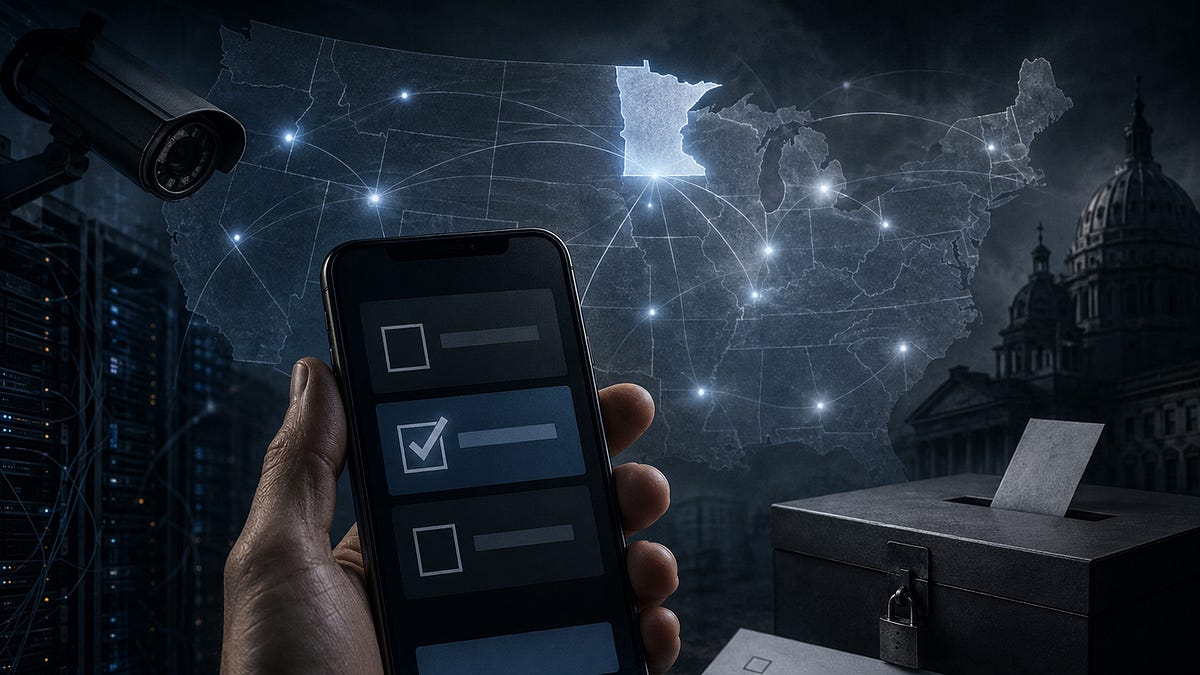 The Vote-By-Phone Machine Comes For Minnesota
Minnesota is now the latest test site for one of the most radical election experiments in America: voting by phone.
A bill introduced in the Minnesota House this spring, HF4962, would write “mobile voting technology” into state election law, defining it as an application on a mobile device used to “complete and submit a ballot” in a secure and encrypted manner. It would also allow voters in jurisdictions that authorize the technology to receive ballots, instructions, and certificates of voter eligibility electronically, then return the ballot electronically through the same system.
Translated out of legislative jargon, Minnesota lawmakers are being asked to open the door to app-based ballot return.
This is not an isolated local reform. It is part of a national campaign.
The Mobile Voting Project, the group pushing this agenda, openly lists active campaigns in Colorado, Maryland, Minnesota, New Jersey, Vermont, and New York City. Its own materials say 330 jurisdictions have piloted mobile voting since 2018, while 13 additional states permit voters with disabilities to return ballots over the internet.
Bradley Tusk, the founder of the Mobile Voting Project, is a venture capitalist and political operative. He has deep ties to Democratic politics, including managing Michael Bloomberg’s 2009 mayoral re-election campaign in New York City and serving as communications director for Senator Chuck Schumer.
The organization’s CEO, Sheila Nix, also comes from the highest levels of Democratic politics. Nix was Kamala Harris’s 2024 campaign chief of staff, Jill Biden’s former chief of staff during the Obama administration, and a former deputy assistant to President Obama.
In New Jersey, the political network is even more direct. A bill sponsored by State Senator Brian Stack, S4163, and its Assembly counterpart, A4960, would create a municipal mobile voting pilot program. Tusk is the brother-in-law of Rep. Josh Gottheimer, one of the state’s highest-profile Democratic members of Congress. Gottheimer is married to Marla Tusk, who serves as general counsel at Tusk Strategies, the consulting firm founded by Bradley Tusk.
The case being sold in New Jersey is the same case being sold in Minnesota and elsewhere. Low turnout. Local elections. Accessibility. Modernization. Trust the app.
The security case is much weaker.
In February, more than 20 computer scientists published a rebuke of the Mobile Voting Project and VoteSecure, arguing that claims about the technology’s security are “untrue and dangerous.” The review stated that “VoteSecure isn’t a complete, usable product, it’s just a ‘cryptographic core’ that someone might someday incorporate into a usable product.”
Andrew Appel, professor emeritus of computer science at Princeton and the lead author of the review, said the scientific consensus has been clear for decades.
“For the last 20 years, it is a well established scientific consensus that internet voting is too insecure for public elections, unless some miraculous new technology is invented. People have been working for 30+ years on such technologies, and no such breakthrough has arrived, or is likely to arrive any time soon. Mr. Tusk should not use VoteSecure as a pretext to promote unsafe internet voting.”
That warning is not coming from election-integrity activists. It is coming from computer scientists.
Yet the project continues to move through state legislatures, municipal governments, and elite democracy-reform circles.
One of the clearest examples came recently from Stephen Richer, the former Maricopa County recorder, who published an April 2026 essay for The Democracy Project making the case for cellphone voting as a solution to a wide range of election-administration problems.
Richer argued that the “most obvious beneficiaries of cellphone voting are the voters themselves,” because it would mean “no more standing in line,” “no more worrying about the weather,” “no more worrying about hurricanes,” “no more worrying about showing up at the wrong polling location,” and “no more forgetting your identification in your wallet that you left in your other car.”
The last example is the tell.
One of the alleged benefits of cellphone voting, according to one of its own defenders, is that it eliminates the problem of voters forgetting identification. A basic safeguard of in-person voting is being recast as a design flaw.
Richer also argued that cellphone voting could accommodate limitless ballot languages because “Americans speak over 350 languages” and most jurisdictions print ballots in only one or two languages. He invoked environmental concerns as well, writing that he felt guilty that Maricopa County “killed a rainforest every time we ran an election,” and citing Runbeck Election Services’ estimate that it uses approximately 6,000 miles of paper for presidential elections.
This is not a narrow case for disabled voters. It is a case for replacing the basic architecture of American elections: paper ballots, polling places, physical custody, local procedures, and public observation.
Richer made the political stakes explicit when he argued that cellphone voting would “fix the parade of horribles that many fear from the Trump administration this fall.”
“ICE at polling places doesn’t matter if people vote on their phones,” he wrote. “If there are no mail ballots to disrupt, then it hardly matters that Trump might test the independence of the United States Post Office. It no longer matters if Tulsi Gabbard seizes ballot tabulators in Puerto Rico, the FBI takes election materials in Georgia, or Sheriff Chad Bianco seizes ballots in Riverside, California.”
That is the real argument. Cellphone voting does not simply make voting easier. It routes around polling places, mail ballots, ballot tabulators, election materials, and local conflicts over physical election infrastructure.
For election-integrity advocates, that is precisely the problem. The features being treated as outdated friction are the same features that make elections tangible, local, auditable, and observable.
The public has seen this sequence before. Mass mail-in voting was sold in 2020 as an emergency pandemic measure. In many states, it became permanent infrastructure.
Now the same political class is asking Americans to accept a far more radical premise: ballots cast through phones, transmitted through internet-connected systems, and secured by technical assurances the average voter cannot meaningfully inspect.
The question is why a Democratic-linked political operation is pushing to move American elections deeper into the custody of software vendors, election-technology nonprofits, political consultants, cryptographic experts, and elite institutions that have spent years dismissing election-integrity concerns as illegitimate.
Please consider subscribing to stay alerted to critical stories like these.