EXCLUSIVE: Inside The Left’s Plan To Turn Homeless Encampments Into Voting Blocs.
A progressive nonprofit is bankrolling a 2026 election initiative designed to mobilize homeless Americans as a powerful voting bloc.
The campaign, Our Homes, Our Votes, is housed inside the National Low Income Housing Coalition. Its own materials describe it as a campaign to “register, educate, and mobilize” low-income voters and housing advocates, including organizations in the “housing and homelessness field.”
The pitch is straightforward: homelessness and housing providers already have access to populations the left wants to turn out. Now, Our Homes, Our Votes is giving those providers money, training, voter-data guidance, mail-ballot instructions, Election Protection referrals, and model legislation.
Beat the censors. Subscribe directly. For Free.
The campaign’s 2026 guide says organizations serving homeless and low-income populations should make voter engagement part of their daily work. “To increase political participation and build the political will for bold housing solutions,” the guide states, “housing and homelessness organizations must bring voter engagement to the forefront of their work.”
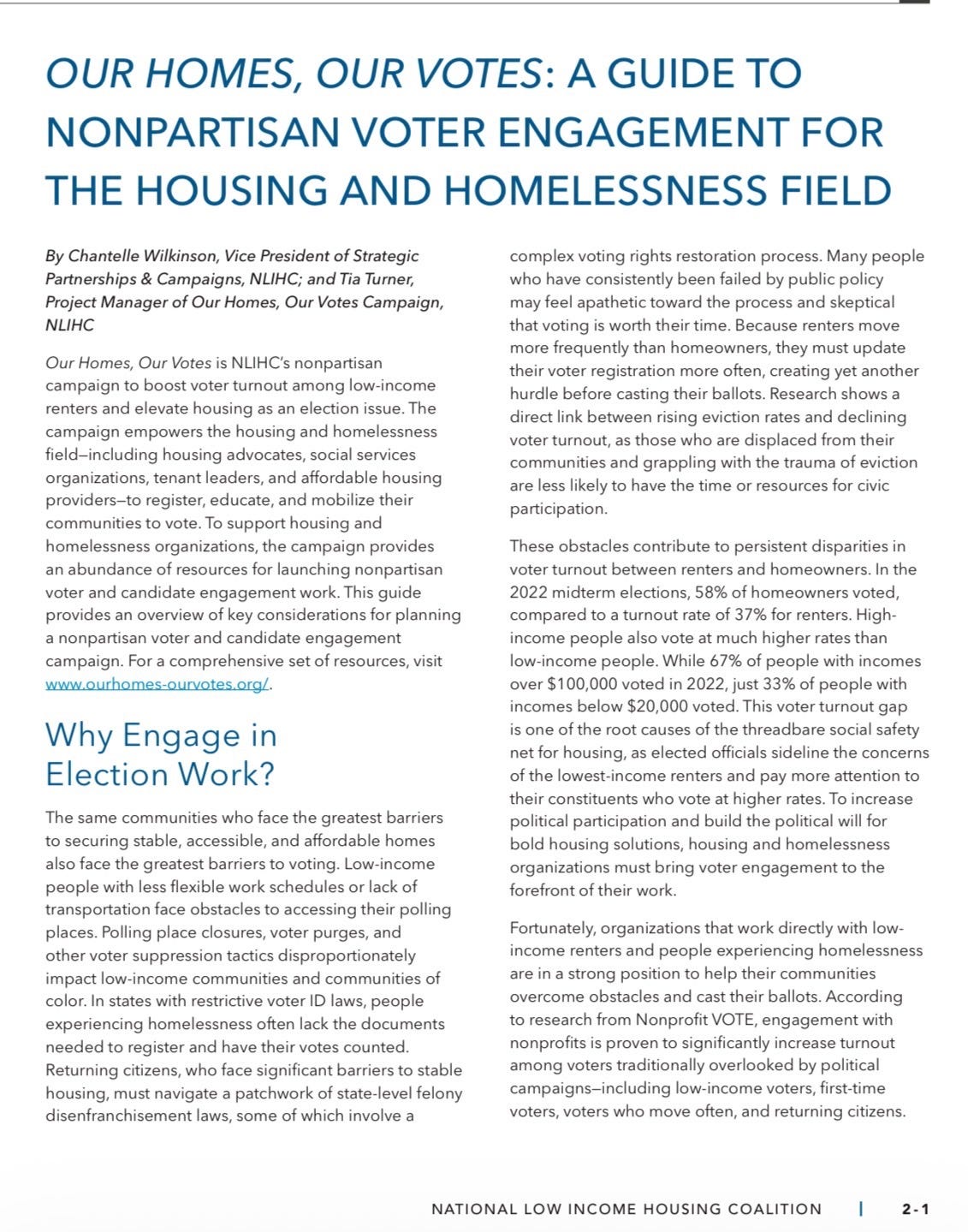
That means more than handing out registration forms. The guide tells organizations to use voter files to identify registered voters, target outreach, and measure success. It specifically names VAN and PDI, campaign-style data tools used to sort voter information and target voters.
It also tells housing providers to build voter registration into ordinary administrative processes. The guide recommends adding voter-registration forms to welcome packets, checking registration during annual income recertification for subsidized housing, and contacting residents on their 18th birthdays to help them register.
The most controversial section concerns people experiencing homelessness. The guide says the National Voter Registration Form allows an individual without a traditional address to designate “an outdoor place where they regularly stay” as their residence for precinct purposes. It then adds: “Shelters and social services agencies should also consider allowing clients to use their addresses and to receive mail-in ballots at their sites.”
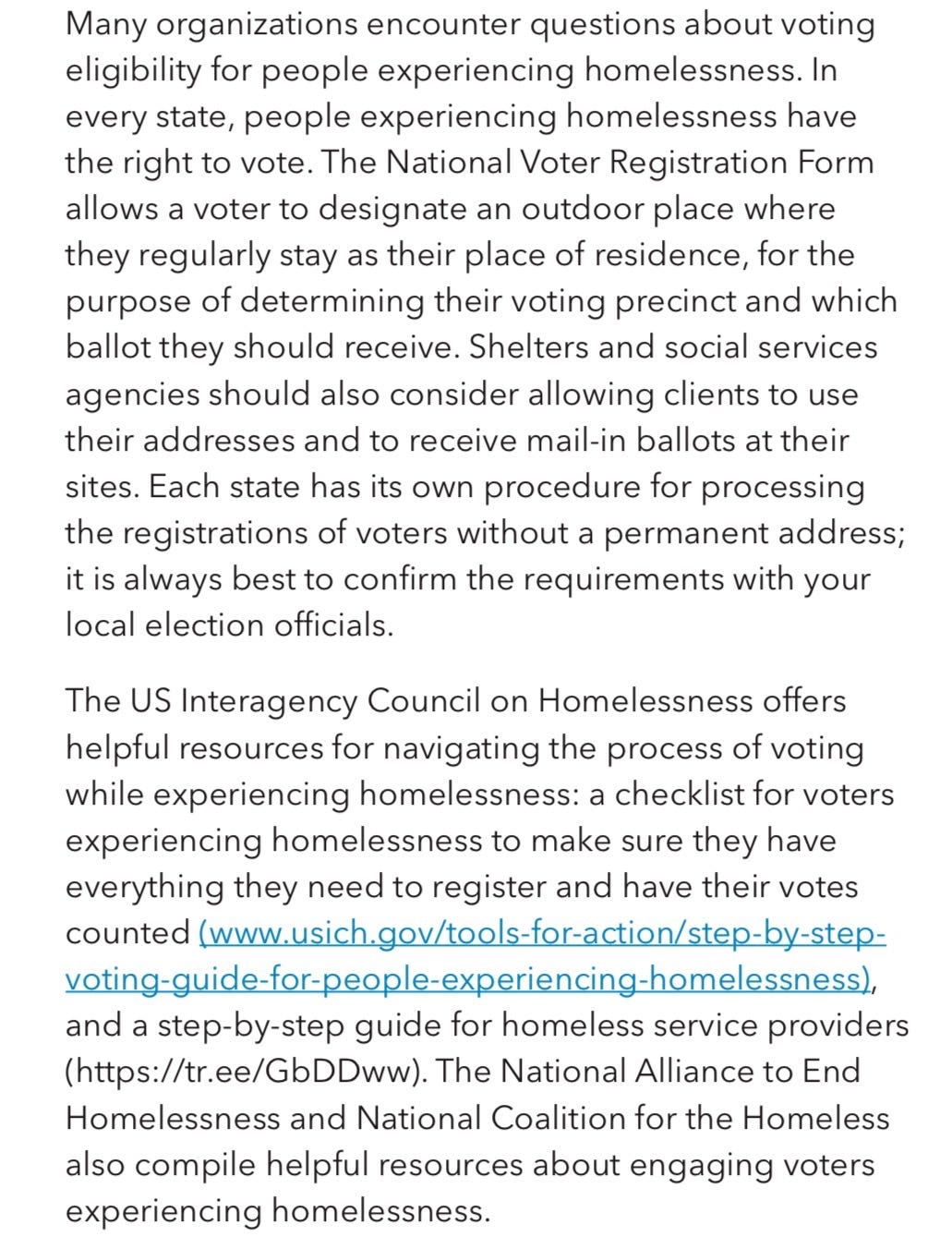
That is the heart of the operation: not just registering homeless voters, but encouraging the shelter and social-service system to become part of the address and mail-ballot infrastructure.
The guide also tells groups to encourage vote-by-mail and early voting, “keep a list of mail-in voters” in their network, and contact those voters at least ten days before Election Day to make sure ballots are mailed in time to be counted.
Our Homes, Our Votes is now funding this model. NLIHC announced that 50 organizations were selected for 2026 mini-grants of $1,500 each after a competitive review. The recipients include “local housing and homelessness advocacy groups,” “community-based service providers,” “grassroots collectives,” and “nonprofit civic engagement partners.”
NLIHC says the grants are meant to help groups “register, educate, and mobilize low-income renters and unhoused communities to vote.” Planned activities include voter-registration events, nonpartisan canvassing, staff trainings, voter ID assistance, and resident-focused civic education. Grantees also receive technical assistance and an Our Homes, Our Votes “swag kit.”
This did not begin in a vacuum. The Biden administration helped normalize voter engagement through the federal housing system.
President Biden’s Executive Order 14019 directed federal agencies to promote voter registration and election access. HUD then circulated guidance telling public housing agencies and HUD-funded recipients that they were “permitted—and actively encouraged!” to facilitate nonpartisan voter-engagement activities.
NLIHC later described the Biden HUD guidance as encouraging public housing agencies to include voter-registration applications in program applications and recertification materials, become voter-registration agencies, permit nonprofit voter-registration groups on property, and display voter-registration materials.
The Trump administration rescinded older HUD voter-registration guidance in 2025. NLIHC responded by telling partners that the rescission did not prohibit voter-registration work and that providers should continue incorporating registration into “day-to-day processes” such as intake, training sessions, and resident-association meetings.
The legislative agenda goes even further.
The Unhoused VOTE Act would require states to allow a person living in a homeless shelter to use that shelter as a residence for voting in federal elections. NLIHC says the bill would also treat emergency shelters as voter-registration agencies, requiring them to distribute voter-registration forms, assist applicants, accept completed forms, and transmit them to election officials. The bill would also allow unsheltered individuals to register using a street location as their residence and create federal grants to expand voting access for people experiencing homelessness.
A related bill, the Our Homes, Our Votes Act, would add public housing agencies and HUD-assisted housing providers to the National Voter Registration Act, commonly known as Motor Voter. NLIHC says the bill would allow residents in PHA-assisted housing to register when they sign leases or recertify incomes, require annual voter-registration training for PHA staff and landlords, and designate certain federally subsidized housing owners as “voter registration agents.”
The money trail is more revealing than a generic donor list.
Public grant records show the National Immigration Law Center gave NLIHC $110,000 for “Protecting Immigrant Families,” tying the housing group’s orbit to one of the country’s major immigrant-rights legal nonprofits. NILC describes itself as dedicated to advancing the rights and opportunities of low-income immigrants, while its political sister organization, the NILC Immigrant Justice Fund, says it works to encourage “full participation of low-income immigrants in the democratic process.”
New Venture Fund also funds NLIHC, the parent group behind the effort, and is one of the best-known vehicles in the left’s nonprofit infrastructure. The Atlantic described the Arabella network around groups like New Venture Fund as part of the “progressive movement’s empire of political cash.”
The right to vote is not the controversy. Homeless Americans who are eligible citizens have that right.
The controversy is the left’s attempt to turn the homelessness-service system into a 2026 voter pipeline: shelters as addresses, shelters as mail-ballot sites, emergency shelters as voter-registration agencies, service providers as registration workers, housing groups using voter files, and grant-funded outreach targeting unhoused communities before the midterms.
Subscribe for what they don’t want you to see.