The FIFA World Cup: Price Controls on Ticket Prices?
The 2026 FIFA World Cup, this year’s quadrennial event, is being held in North America. The last time that happened was way back in 1994, so it’s no surprise that demand for tickets has been unlike anything seen at previous World Cups. That gap in the number of years—32 years—since a World Cup was played on North American soil, is quite similar to the number of years it was, 27 years, since a New York Knicks NBA Finals appearance. And, with such an extended North American break for the world’s biggest sport’s competition (~1.5 billion people tuned in for the 2022 World Cup final), comes a feverish demand.
Resale ticket prices for each tournament round are, on average, going for roughly 5x their original face value. The resale ranges for the upcoming Quarterfinal and Semifinal rounds are $2-10K and $4-20K, respectively, with the Final’s range going for a gargantuan $10-40K. It’s apparent that in a sport where the average viewership of a World Cup match was 175 million in 2022, the resale ticket prices are going to reach heights that appear ridiculous at first glance, especially when, no pun intended, they are taken at face value.
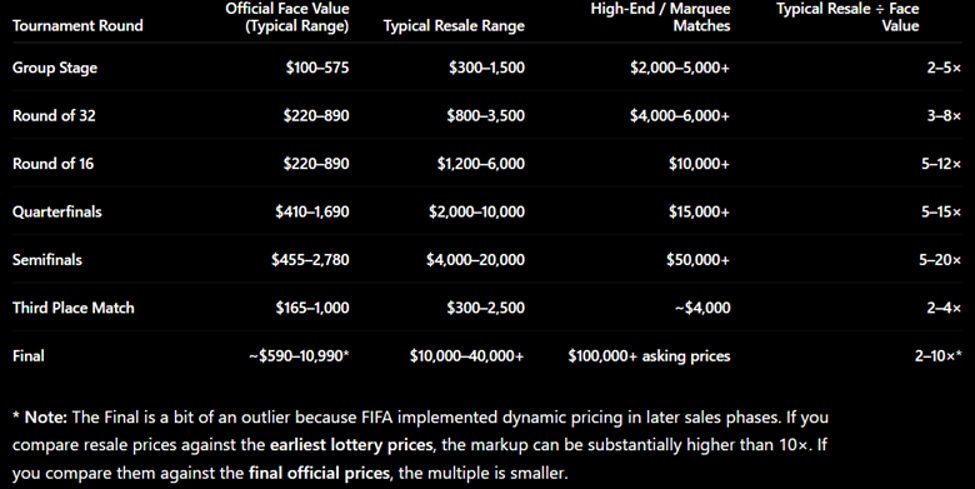
The World Cup is clearly different from any other sporting event in the world, and just because resale ticket prices may appear outrageous in the days leading up to a highly-anticipated match does not mean they won’t fall back down to Earth some, as happened with Team USA’s match against Bosnia in the Round of 32. On the other hand, the Round of 32 matchup between Portugal and Croatia saw a smaller drop in resale ticket prices prior to that match’s kickoff. Prices are constantly fluctuating based upon their supply and demand, and no two World Cup matches are entirely the same (they can feature different times, weather, venues, seating capacities, cities, nations, fanbases, players, storylines, significance, etc.), so prices will vary.
The Round of 32 match between Portugal vs. Croatia was played in Toronto, where, ironically, the province of Ontario passed a law earlier this year capping ticket resale prices, called the “Putting Fans First Act.” This law made it illegal for “tickets to concerts, cultural, sports and other live events in Ontario to be re-sold for more than their original cost.” By doing so, Toronto became the only World Cup host city of the 16 across North America (not even Vancouver in the Canadian province of British Columbia) to be burdened by an anti-scalping law to “protect fans and consumers from exploitative, professional resellers who artificially drive up ticket prices.”
The province of Ontario passed a similar law in 2017, prohibiting resale tickets from being sold for more than 50 percent of their original face value. This more relaxed cap was scrapped in 2019 and Sports Fans Coalition, a grassroots fans advocacy organization, found that contrary to the rationale behind the 2017 law, actually “across Toronto’s four major professional sports teams, fans saved more than $10 million from 2021 through 2025 by buying resale tickets below face value, and that nearly 43 percent of Blue Jays resale tickets sold below face during that period.”
Anti-scalping laws, which aim to cap ticket resale prices, are nothing new. In fact, as this 2010 Cato Institute study explains, the US states of Minnesota, Missouri, New York, and Pennsylvania all had some form of price caps for resale tickets throughout the 20th century, New York and Pennsylvania for nearly the entire century, until each of the states repealed its anti-scalping laws in 2007. These were a few of the last US states to repeal these laws, and the impetus behind the repeal for these states was due in large part to technological innovations spurred on by the internet, with advocates for repeal arguing it would move reselling from the “shadowy world of scalpers to the more transparent one of the Internet, increasing the intensity of competition and leading to lower ticket prices.”
In this insightful article covering the new Ontario law, it’s noted that the law does not regulate primary-market pricing, as it applies only to what happens after the initial sale, meaning primary sellers remain free to price dynamically based on demand, timing, and other factors. Those prices then become the legal ceiling for resale, which of course begs the question of how exactly it is fair to resellers, the secondary sellers, that they must sell at a cap, but the primary sellers don’t have to? Why stop there? Why not impose a price control on the primary sellers too? This is just the kind of second-order thinking Mises brilliantly lays out in his classic 1929 book A Critique of Interventionism.
Mises warns about the ripple effects of price controls, stating:
It can thus be readily seen that it is inconceivable to resort to price controls as an isolated intervention in the private property order. Government is unable to achieve the desired result, and therefore finds it necessary to proceed step by step from the isolated pricing order to comprehensive control over labor, the means of production, what is produced, how it is produced, and how it is distributed. . . He who observes a war economy is clearly aware of the phases mentioned above: at first price control, then forced sales, then rationing, then regulation of production and distribution, and, finally, attempts at central planning of all production and distribution.
As the 2010 Cato Institute study found, maximum price controls on resale tickets are near impossible to enforce due to the pervasiveness of the internet, so the result of these laws is to turn a peaceful and seamless legal market into a fragmented underground black market, and as the aforementioned Sports Fans Coalition group explains, “when regulated resale marketplaces are constrained, ticket transactions do not disappear but instead migrate to informal channels such as social platforms, private handoffs, or other less-protected environments.” Hence, the resale ticket market is pushed underground, as a substantial number of buyers and sellers will still desire to trade, finding ways to evade restrictive government price controls.
Turning a legal market into a black market is not something I would call “putting fans first,” as the name of the Ontario act implies. The fact is that black markets emerge to meet the still very real demand of customers. If one knows anything about the 13-year prohibition era in the United States or the never-ending now 55-year war on drugs, black markets create a whole new swath of problems, some of which can lead to literal death and destruction for both the buyers and sellers involved, bringing forth scares and tragedies that would never happen if certain markets were kept legal or made to be legal.
The Round of 32 match played in Toronto between Portugal and Croatia, which I had shared figures on from the resale market, did indeed have resale tickets selling above their original face value, even though this market had been “banned” by the new Ontario law. Predictably, as previously mentioned, anti-scalping laws in the day of the internet (and now instant mobile ticket transfers) are incredibly difficult to enforce, regardless of whether the laws’ punitive non-compliance penalties include court-ordered fines of up to $50,000 for individuals and $250,000 for corporations.
To abide by the law, FIFA did what it was compelled to do: cap resale ticket prices at their original face value on its official marketplace website. However, FIFA could not prevent individual resale sellers from listing their tickets on other secondary resale platforms (e.g., StubHub, SeatGeek, Vivid Seats, etc.). Since many of the sellers were located outside Ontario’s jurisdiction and many of the secondary resale platforms are headquartered elsewhere, the inevitable lack of enforcement was obviously a motivating factor in both the sellers’ and platforms’ circumvention of the new law.
It really doesn’t get any clearer that the attempt at trying to control a largely digital resale ticket market, and an international one at that—for the biggest sporting event in the world—when all of the other 15 host cities across the continent are not beholden to such draconian price control laws, was an exercise in futility, hubris, and ignorance by the Ontario government.
Allow this to be a lesson for all sports fans around the world: the price of resale tickets, as with any other product on an open market, is determined by the supply of that product and the intensity of demand for it. There is nothing unfair about prices; they are an impersonal economic reality arising from the law of supply and demand, mixed with the subjective theory of value.
So, the next time a politician declares the need to magically legislate away an economic reality, as in the case of placing price controls on World Cup resale tickets, consider them to be just as obtuse and foolish as someone who were to claim they can defy the laws of gravity.
It’s a beautiful game, and it can be a beautiful world too. Let markets reign.