Mythbusting Before the Midterms, Part III: Lessons from 2024
Welcome to part three of our three-part series on the campaign myths Democrats need to ditch before November. Catch up with the first two posts on campaign tactics and lessons from 2024.
Last month, the Democratic National Committee released (okay, it leaked, so they released it, but whatever) its long-awaited “autopsy” of Vice President Harris’ 2024 election loss. Clearly, this product left more questions than answers—no one was satisfied. But, to me, what’s just as notable is how strongly rank-and-file Democrats have been demanding such an autopsy or after-action report throughout the past year. That doesn’t come from a place of schadenfreude or to finger-wag; instead, I think it underscores just how nervous Democrats are about properly identifying the strategic mistakes that doomed the Biden/Harris campaigns, and how desperate we are to avoid making them again, both in the 2026 midterms and beyond.
I get it. I’m nervous, too. That’s why, over the past month, I started discussing some of the most common myths that have plagued Democratic campaigns and hurt our strategic planning for far too long. In Part I of my Mythbusting series, I talked about some of the least effective tactics our candidates continue to rely on. In Part II, I wrote about long-pervasive messaging that isn’t resonating with the swing voters Democrats need to win. Given all the attention and focus on the lessons of 2024 right now, I’ll use this last post in the series to break down four more myths that I saw undermine our party throughout the 2024 presidential election cycle–and that I worry are again seeping into our collective 2026 and 2028 thinking.
To be clear: I’m not saying these are the four biggest issues Democrats faced in 2024, or that they were unique to Kamala Harris’ campaign, or that they are the principal reasons the Vice President lost. What I am saying is that I still see these four myths pervade the logic of a lot of our party’s candidates, strategists, and stakeholders, and that we all need to rid ourselves of these fallacies before they jeopardize the momentum Democrats are carrying into the midterms and the coming presidential cycle.
Myth #1: Demographics Will Save Us In The Long RunFor over two decades, a certain strain of Democratic thinking has operated on the belief that “demographics is destiny”—the idea that growing populations of Latino, Black, and young voters would inevitably turn a bunch of previously unwinnable states, like Texas, Arizona, Nevada, and Florida, reliably Blue. The idea dates back to the 2002 book The Emerging Democratic Majority, by political scientists John B. Judis and Ruy Teixeira, and it was reinforced by Barack Obama’s victories in 2008 and 2012. (This is no criticism of the authors; Ruy especially has done yeoman’s work in charting a new path for the party.)
If Donald Trump’s victory in 2016 made the flaws of this theory clear, then his 2024 election delivered a death blow to it—even by the original authors’ own admission.
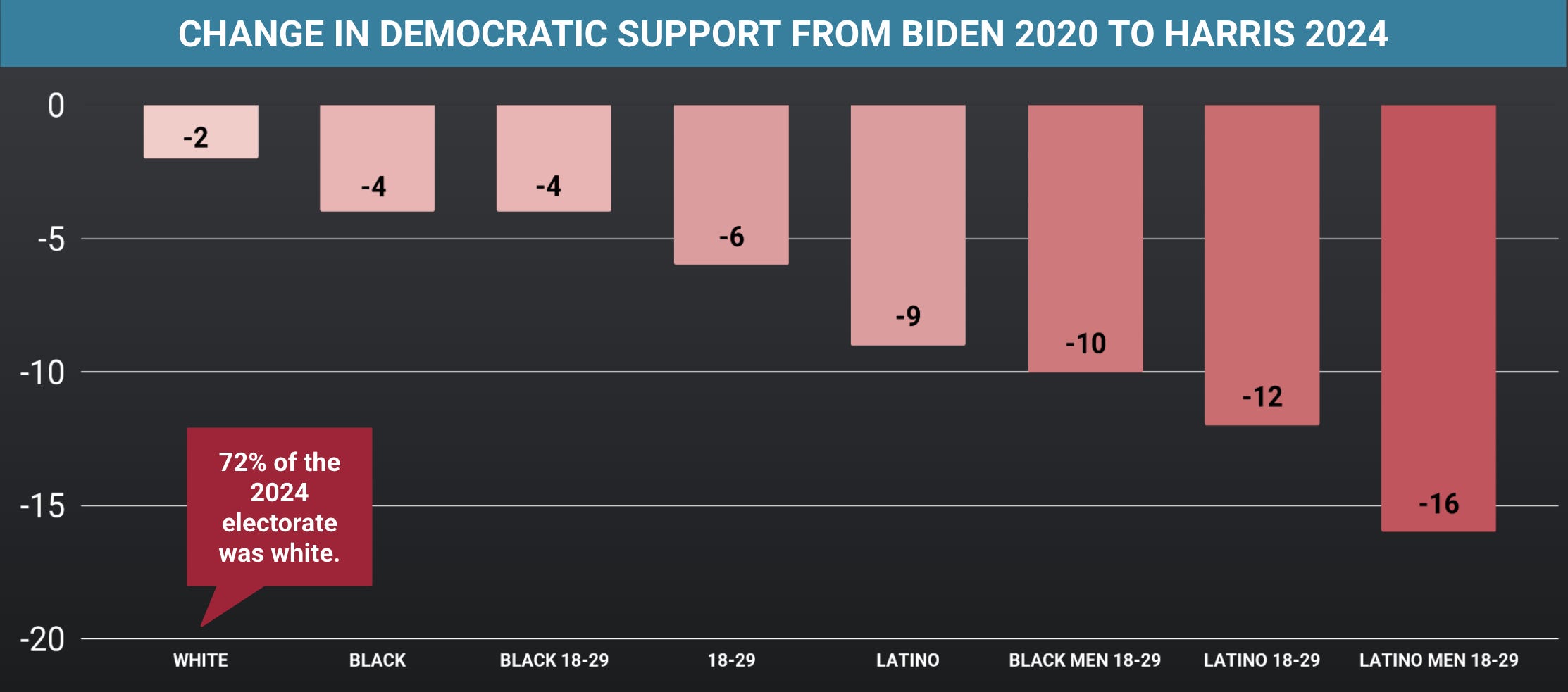
Trump made significant gains across virtually every gender and racial group in 2024. He battled to near parity with Hispanic voters, winning 48% of their vote compared to Harris’s 51%. That’s a jaw-dropping shift from 2020, when Joe Biden won Hispanic voters by 25 points. Joe Biden won Hispanic men by 18 points—Harris lost them by two points. Among Black voters, Trump nearly doubled his support, going from 8% in 2020 to 15% in 2024. Young men went for Donald Trump by 14 points in 2024, 56% to 42%.
 Source: Catalist
And it’s worth noting that, all these years later, white voters are still the largest voting bloc in America—72% of the electorate in 2024, the same as in 2020. Harris and Biden both lost these voters by 12 points.
Demographics won’t lead our party to the promised land. And even if they could, providence would be a very, very long way off.
Yet despite overwhelming evidence to the contrary, I fear our party risks falling into that same trap again as we head into the 2026 midterms. In a vacuum, recent polling looks encouraging for Democrats: Trump’s approval among Hispanic voters has cratered. Trump is underwater among Hispanic voters—70% to 29%. And Trump’s net approval rating among Black voters has collapsed to just 14%. But the takeaway for Democrats shouldn’t be that these voters have come home for good. It should be a reminder that every demographic group can swing between parties at the ballot box. These voters responded to economic anxiety and a sense that Democrats weren’t speaking to them in 2024. They’re souring on Trump now, because his agenda is causing them real pain.
Their votes in 2026, 2028, and going forward are winnable. But Democrats have to go out and earn them, over and over again. And that means treating these voters as persuasion targets and not turnout targets, a crucial distinction. That means making a very clear case on how we will make people’s lives demonstrably better.
Thanks for reading The Messina Memo! Subscribe to receive the latest from Jim and team.
Myth #2: What Works In A Midterm Will Work In A Presidential—And Vice VersaIn 2022, Democrats bucked the historic trend and defied widespread predictions of a coming “red wave,” driven by surges in suburban and college-educated women’s turnout. MAGA’s ongoing threat to democracy and abortion rights in the wake of the Supreme Court’s overturning of Roe v. Wade were both dominant issues. Voters who said the Supreme Court overturning Roe was the single most important factor in their vote went more than 2:1 for Democratic candidates—and about a quarter of voters said the Court’s decision was the single most important factor in their midterm vote. We expanded our majority in the Senate, we limited House losses to a narrow Republican majority, and we entered the 2024 cycle with a genuine sense of hope and momentum.
And so, two years later, we…more or less ran the same play. Democrats centered our 2024 messaging heavily on protecting abortion access and framing Republican candidates as “MAGA extremists” who posed a threat to democratic norms. We focused on turning out our base. But the problem was, the game we were playing had fundamentally changed.
Too many Democrats forget that the electorate that turns out for a presidential cycle every four years is not the same electorate that votes in a midterm–and the difference matters enormously for how campaigns should operate.
Midterm electorates are, on average, about 3% whiter than presidential electorates, 9% older (skewing heavily 45-and-up), and 4% more college-educated. That’s a structurally different audience, and they respond differently to messaging, consume media differently, and prioritize different issues.
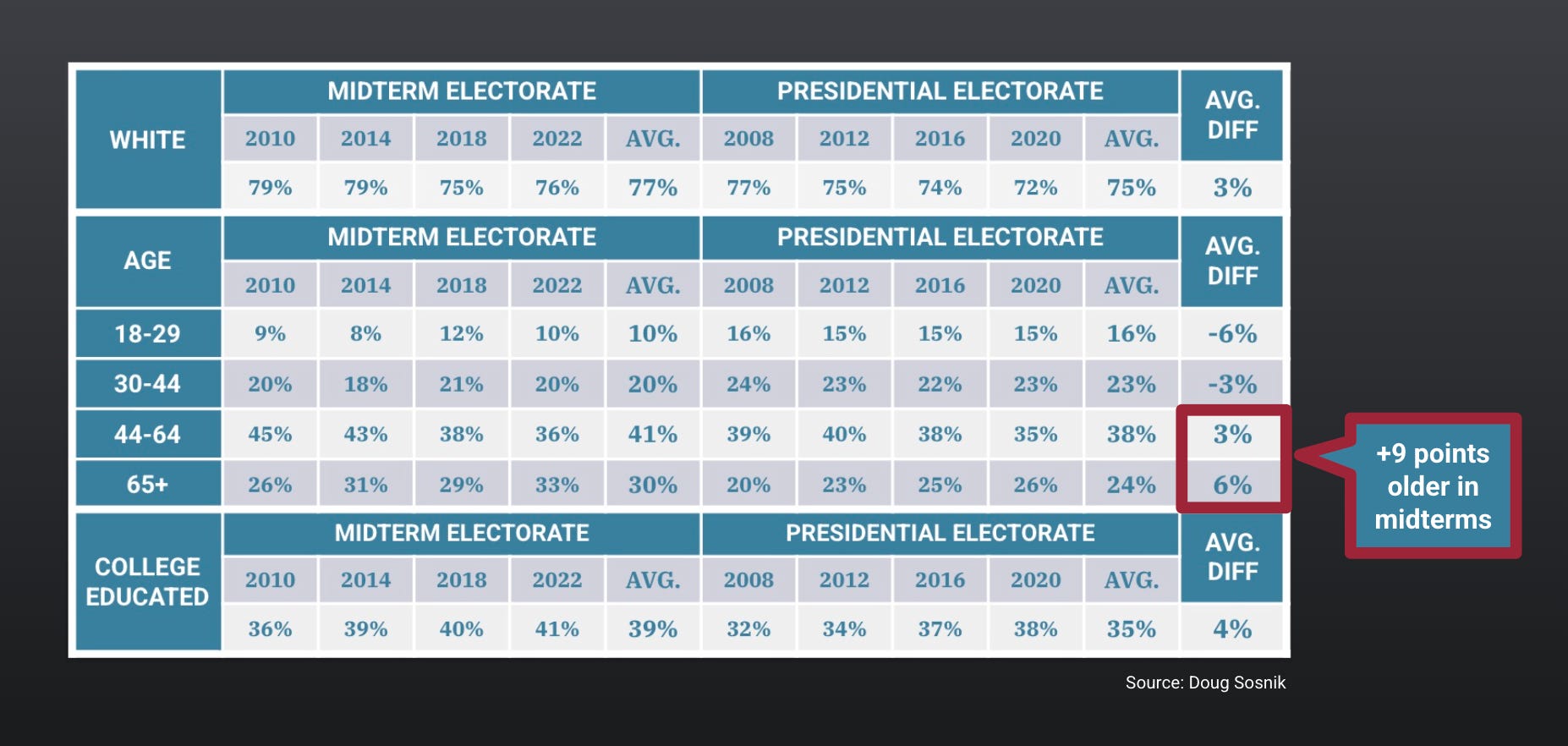 Midterm and Presidential electorates have different compositions, requiring different messaging, tactics, and strategy. Source: Doug Sosnik
In 2024, the expanded presidential electorate brought in more young voters, more working-class voters without college degrees, and more voters of color–groups who were more economically anxious and less receptive to a campaign that often felt more focused on Trump’s character than their kitchen-table concerns. Abortion was a powerful motivator in the constrained, high-information midterm electorate of 2022. It was the eighth-most-cited top issue in the broader presidential electorate of 2024, trailing the economy by 30 points.
Democrats who want to win in 2026 or 2028 shouldn’t just rerun 2024 with an extra dash of podcast appearances thrown in. Winning campaigns deploy tactics and messaging that work for their races, on their issues, in their year. Look at the big-picture playbook Abigail Spanberger and Mikie Sherrill followed in their gubernatorial wins: they adapted every element of their campaign–from their media strategy to their surrogate operations–to meet voters where they were on the issues that mattered most to them, from a hard focus on affordability in New Jersey to the impact of federal layoffs in Virginia. Both wound up flipping 7% of Trump voters, and both won their races by double digits.
That’s the model Democratic candidates should be following in 2026–and in 2028.
Myth #3: There’s So Much Money Now, Nothing Moves The NeedleA lot of party stakeholders and donors I talk to these days have the same, very fair complaint: in the post-Citizens United era, campaigns up and down the ballot are spending more money than ever before, but it doesn’t seem to make any appreciable difference come Election Day. Kamala Harris’s campaign raised and spent over a billion dollars (in just over 100 days!) and still lost.
This pessimism–coupled with a persistent lack of enthusiasm for our party’s brand right now–is leading some of these Democrats to grow tired of opening their checkbooks. There’s still small-dollar enthusiasm among the Democratic base. But it’s no surprise that the Republican national groups that can take unlimited money are significantly outraising their Democratic counterparts this cycle.
No one wants to feel like they’re throwing their hard-earned money into a void. But money still matters in politics. That’s especially true in midterms and local elections: as races move further down the ballot, candidates face growing challenges with name recognition and issue salience. Running ads, funding fliers, and paying for field operations for these candidates can substantially increase their name recognition and change their standing with voters. One study found that a 100-ad test does not produce a statistically significant shift in presidential races, but it substantially increases voter familiarity with candidates in down-ballot races–about seven times more in Senate races, and 16 times more in House races–wow!
More to the point: there will be no lateral disarmament. The reality is that Republicans are raising a metric ton of money, and they aren’t going to stop spending it. There are no moral victories in being outspent 10-to-1 in an election–you just lose.
Being frustrated with the state of the political economy is understandable; giving up is not. Raising and giving money has never been more vital to the success of a campaign, and everyone with the ability to help on this front needs to do so.
Myth #4: Trump Will Steal The Election, So It Doesn’t Matter What We Do NowEven though Joe Biden beat Donald Trump in 2020, and even though Donald Trump is (and always has been) historically unpopular while governing, there’s still a traumatized portion of the Democratic Party that views Trump like the Brady-era Patriots: never out, always capable of using every trick in the book to claw back a win, no matter how much they’re losing by.
These Democrats think Trump will cheat and scheme his way to victory in 2026 and again in 2028. Just like he allegedly did in 2016, and again in 2019, by soliciting foreign interference against his opponents. Just like he did when he attempted to overturn the 2020 election. Just like he did in 2024, when his ally, Elon Musk, gave away million-dollar checks to swing-state voters at Trump rallies. Just like he’s doing right now, through partisan pushes to redistrict, purge voter rolls, change voting ID rules, and so much more.
Democratic doomerism is not irrational. Trump is trying to rig the playing field, and he’ll try to again in 2028. But we can’t let it kill our enthusiasm for fighting back. Instead, we have to harness it.
We’ve been here before. In 2020, we knew what was coming; we knew Trump would contest the election results, we knew he would muddy the public discourse with disinformation, we knew he would attempt to suppress Democratic turnout, and we knew he would turn up the pressure on election officials. So we organized, built a legal infrastructure, raised money for that fight, and challenged the President in the courts. And it worked.
That’s why I’m proud to be doing exactly that work again through Democracy Defenders PAC (DDPAC), alongside super lawyer Norm Eisen and a bipartisan coalition that includes former Republican Rep. Barbara Comstock, former Labor Secretary Tom Perez, and AFT President Randi Weingarten. As Ben Wikler put it, our goal is to “sabotage-proof” the electoral system before 2028–and we’re doing it by zeroing in on the down-ballot races that actually decide whether elections are free and fair: state supreme courts, attorneys general, and secretaries of state. These are the offices that handle certification disputes, election litigation, and voting rules, and they are chronically underfunded relative to their importance. DDPAC finds those races, resources them, and wins them.
Look at what Democracy Defenders has already accomplished over the last 13 months: in Wisconsin, Susan Crawford won her Supreme Court race by 11 points, protecting a pro-democracy majority through 2029. In New Jersey, we worked to counter potential ICE intimidation at the polls, and Mikie Sherrill won by 14. In Pennsylvania, we closed the digital gap on judicial retention, and all three pro-democracy candidates won by 22 points or more.
We, the people, decide democracy’s future. Fatalism is a trap Trump wants us to fall into; we have a patriotic duty to avoid it.
Nothing Given; Everything EarnedEvery myth I’ve highlighted across this entire series is a reason not to act—a permission slip to sit on the couch, doom-scroll through bad takes, and convince yourself that the Election Day die has already been cast.
But here’s one thing I know from decades of running campaigns across this country and around the world: the campaign that wins is almost never the one that has all the advantages. It’s the campaign that nevertheless outworked, out-organized, and out-thought their opponent. It’s the campaign that was smart enough to know what was actually working, and honest enough to stop doing what wasn’t.
Democrats don’t need to be lucky in 2026. We need to be disciplined. We need to persuade the voters we’ve been ignoring, run ads that actually land, start earlier than feels comfortable, and raise the money to do it all at scale. We need to stop relitigating 2024 and start building the strategies that will define 2026, 2028, and beyond.
None of that is easy. I won’t pretend otherwise. But the conditions for a genuinely historic midterm, and a landslide 2028, are sitting right in front of us. Trump is wildly unpopular. His economy is inflicting real, daily pain, and voters know exactly who’s responsible. The energy is on our side.
Let’s go get it.
Thanks for reading The Messina Memo! Subscribe to receive the latest from Jim and team.