Lindsey Graham and the ritual post-mortem beating of the corpse
By Melinda Henneberger
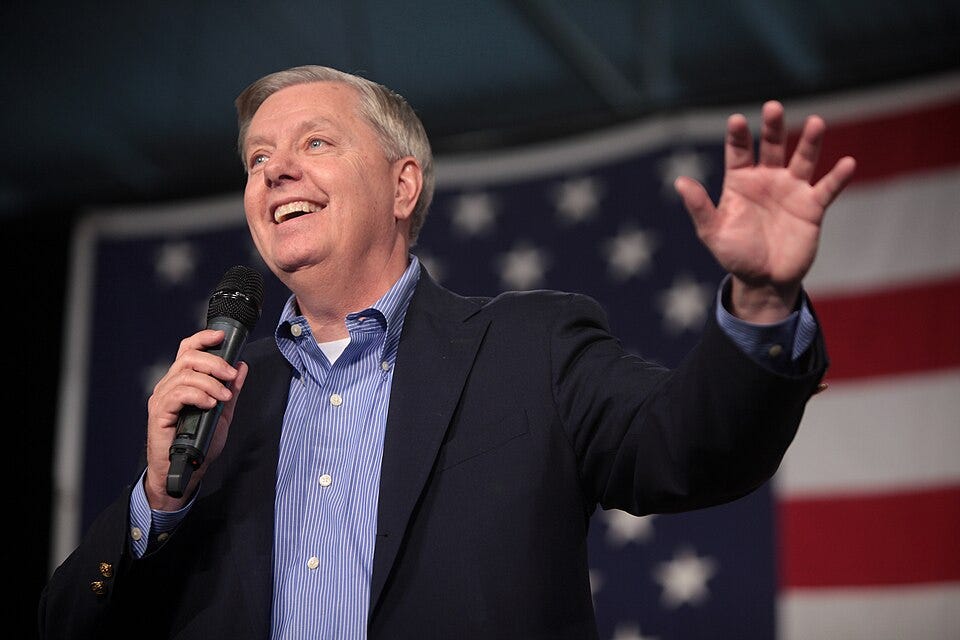 Sen. Lindsey Graham, photo by Gage Skidmore
Would you like to hear about my interactions with the late Republican Sen. Lindsey Graham during my 20 years as a reporter in Washington, D.C.? Didn’t think so, and anyway, what’s on my mind is Lindsey Graham and you.
Specifically, I appreciate those of you who passionately disagreed with late-stage Graham — as I did, on pretty much everything except his support for Ukraine — and yet after his unexpected death on Saturday could still speak of him as a friend, colleague or even just a human being.
For a while now, our ghoulish post-mortem ritual in America has been to spend several days gleefully beating the corpse of political figures. Or really, anyone we didn’t approve of, even if we never heard of that person before, and no matter how unjustified and horrible their death.
Now it isn’t only Graham himself who is being derided, but those across the aisle who dare to remember him in full, as a person with some redeeming qualities.
Jennifer Rubin, former columnist for the Washington Post, described the warm tributes to Graham from Democrats as “nauseating,” and “everything that’s wrong” with the Senate. Others, too, saw these as “soft” and as displays of weakness.
No, the last vestiges of comity in the Capitol are not what’s wrong, but the financial and other incentives that have rewarded the extremes.
And what’s feeble is seeing a simple gesture of sympathy over the death of someone you have worked alongside as weakness. Is it “woke,” too? Because in yet one more way that I see some MAGA critics becoming what they hate, this way of thinking adopts the upside down Musk logic that empathy is a frailty instead of a strength.
So I’m glad to see Rep. James E. Clyburn, from Graham’s home state of South Carolina, along with Senators Chris Coons of Delaware, Adam Schiff of California, Elizabeth Warren of Massachusetts and Amy Klobuchar of Minnesota, among others, opting out of the now long-running competition to see how miserably we can behave when a political adversary dies or suffers some other calamity. I’m glad to hear them speaking like people who knew this man instead of like party operatives.
It’s no surprise that they were criticized simply for treating him in death as we would all want to be treated. So too was Democratic Senator Sheldon Whitehouse of Rhode Island, who called Graham “a giant in the Senate,” and said, “I’ve lost a dearly cherished friend.”
That he could really be a dearly cherished friend to someone with such different views cuts against all of the algorithms of our ‘unfriend me now’ culture. That it takes some fortitude just to praise a dead colleague — and that I find that they have done something worth noting at all — tells you how much humanity we’ve lost.
Some of you are going to tell me that this humanity didn’t just go missing one day, but was systematically cut back again and again by the same President of the United States who when former FBI director Robert Mueller died said, “Good, I’m glad he’s dead.” Who when film director Rob Reiner was brutally murdered, allegedly by his severely mentally ill son, said Reiner and his wife Michele had died “reportedly due to the anger he caused by others through his massive, unyielding, and incurable affliction … known as TRUMP DERANGEMENT SYNDROME.” And who at his friend the conservative activist Charlie Kirk’s memorial service said, “I hate my opponent, and I don’t want the best for them.”
But I still agree with Allan Katz, founder of the Kansas City-based American Public Square, who said this in an interview: “I was never a huge fan of Lindsey Graham even when he was one of the three amigos. But none of us are one-dimensional.”
That’s all that the comments from Democrats are saying when they remember his sense of humor and his dedication to the job and the Senate and the country. I don’t see where all of this beating on the body is getting us, except further from who we’ve always said we were, and further from one another.
“When Joe Biden dies,” Katz says, “you’ll see the other side piling on.” This is not to say that all commentary is equally valid. But this ritual roughing-up after a death does, as Katz says “make things harder for those who want a civil society to live there.”
And then there’s this: “Even if you think it, can’t you just shut up?”