Europe at a crossroads between AI sovereignty and managing reliance on U.S. tech
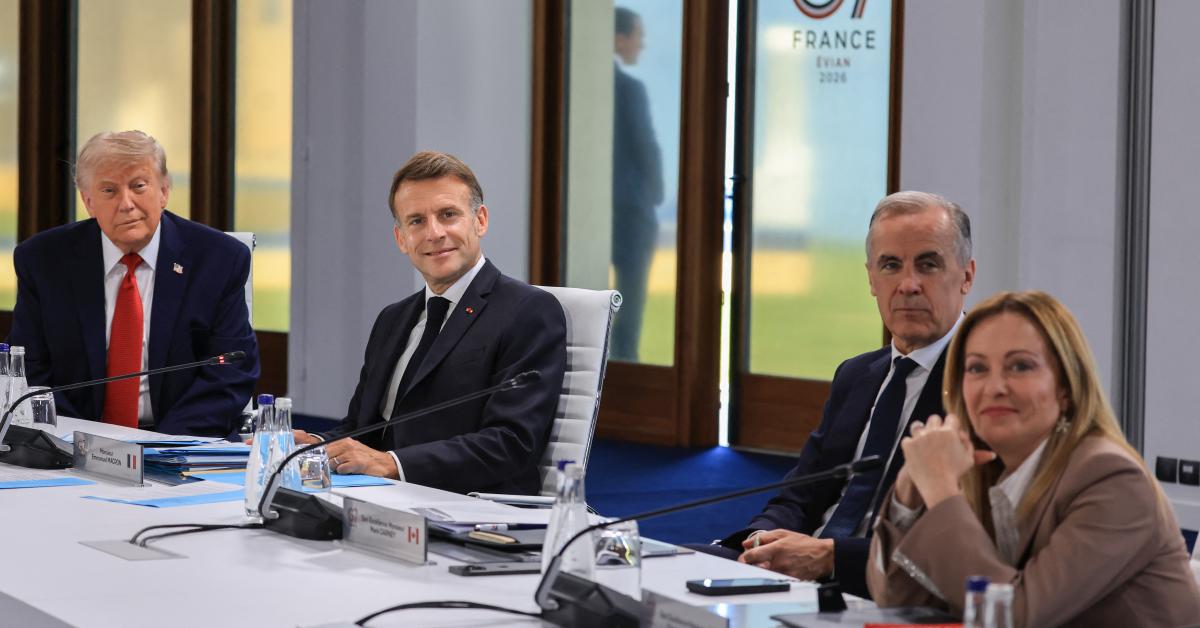
The last day of discussions by the Group of Seven leaders in the French Alps on Wednesday focused on the governance of frontier artificial intelligence, with discussions dominated by broadening access to advanced U.S. models against a backdrop of Europe's push for technological sovereignty.
The leaders of the most powerful AI companies, including OpenAI CEO Sam Altman, Anthropic CEO Dario Amodei and Google Deepmind CEO Demis Hassabis, joined a working lunch on Wednesday on “Ensuring a safe, rapid and effective deployment of artificial intelligence” at the Evian-les-Bains lakeside resort on the last of three days at the summit.
This came after G7 leaders called the tentative U.S.-Iran deal to end the Middle East war a “historic opportunity,” with the summit dominated by talks around the wars in Iran and Ukraine.
G7 and tech leaders discussed a plan for selecting “trusted partners” for access to advanced AI models from U.S. companies such as Anthropic. “Trusted partners” could mean countries or companies, according to Reuters. The agreement that grants broader access to the advanced models would allow G7 countries to strengthen guardrails around cybersecurity against its competitors such as China.
Many outside the U.S. took notice of how Anthropic disabled access globally to its frontier AI models, Fable 5 and Mythos 5, after President Trump ordered the company to block foreign nationals from accessing the models, citing national security concerns.
For Europe, this has stoked further anxiety regarding its dependence on AI from American companies, and what would happen to strategic infrastructure if access could be revoked overnight.
French President Emmanuel Macron said that it was a “good thing” that U.S. officials recognized that frontier AI models could be dangerous.
“What do they fear? That these models could be used by others to attack them or attack," he said. However, he also said that Trump blocking the use of Anthropic’s latest AI models was “strictly nationalist," and that it was in Washington’s interest to make Mythos more broadly available because nobody would buy U.S. AI if there were concerns it could be shut down at any moment.
Canadian Prime Minister Mark Carney also addressed the development around Anthropic on his way to the G7 summit, telling reporters in Ireland that it indicated a need to “build out and diversify.”
Recently, Europe has been pushing for increased sovereignty in technology, including plans for AI “gigafactories” and large-scale infrastructure for computing power that the region can access. The European Commission’s recent tech sovereignty package includes plans to boost domestic cloud, AI and semiconductor industries and cut back reliance on U.S. Big Tech.
European Commission President Ursula von der Leyen said during the lunch that it was the mutual interest of the U.S. and the European Union for the EU to access frontier AI, commending the U.S.’ actions to make sure that AI companies acted responsibly when introducing new models.
“We use each other's trusted technology, and our financial systems are interconnected," she said, framing European access to U.S. frontier models as a move for mutual economic stability, even as Europe seeks to diversify and build digital sovereignty.
G7 leaders issued a joint statement on Wednesday, in which they said they would task regulators, finance officials, and cybersecurity experts to assess how emerging AI models can impact financial stability, labor markets, and productivity.
Amid ongoing discussions about national security mandates, tech leaders also opted for AI to be governed by "democratic governments" instead of by tech companies.
“Do not cede your responsibilities to AI labs like mine," OpenAI CEO Sam Altman said. "We develop the technology, and the citizens of the free world make the rules." He said that the G7 should take control of AI governance for emerging AI systems because they had the potential to reshape the global economy and scientific discovery.
Altman also floated the idea of creating an international forum, potentially led by the U.S. to establish global standards for advanced models.
Meanwhile, Anthropic CEO Amodei said that there should be international cooperation for structured access to frontier models, trading of chips and critical components which excluded China, and countries cooperating on risks of AI in cyber, bioterrorism and intelligence, according to CNBC.
The discussions on AI also included ones on greater protection for children online, with Brigitte Macron, wife of the French president, leading the spouses of G7 leaders in a forum titled, “Protecting Children in the Age of Artificial Intelligence” while their partners convened with top tech executives.
Tensions remain high regarding the extent of government oversight concerning the protection of children. European G7 members have been pushing for more security to protect minors in a fast-changing world, while the United States is largely against blanket regulations on artificial intelligence and has also pushed for more AI literacy in schools.
British Prime Minister Keir Starmer said ahead of the G7 summit that children under 16 would be banned from using social media in the country, with France also considering a similar measure.
"So my message to tech bosses is clear: work with us to keep kids safe, or I'll do whatever it takes to make that happen," Starmer told reporters in London ahead of the summit.
President Macron said on Wednesday that he believed progress would be made in the coming weeks to broaden access to frontier U.S. AI models. However, immediate steps remain caught in a balancing act of navigating the urgent U.S. national security mandate while Europe pushes for technological sovereignty in the long-term.
Also present at the lunch were Meta’s chief AI officer, Alexandr Wang, as well as the leaders of smaller AI labs, including France’s Mistral, Germany’s Black Forest Labs, Italy’s Domyn, Japan's Sakana AI and United Kingdom-based Synthesia.
The G7 includes Canada, France, Germany, Italy, Japan, the U.S. and the United Kingdom, with Brazil, Egypt, India, Kenya, South Korea, Qatar, Ukraine and the United Arab Emirates participating as guest nations at the summit.