Dump the Flock: Flock Cameras as the Catalyst for a Modern Boston Tea Party - Joe Hoft
By Danielle Walker | The State of Freedom
We saw it with COVID: Under the banner of “safety,” governments and partners bypassed privacy norms, imposed vaccine passports and proof-of-status requirements for everyday public spaces, and normalized emergency powers that eviscerated medical choice and bodily autonomy. The same playbook is now expanding into perpetual surveillance.
ADVERTISEMENTPicture this: Every time you drive down the road — to work, to church, to pick up your kids, or just to clear your head on Louisiana’s backroads — a network of cameras is logging your license plate, your vehicle’s make, model, color, and often more. Timestamped. Geolocated. Uploaded to the cloud. Searchable by police departments across the country, sometimes federal agencies, with little to no warrant required for historical “fishing expeditions.”
This isn’t science fiction. This is Flock Safety’s automated license plate reader system — over 80,000 cameras strong nationwide, expanding fast, and already operating in places like Central, Baton Rouge, and New Orleans right here in Louisiana. Marketed as a “safety tool” to catch stolen cars and criminals, it’s fast becoming the infrastructure of a modern surveillance state.
Layering on top of that is Louisiana’s new law (House Bill 1085, signed by Gov. Jeff Landry in June 2026). Beginning January 1, 2027, traditional vehicle inspection stickers (brake tags) are phased out for most passenger vehicles and replaced with a $6 proprietary QR code decal tied to vehicle registration. The QR code, displayed on the windshield, lets law enforcement instantly scan for Vehicle Identification Number, insurance proof, and outstanding warrants. This isn’t just modernization — it supercharges surveillance tools like Flock. With artificial intelligence-enhanced cameras and video capabilities, these systems can now read and log QR codes alongside plates, creating a richer digital profile of every vehicle and driver. Another feature in the surveillance machine being built in the unholy alliance between sociopathic big tech corporatists and tyrannical big government.
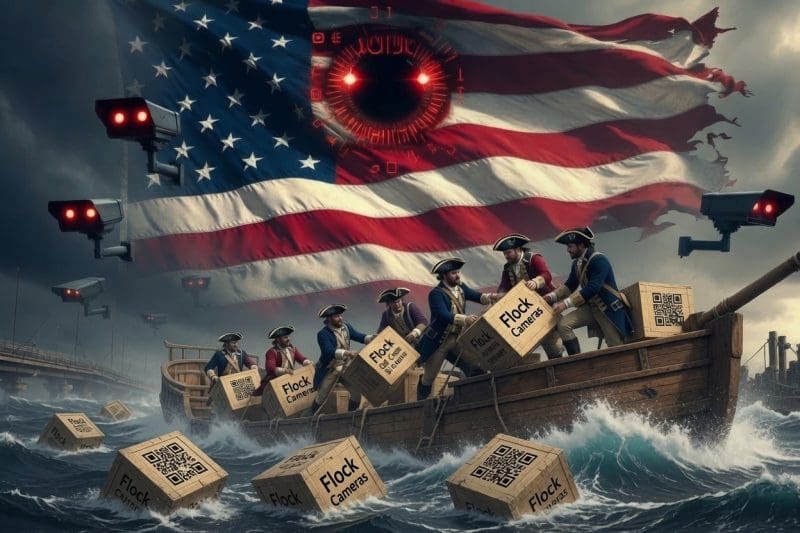
And just like King George’s tea tax and East India Company monopoly sparked the Boston Tea Party in 1773 — a direct rejection of tyrannical overreach into the lives and liberties of free people — these cameras, the government-tech partnership propping them up, and the full dragnet of data mining are the provocation that just may ignite a new American revolt for liberty today.
ADVERTISEMENTThe Provocation: Dragnet Surveillance on Every Road
Flock cameras don’t just snap plates when there’s probable cause. They capture data on every vehicle that passes — innocent commuters, families, delivery drivers, you name it. Details include not only the plate but vehicle characteristics, sometimes occupant counts or accessories via artificial intelligence enhancement. Data streams to Flock’s servers, retained for weeks or more, and made available to any subscribing law enforcement agency nationwide.
No individualized suspicion. No warrant for bulk access in practice. Just a permanent record of your movements in public spaces.
Critics from the Electronic Frontier Foundation (EFF), American Civil Liberties Union (ACLU), and Institute for Justice (IJ) rightly call it mass surveillance. Recent litigation, including the Norfolk, Virginia case backed by the IJ, argues this pervasive tracking violates the Fourth Amendment — building on the Supreme Court’s Carpenter v. United States (2018) ruling that prolonged location tracking (even of public movements via cell data) constitutes a search requiring a warrant. A recent Supreme Court decision on geofence warrants and location data has only intensified questions about systems like Flock’s.
Here in Louisiana and across the nation, local police departments sign contracts with taxpayer dollars. But the data doesn’t stay local. It flows into a centralized system ripe for cross-jurisdictional sharing — and abuse.
Government Meets Tech Oligarch: The Prostitution Pact for Our Privacy
This isn’t old-school policing with a few cameras on Main Street. This is a sordid public-private bargain in the streets where government gains a powerful surveillance tool and a private company (Flock Safety, backed by investors) profits handsomely while centralizing control over your data.
Local agencies “own” the data per contracts, Flock claims. They say they don’t sell it. But the reality? Widespread access by thousands of officers across state lines, documented instances of federal agencies (Immigration and Customs Enforcement, Customs and Border Protection, Department of Homeland Security) gaining entry — sometimes indirectly through local partners, sometimes via admitted pilot programs despite earlier denials. Electronic Frontier Foundation investigations exposed how Flock’s architecture enables this, sparking congressional probes and state audits (like in Illinois and California).
And it’s not just government cameras. Modern vehicles themselves are rolling data collectors. Car dealerships, automakers, and connected car systems pull detailed driving behavior from onboard computers — hard braking, rapid acceleration, speed patterns, locations — and share or sell it to data brokers and insurance companies for risk profiling and personalized premiums. This private telemetry feeds seamlessly into the broader ecosystem, amplifying Flock’s public-road tracking into a near-complete picture of your habits. Reports show this data often moves without clear consent, turning your own car into a snitch sold to the highest bidder. Another facet of the same kind of tyrannical partnership our ancestors dumped into Boston Harbor.
Reports detail plans or moves toward integration with commercial data brokers for “people lookup” tools — jumping from plate to person. Artificial intelligence upgrades now allow natural language searches (“landscaping trailer with ladder”) and video clips. Some analyses point to flagging “suspicious” movement patterns — Minority Report territory, where algorithms decide who looks guilty before any crime.
This is the surveillance state as a service. And the “prostitution” runs both ways: Government sells out citizen privacy for the illusion of total awareness; tech oligarchs cash in on the contracts while expanding the dragnet into video, artificial intelligence inference, and beyond. No meaningful consent from We the People. No robust limits. Just “trust us” while audit logs and role-based access prove insufficient against insider abuse or mission creep.
1984 in Real Time: Big Brother’s License Plate Grid
George Orwell warned of a world where every movement is watched, recorded, and used against you. Flock (plus onboard vehicle telemetry and always-listening tools like Alexa, Siri, and the devices in our purses, pockets, and hands) delivers a decentralized-yet-centralized version: No telescreens in every home (yet), but cameras on countless corners and highways logging your comings and goings 24/7 — often supplemented by data your car itself reports and sells. Layer in social media monitoring, where government agencies and partners tracked users expressing protected First Amendment opinions — particularly in the aftermath of the 2020 election when citizens voiced concerns about the election being stolen. Public records requests have even highlighted Louisiana’s own Secretary of State’s office playing a role in efforts to monitor, silence, and report Louisiana citizens to federal authorities over such speech. The tie between Flock’s physical location tracking and social media profiles is extremely alarming: Your drives to rallies, meetings, or places of worship can now be cross-referenced with your online posts in real time. Add purchase tracking and debanking — where financial institutions cut off services based on social media activity or “risky” purchases tied to certain views — and the surveillance web tightens into a stranglehold on dissent. Funding our own privacy violations is the tea tax being forced down our throats once again — and like 1773, the time has come to dump it overboard.
Even your everyday movements lose all sense of privacy when aggregated into a searchable database. The patterns expose where you worship, who you associate with, your daily routines, and any deviations that might flag you as suspicious. Add artificial intelligence video analysis and expanding capabilities, and the panopticon grows.
The lack of accountability is staggering — and deliberately murky. Flock has faced accusations of misleading city councils and police about federal data sharing. Some cities violated their own state privacy laws by allowing out-of-state or federal access, leading to lawsuits (California Attorney General actions, class actions). Officer misuse cases have surfaced — using the system to stalk exes or personal targets, with rare but telling prosecutions.
“He said-she said” problems abound when it comes to data ownership. Contracts often claim local agencies “own” the data while Flock hosts and controls access. This blurs lines for public records requests (Freedom of Information Act and Public Records Act equivalents). Is the data governmental (subject to transparency) or private company property (shielded from scrutiny)? Courts have split — some rule Flock footage is public record even if vendor-held, as it’s created for governmental purpose. Others see exemptions or fights that force individuals into expensive litigation just to access or challenge “evidence” used against them in court for alleged violations. Defending yourself becomes a rich man’s game while accountability evaporates in the fog of private-public handoffs.
Where is the outrage? Where are the consequences for the architects of this system? Breaches of trust pile up, yet the cameras multiply like rabbits.
The COVID Precedent: “Emergency” as the Master Key to Privacy’s Door
Remember COVID? We were told temporary measures, emergency powers, enforcement discretion on the Health Insurance Portability and Accountability Act for telehealth and data sharing to “save lives.” In practice, it became a convenient bypass for normal privacy protections around medical choices, vaccine status, contact tracing, and health data. Vaccine passports and mandates requiring proof of vaccination documentation to enter buildings — even many public ones — pressured disclosure of private medical information in ways that sidelined longstanding norms. Apps and databases collected data with questionable long-term safeguards. Normal rules were bent or ignored under the banner of public health, and accountability for resulting privacy erosions or coercive tactics has been thin.
This set a template: Declare a crisis (health, safety, climate, whatever), suspend or dilute constitutional and statutory protections, expand surveillance and control, then normalize it. Flock cameras and the broader automated license plate reader and artificial intelligence surveillance push follow the same script — “public safety” as the eternal emergency justifying perpetual dragnet data collection without warrants or consent.
If they can ignore or creatively interpret the Health Insurance Portability and Accountability Act for medical privacy during one crisis — including demands for vaccine status to access everyday spaces — what stops the same logic for your location data, associations, and daily life under the next “safety” imperative?
Two Tiers of Justice: Minority Report for Innocents, Impunity for Predators
Here’s the cruel irony fueling the fire: This surveillance apparatus tightens the net on law-abiding citizens while real threats often evade real accountability.
Documented cases show Flock data enabling stops, interrogations, or investigations based on “hits” that turn out to be mistakes, old data, or pattern-based suspicion — innocent people hassled because an algorithm or database flag said their car “matched” something. Artificial intelligence “suspicious movement” detection risks automating bias and pre-crime style targeting.
Meanwhile, in too many jurisdictions, clearance rates for rape, murder, and violent crime lag. Resources chase data-driven leads or low-level enforcement visible on cameras, while predators exploit soft prosecution policies, rogue judges, reduced policing in some areas, or sheer overload. Political cases or favored narratives get aggressive pursuit; everyday violent crime victims wait for justice that never fully arrives. Other threats are permitted to slip through.
It’s two Americas: One where your every drive is recorded and potentially weaponized by the state-tech complex, and another where accountability for heinous crimes feels optional depending on who you are or what the prevailing priorities dictate.
This isn’t justice. It’s control layered on selective blindness.
Law-abiding Catholics and traditional families were painted with a broad brush tied to their faith when the feds had zero grounds on which to target them in the first place. Mass surveillance like Flock doesn’t just chase “criminals” — it opens the door wide for targeting based on beliefs, associations, and dissent. Under the prior administration, the Biden Department of Justice and Federal Bureau of Investigation drew sharp criticism for memos and policies that labeled or investigated law-abiding Americans exercising their rights. The 2021 National School Boards Association letter compared concerned parents protesting at school board and PTA meetings to “domestic terrorism,” prompting Attorney General Merrick Garland’s memo directing the Federal Bureau of Investigation and U.S. Attorneys to address threats against school officials — complete with a special “threat tag” for tracking. Parents voicing views on curriculum, masks, or gender issues found themselves under scrutiny.
Even more starkly, the Federal Bureau of Investigation’s Richmond Field Office issued a January 2023 memo linking “radical-traditionalist Catholic” ideology to racially or ethnically motivated violent extremists. It suggested mitigation opportunities, including potential engagement with Catholic parishes, based partly on a single case but broadly framing traditional beliefs (rejection of certain Vatican II changes, preference for Traditional Latin Mass, etc.) as potential gateways to extremism. The memo relied on sources like the Southern Poverty Law Center and sparked congressional investigations, Department of Justice Inspector General review, and later firings of involved analysts.
Comprehensive vehicle tracking via Flock cameras — logging every route to church, school board meetings, or community gatherings — combined with new digital identifiers like Louisiana’s upcoming QR code system, makes such ideological or viewpoint-based monitoring far easier and more scalable. Your movements, associations, and routines become data points that can be queried, patterned, and weaponized. When the state-tech apparatus already has the infrastructure, the temptation (or justification) to use it against “threats” defined by beliefs rather than actions grows dangerously real. This is the two-tier reality in action: dissent and traditional faith scrutinized while other threats are permitted to slip through.
The Catalyst: Time for We the People to Dump the Tea
Our forefathers didn’t petition politely forever. When the Crown imposed taxes without representation and granted monopolies that crushed liberty and commerce through favored corporate vehicles, colonists boarded ships and dumped the tea in a bold act of defiance. It was a clear message: This far, and no farther. Tyranny disguised as a matter of course will not stand.
Flock cameras — and the entire edifice of warrantless mass surveillance, data centralization, government-tech cronyism, and unaccountable overreach they represent — are today’s tea tax. We the taxpayers are funding these very cameras that log our every move. They tax our privacy, our presumption of innocence, our freedom to move without being logged into a permanent searchable record. They empower a partnership that profits from invading the spaces once rightly considered ours. Just as the original Tea Party rejected the King’s domineering and control along with the monopolistic corporate entity he used as the vehicle, we must reject this digital monopoly on our movements, associations, and beliefs.
The good news? Pushback is growing. Cities are canceling contracts over privacy and data-sharing scandals. Lawsuits are advancing on Fourth Amendment grounds. State legislators are waking up to the need for strict limits: warrants for historical searches, data minimization, local control only, bans on certain sharing or artificial intelligence expansions, transparency requirements.
This is our moment. The provocation is here — every camera, QR code, social media profile, and data broker file. The question is whether we answer with the same courage that founded this republic and dumped the tea in Boston Harbor.
What a Modern Boston Tea Party Looks Like
It doesn’t have to be literal axes and harbors (though symbolic protests have power). It looks like a coordinated, fearless rejection of the surveillance monopoly, just like our ancestors rejected the tea monopoly:
The surveillance state wants you passive, tracked, and compliant. The Spirit of ’76 — and the spirit of the Boston Tea Party — says otherwise.
From the bayous where fierce independence runs in the water to every highway and neighborhood across this land, the call is the same: Stand. Speak. Resist the dragnet. Reclaim the ground our ancestors won by dumping the tea.
The Flock has come home to roost. Now it’s time to show them the door — or dump the whole rotten system overboard, just as our forefathers did in 1773.
Stay bold. Stay true. Stay free.
Danielle Walker is the Louisiana-based creator and co-host of The State of Freedom podcast and content series, fighting for sovereignty, accountability, and the unalienable rights of We the People.
Disclaimer: This is an opinion and analysis piece based on publicly available reports, court documents, legislative records, official memos, and investigations by groups including the Electronic Frontier Foundation, American Civil Liberties Union, and Institute for Justice. It reflects The State of Freedom’s perspective on government overreach, privacy, and accountability. Readers should do their own research and form their own conclusions. Not legal or financial advice.