Trump Showed the Receipts, the Math Finally Works, and Now the Senate Can Pass the SAVE America Act
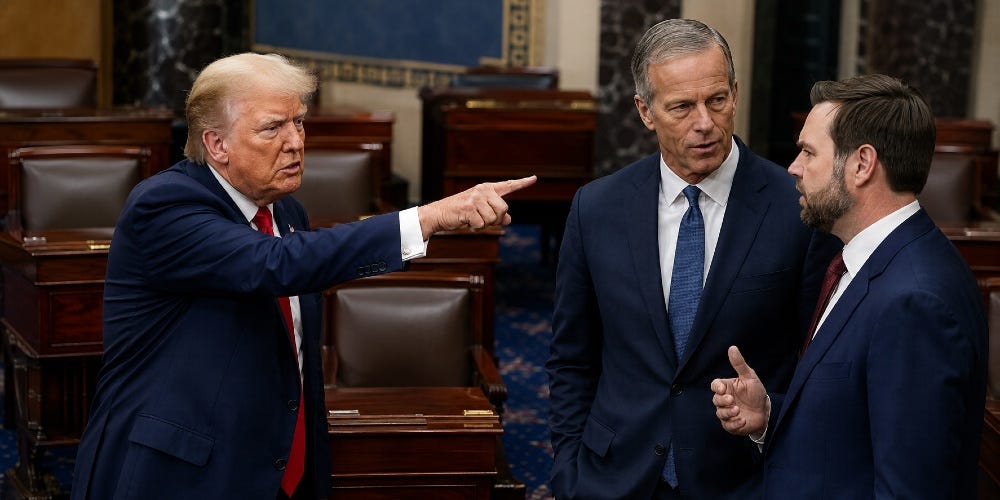
President Trump walked into the East Room Thursday night and did the one thing his critics have insisted for years he could not do. He produced documents. Not rally-stage assertions, not dueling affidavits, but declassified intelligence assessments, FBI case files, and Department of Homeland Security findings, all posted for public download at whitehouse.gov.
For the better part of six years, every conversation about securing American elections has been strangled in the crib by two talking points. There is no evidence of a problem, and there is no path to fix it anyway. In the span of about 48 hours, both of those excuses died.
I will be talking about all of this in detail on today’s episode of The JD Rucker Show at noon Pacific.
The evidence half collapsed when the White House released files covering five areas of concern, from foreign acquisition of American voter data to buried fraud investigations to hundreds of thousands of noncitizens sitting on state voter rolls. The path half collapsed when the House Budget Committee advanced a budget resolution designed to carry the SAVE America Act through the Senate on a simple majority. The floor vote on that resolution could come as early as next week.
What remains between the American people and the election security they overwhelmingly demand is not a shortage of proof and not a procedural dead end. It is a handful of people in the United States Senate, and the question of whether they have the spine to act.
There is an old promise about hidden things, and Thursday night felt like a down payment on it.
For nothing is secret, that shall not be made manifest; neither any thing hid, that shall not be known and come abroad. (Luke 8:17)
What was hidden is now manifest. So let us look at it squarely, all five parts of it, and then walk through exactly what the Senate must do, because the details matter and the window is short.
What the Documents Actually ShowA note of precision before the deep dives, because precision is what separates an argument from a tantrum. These documents describe vulnerabilities, foreign data theft, buried investigations, and corrupted voter rolls. They do not prove that vote totals were switched in an American election, and Trump himself drew that distinction from the podium, saying the purpose of the release is to earn confidence by confronting vulnerabilities and correcting them.
Do I believe the 2020 election was stolen? Absolutely. Do I believe Joe Biden got 81 million votes? Nope. But the information President Trump released is designed to clear the path forward, not litigate a past event that cannot be undone.
The fact-checkers spent Thursday night triumphantly announcing that the files contain no smoking gun of altered results, as though that settles anything. It settles nothing. If your bank told you that burglars had copied your account information, cased the vault, and bribed a teller, you would not be comforted by the news that no withdrawal had yet been confirmed. You would demand new locks. Keep that frame in mind as you read what follows.
The Machines Were Never as Safe as They Told YouThe first tranche consists of previously classified intelligence community assessments, spanning January 2020 to June 2026, on the security of electronic voting and ballot-counting systems. One assessment was very telling...
We judge that U.S. adversaries, including at a minimum Russia, China, Iran, and North Korea, as well as non-state groups, have the capability to compromise U.S. election infrastructure.
Another concludes that centralized election data repositories, including voter registration databases, pollbooks, and official election websites, are the systems most vulnerable to exploitation, and that adversaries could use access to them to disrupt election processes.
Remember, these are not blog posts on a conspiracy theory site. These are the government’s own analysts, writing in classified channels, during the same years when the public was being lectured that questioning election infrastructure was disinformation. The agencies knew the exposure was real. They assessed it, documented it, stamped it secret, and then watched officials assure the country that everything was airtight.
Venezuela Proved the ConceptThe second item answers the question skeptics always deploy as a conversation-ender. Could anyone actually manipulate vote totals digitally? According to the newly released files, the CIA obtained reporting on a specific plot by the Maduro regime to digitally rig Venezuela’s own 2020 elections, including details about methods developed to alter vote totals in ways that could evade detection even under audit.
As Breitbart reported, Trump described the intelligence as showing a plot conducted in favor of the corrupt Maduro regime, and that is exactly what happened. The point is not that Caracas hacked Wisconsin. The point is that a hostile regime built the tools and used them on its own people, which means the capability exists in the world, held by governments that despise us. A vulnerability plus a demonstrated capability is not a conspiracy theory. It is a threat assessment.
Beijing Has Your Voter FileThe third disclosure is the one that should end careers. Beginning in the 2020 election cycle, according to the released intelligence, the People’s Republic of China carried out what is believed to be the largest compromise of election data in history, illicitly acquiring 220 million American voter files containing names, addresses, phone numbers, and party preferences. Declassified records indicate China compromised voter roll data in at least 18 states, and that the regime assigned a dedicated data exploitation unit to the project.
The White House further alleges that members of the intelligence bureaucracy actively suppressed and downplayed the extent of the theft, keeping it from both the president and the public. Sit with that. The nation that runs the world’s most sophisticated influence operations holds a near-complete map of the American electorate, and the people paid to sound the alarm chose silence. Whatever one believes about 2020, there is no innocent explanation for hiding that from the country.
Michigan Found Fraud and Washington Buried ItThe fourth item moves from foreign threats to domestic rot. Among the disclosures are FBI files on a large-scale voter registration operation in Muskegon, Michigan. In 2020, Michigan State Police raided a Democrat get-out-the-vote organization and were alarmed enough by what they found to call in the FBI’s Detroit office. According to the documents, canvassers admitted to federal agents that they signed voter registration forms in other people’s names, submitted registrations for people who did not exist, and were compensated with gift cards tied to the number of applications they produced.
The agents on the case believed crimes had been committed. The Department of Justice slow-walked the matter for years. Director Patel has now been directed to see the investigation through and work with the DOJ to prosecute. This is the part the fact-checkers cannot wave away, because it is not an intelligence estimate. It is a criminal file, with confessions in it, that simply went nowhere until this week.
A Quarter Million Noncitizens, and That Is the UndercountFinally, a DHS review of state voter rolls and public records identified approximately 278,000 noncitizens registered to vote in federal elections. That figure comes only from states willing to share their files. Democrat-run states refused to cooperate, which means the true national number is necessarily higher, and the refusal itself tells you something.
States confident in the cleanliness of their rolls do not hide them from auditors. Put the five items together and the picture is one no honest person can defend. Foreign governments hold our voter data, our machines and databases are assessed by our own analysts as exposed, a proven digital rigging capability exists abroad, documented fraud was buried at home, and the rolls are salted with hundreds of thousands of people who have no legal right to be on them. And still we conduct federal elections with no photo ID requirement and no proof of citizenship.
The Cover-Up QuestionHere is where the irony turns bitter. The same years these assessments were being written, the public was told, repeatedly and with institutional certainty, that 2020 was the most secure election in American history. That phrase came from the very apparatus whose classified product was cataloguing adversary capabilities against election infrastructure. Both things were presented as true simultaneously. The system is impenetrable, said the press releases. The system is penetrable by at least four hostile nations, said the classified assessments. Americans were mocked, deplatformed, and in some cases prosecuted for suspecting what the government’s own analysts had written down.
The critics’ strongest remaining card deserves an honest answer, so here it is. They will say that no released document proves a single vote was changed, and as far as the public files show, that is correct. But notice what that defense concedes. It concedes the data theft. It concedes the vulnerabilities. It concedes the Michigan confessions and the noncitizen registrations. Their entire remaining argument is that the burglars, so far as we can prove, have not yet spent the money. That is not a defense of the system. It is a plea to keep the vault unlocked.
And judgment is turned away backward, and justice standeth afar off: for truth is fallen in the street, and equity cannot enter. (Isaiah 59:14)
Truth fell in the street for six years. Thursday night, somebody finally picked it up.
The Path Through the SenateNow to the half of the story most coverage is ignoring, which is that the path to fixing this exists right now and runs through a very small number of identifiable decisions. On Wednesday, the House passed the National Defense Authorization Act with the SAVE America Act language attached, 217 to 209, sending it to the Senate, where Democrats will filibuster it.
Anticipating exactly that, House Republicans launched Reconciliation 3.0, a roughly $95 billion package covering defense funding, farm assistance, and election integrity. The Budget Committee advanced the resolution Thursday on a 20 to 14 party-line vote, with a floor vote expected as soon as next week. The design gives the House Administration Committee $10 billion to implement SAVE Act provisions, structured around funding so the measure is, in Chairman Jodey Arrington’s words, materially budget in nature. Sen. Roger Marshall told Fox News he believes a properly written provision can survive reconciliation’s rules, while warning he is not satisfied with a Band-Aid.
Reconciliation matters because it needs 51 votes, not 60. And here is the fact that should anchor every conversation about this bill going forward. Majority support has already been demonstrated on the Senate floor. During June’s vote-a-rama, after a modified version failed, Sen. Mike Lee forced a vote on the original House-passed SAVE America Act, and it received 50 votes, with Susan Collins flipping to yes, against 49. With Vice President JD Vance available to break a tie, that is a passing margin. The bill is not short of votes. It is short of a ruling.
That ruling belongs to the Senate parliamentarian, Elizabeth MacDonough, who has held that the SAVE Act fails the Byrd Rule and cannot ride reconciliation. President Trump has twice demanded that Majority Leader John Thune fire her outright, and Thune has twice declined, telling Fox Business the problem is a function of math.
Fine. Then let us do the math, all of it, including the part Thune leaves out. The parliamentarian does not actually possess a veto. Her role is advisory. The presiding officer of the Senate makes the ruling, and the presiding officer of the Senate is the Vice President of the United States. When the Byrd Rule point of order is raised against the SAVE provisions, Vance can take the chair and rule that they qualify. Democrats would appeal, and overturning the chair requires a majority. A 50 to 50 tie sustains the ruling.
This is not radical invention. It is the same mechanism, in principle, that both parties used for the nuclear options of 2013 and 2017. Thune’s cooperation is not required. His acquiescence is.
The honest complication is Susan Collins, and it deserves naming rather than hand-waving. Voting for the SAVE Act on substance, as she did in June, is not the same as voting to sustain a chair ruling that overrides the parliamentarian, and Collins is the Senate’s most reliable institutionalist. But consider her position. She faces the most competitive re-election of her career in a cycle where support among Republicans for photo ID and proof of citizenship polls between 91 and 95 percent. Explaining to Maine voters that she supports election security but voted to kill it over an unelected staffer’s advisory opinion about budget scoring is not a speech anyone survives comfortably.
The other defectors are a different story. Thom Tillis and Mitch McConnell are retiring and answer to no one. Lisa Murkowski objects to what she calls federalized elections. Assume all three vote no. The conference still holds 53 seats, including the newly sworn Darline Graham Nordone, who took her late brother Lindsey Graham’s seat this week with a public pledge to support the president’s efforts. Fifty plus Vance carries both the ruling and the bill.
No More Reasons, Only ChoicesSo strip it all down. The evidence exists, published by the White House for anyone to read. The legislative vehicle exists, moving to the House floor within days, as the Daily Signal details. The votes exist, demonstrated on the record in June. The constitutional mechanism exists, sitting in the chair Vance is entitled to occupy.
Every structural excuse offered since 2020 has been dismantled, piece by piece, in a single week. What remains is will, and will is a choice, made by named individuals who must answer for it in November and beyond. Speaker Johnson called this package the party’s best shot at enacting the SAVE America Act. He is understating it. It is the last shot before the midterms, and everyone in the building knows it.
Trump closed the argument himself Thursday night, in a single sentence that will hang over every senator who hesitates.
The only reason you wouldn’t pass it is you want to cheat.
Harsh? Certainly. Answerable? Let the Senate try. The receipts are on the table, the path is marked, and the country is watching to see who stands in the gap and who steps out of it.
Check out my hand-curated conservative and Christian news aggregator, jdrucker.com