Elon Musk is a Genius, and a Litmus Test
Today, Elon Musk took his privately owned SpaceX public. The result was the first $2 trillion market valuation on any company, ever. What’s more, unlike other most huge companies that have made people rich, like Google and Facebook, it’s a company that deals in atoms, not bits. (Amazon is sort of in-between, really). If Facebook and Google are fairy dust, SpaceX is heavy metal. It builds big things that sometimes blow up. They’re things that a lot of “experts” (*cough* Neil de Grasse Tyson *cough*) thought he couldn’t build, and certainly couldn’t operate at a profit. But he has. Now he’s promising, right in the prospectus, to go much farther.
There are two kinds of reactions to this: Celebration, and jealousy. They are diagnostic.
There’s lots of room for celebration. James Pethokoukis is one of the celebrants. He writes that it’s good that Elon Musk is a trillionaire now, because of what he’s accomplished: “If more trillionaires emerge because AI, robots, clean energy, genetic editing, and space access become vastly cheaper and more capable, everyone gains.”
Yes, SpaceX is worth a lot of money — and with it Elon’s shares — because it’s already doing amazing things and people expect it to do a lot more of them in the future. He writes:
It’s definitely a good thing for Americans when someone becomes superrich starting a company that provides goods and services deemed desirable and valuable by society through its purchase decisions. It’s a sure sign American techno-capitalism is working.1 Steve Jobs, Jeff Bezos, and the Google founders all started companies that sell an economically valuable product. Apple gave us the one device. Amazon built the everything store. Google became the internet’s front door.
And as wealthy as those businesses made their founders, we assuredly made out even better. We always do when an entrepreneur builds a business around an innovative technology or a cheaper way to make something people want. Nobel laureate economist William Nordhaus actually ran the math, finding that innovators captured barely 2 percent of the value their inventions threw off across half a century, leaving the other 98 percent to the rest of us.2
The same will be the case for Musk and SpaceX if the vision outlined in its IPO prospectus—cheap and fully reusable rockets, a planet-scale Starlink business, orbital AI infrastructure, and ultimately cities on Mars—pans out. Massive benefits for humanity, not just SpaceX shareholders. . . .By the way, no Starship means no guarantee on that trillionaire status. The sustainability of the vast bulk of Musk’s wealth depends on his ability to create value through SpaceX that civilizationally benefits us more than it ever will him. Fixating on the size of any Musk’s or any individual fortune misses what is surely the bigger story: If more trillionaires emerge because AI, robots, clean energy, genetic editing, and space access become vastly cheaper and more capable (or simply because someone started a company that’s really good at selling stuff we really want) everyone gains.
That’s clearly true. And in putting together his various companies, Musk has walked a long and rocky road, flirting with bankruptcy more than once and displaying near-supernatural engineering and managerial talents. (As I’ve written before, the largely untold story is how he managed to put together such huge teams of super talented people. I mean, Boeing can’t do that.)
Musk is a once-in-a-millennium piece of human capital, and he’s chosen to use his abilities for good. He should be praised and admired.
But.
The more he accomplishes, and the more obviously good it is for humanity, the worse it makes people whose accomplishments are minor and whose self-regard is immense. He’s a threat to their self-image, and must be brought down.
My old law professor Charles Black, who wrote the brief with Thurgood Marshall in Brown v. Board of Education, wrote a famous essay on how his exposure, as a Texas high-school student, to the blistering genius of Louis Armstrong in 1931 changed his views of race and led to his civil rights work. But the reaction of the “good old boy” student who was with him is what I’m reminded of now. “We listened together for a long time. Then he turned to me, shook his head as though clearing it — as I’m sure he was — of an unacceptable though vague thought, and pronounced the judgment of the time and place: ‘After all, he’s nothing but a God damn n*gger.’”
A lot of people, mostly though not exclusively on the Left, are doing something similar now regarding Elon Musk.
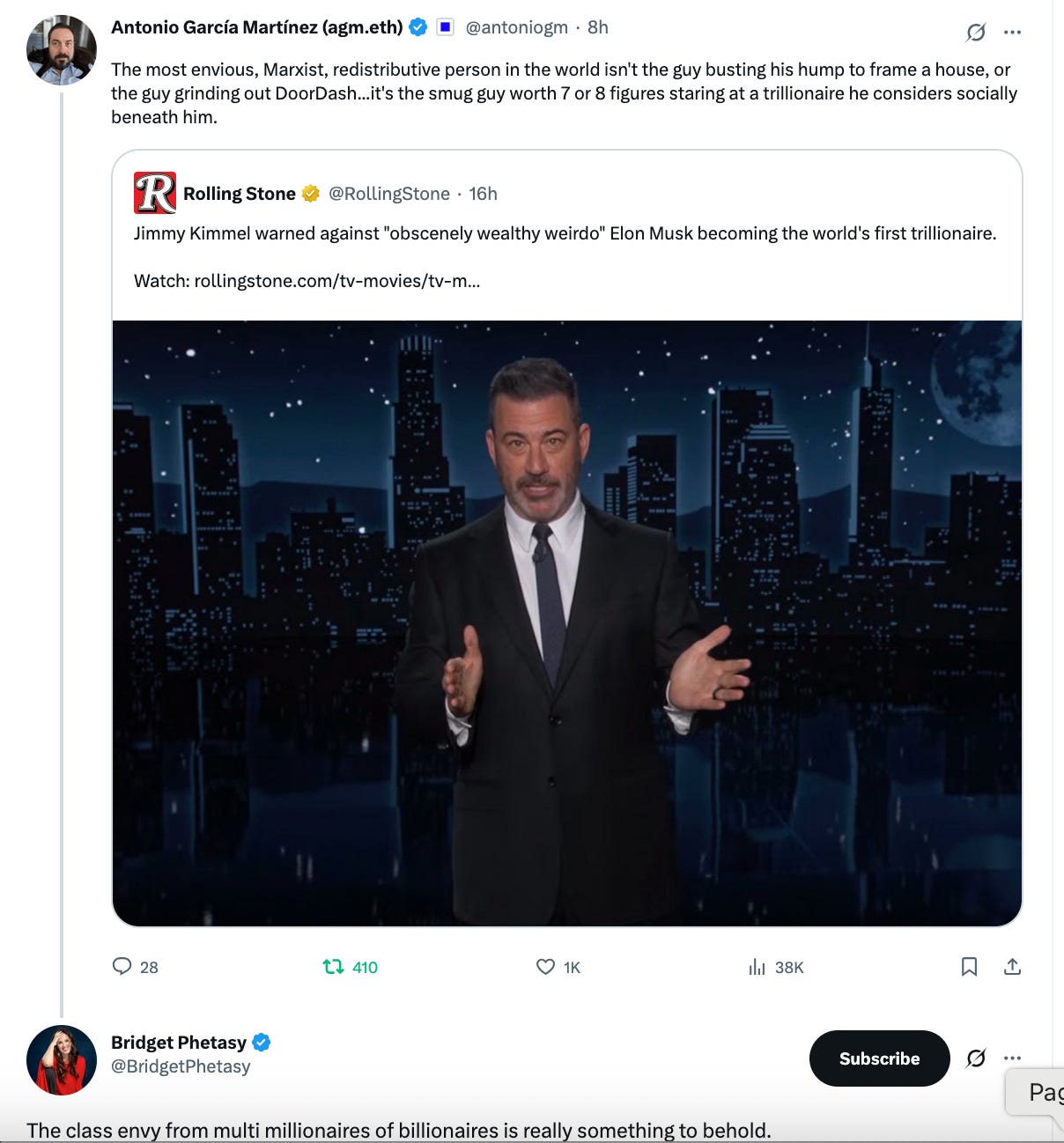
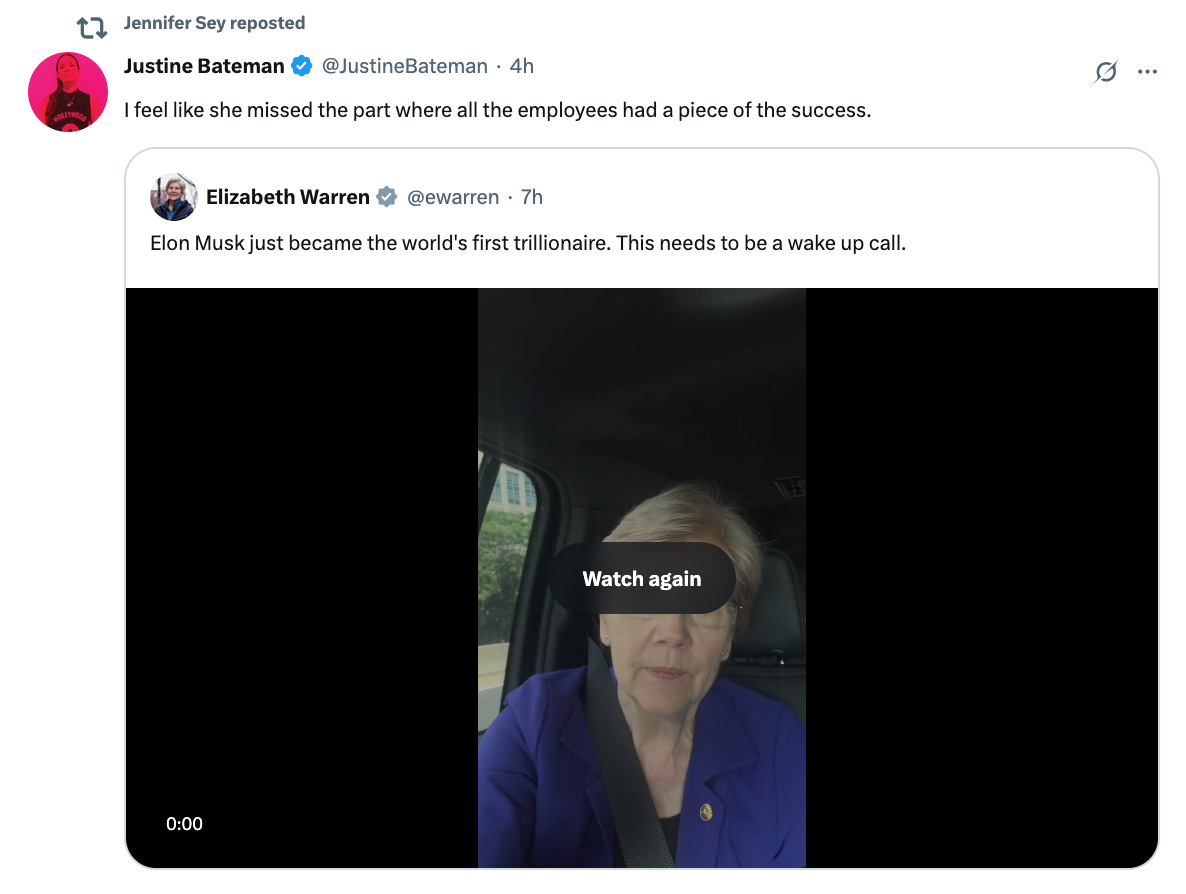

"There shouldn’t be trillionaires” is junior-high-level stuff. We should have people producing trillions of dollars in value for society. The argument that Elon should be spending his money on “feeding the hungry” is stupid in a country where the federal government spends multi-trillions a year on just that, with dubious results. It also betrays either a notion, or a lie, based on Musk having a Scrooge McDuck style Money Bin with a trillion dollars in it. In fact, of course, he owns assets that are busy producing useful things, not cash just lying around somewhere going to waste. Most of the people pretending otherwise know better, but hope their listeners don’t. The rest are just imponderably stupid.
SpaceX’s IPO created 4,400 millionaires, according to the New York Times. Critics like Bernie Sanders, AOC, and Elizabeth Warren have created one each — themselves.
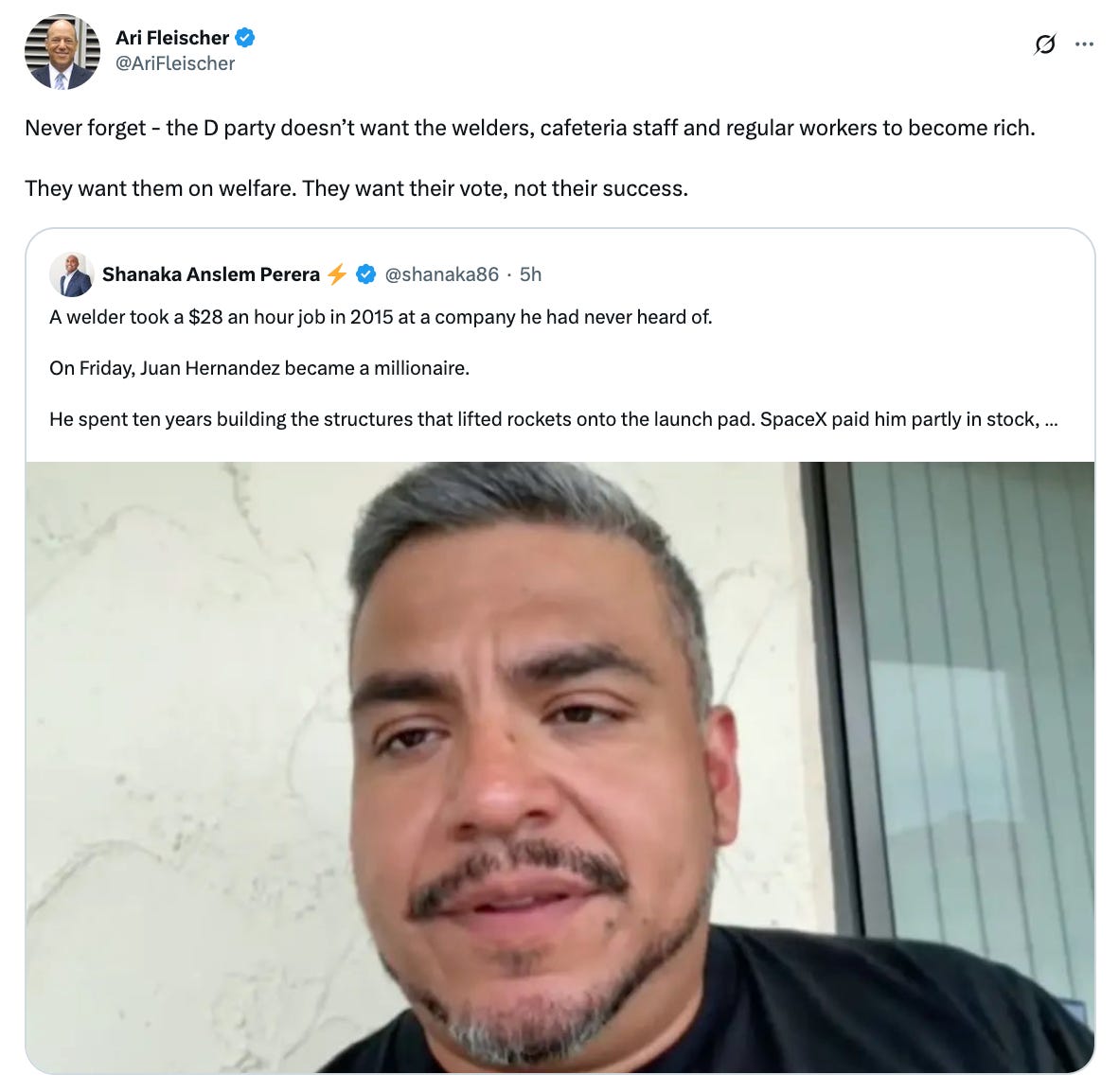
People denounce Elon, and many other billionaires, for “greed.” But most self-made billionaires — which is 70% of all billionaires in America — weren’t operating from greed, so much as the desire to build something. That’s certainly true in spades for Elon Musk. Money for him is a tool.
And it’s not as if he isn’t doing good with it already.
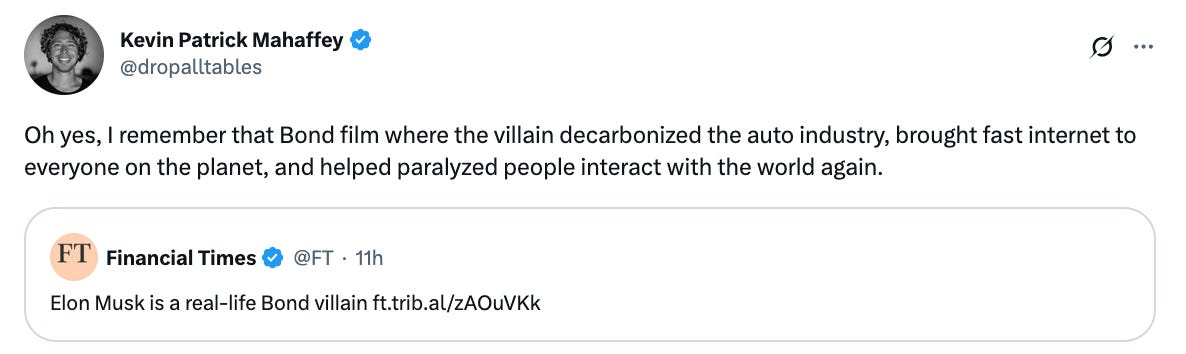
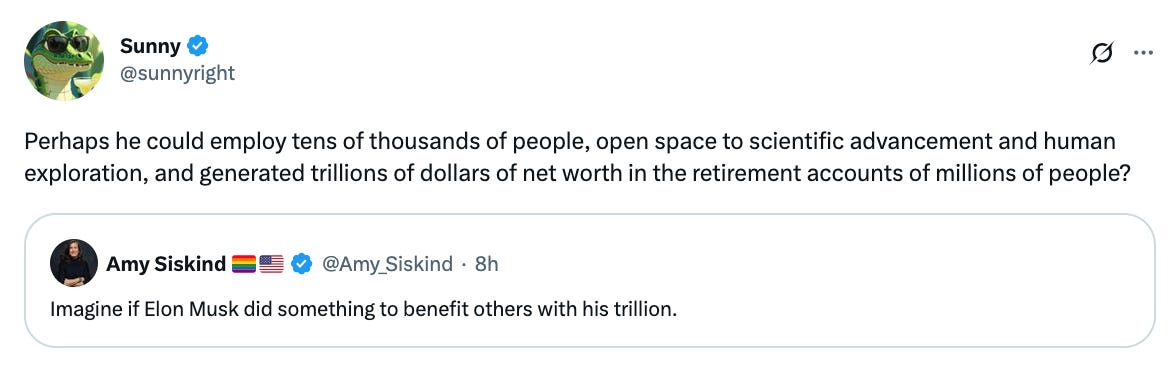
(And where have we gotten when the Financial Times, of all newspapers, would characterize Elon Musk as a Bond villain?)
But while Greed is a sin, so is Envy. And Elon’s critics envy not just his wealth, but his significance. He is doing great things, and they are not, and they really, really need to feel significant. But they aren’t, and it just kills them. The attacks are about trying to assuage that narcissistic wound more than anything.
Back after Apollo 11, Norman Mailer wrote that Apollo was the revenge of the “squares.” The hippies, with their tie-dye and their music and their psychotropic drugs were trying to bring something into being that humans had never achieved. But in fact it was those squares in their short-sleeve dress shirts and skinny ties, with their crewcuts and slide rules, who actually went and did it. It was unforgivable, and the hippies turned their considerable cultural power toward killing it and making it uncool, and they almost succeeded.
Almost. I have $2 trillion that says they failed.
Which is good news not just for Elon, but for humanity.