Supreme Court Set To Decide Fate of Trump’s Birthright Citizenship Order
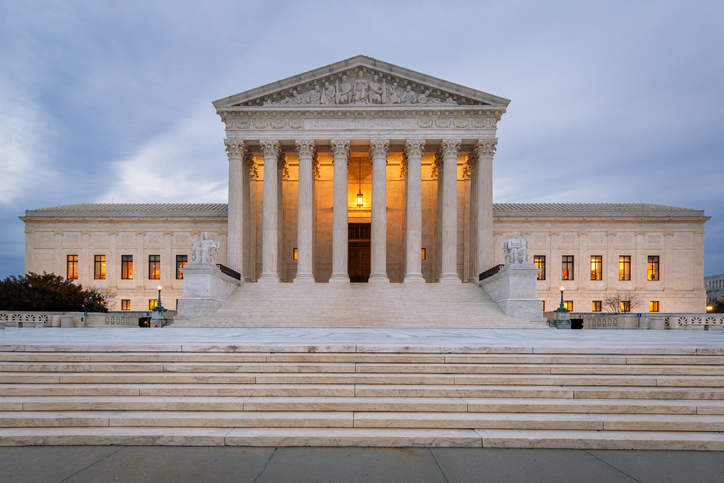
The nation’s long-running debate over birthright citizenship is heading for a decisive moment after the Supreme Court announced it will take up President Donald Trump’s executive order limiting who qualifies as an American citizen at birth.
According to The Associated Press, the announcement marks the first time the high court will fully weigh in on one of Trump’s major immigration directives since the start of his second term.
The order, signed on Jan. 20, declares that children born in the United States to parents who are in the country illegally or temporarily are not U.S. citizens. The policy has been blocked nationwide, and none of its provisions have taken effect.
The justices agreed to hear Trump’s appeal of a lower-court ruling that struck down the order. Arguments are scheduled for the spring, with a ruling expected by early summer.
The birthright citizenship policy is a key component of Trump’s broader immigration push, which has included enforcement surges in major cities and the administration’s first-ever peacetime use of the 18th-century Alien Enemies Act.
Several of these actions have already faced intense scrutiny from the courts, producing mixed signals in emergency rulings.
In recent months, the Supreme Court halted the administration’s attempt to use the Alien Enemies Act to swiftly deport alleged Venezuelan gang members without court hearings. At the same time, the justices allowed immigration stops in the Los Angeles area to resume after a lower court blocked them over concerns tied to race, language, job or location.
Another dispute still pending at the high court involves the administration’s request to deploy National Guard troops in the Chicago area to assist with immigration enforcement. A lower court has barred the deployment indefinitely.
Birthright citizenship, however, is the first of Trump’s immigration policies to reach the Supreme Court for a final ruling.
The order challenges more than a century of legal understanding that the 14th Amendment grants citizenship to nearly all children born on American soil, with narrow exceptions for children of foreign diplomats and occupying forces.
Should the Supreme Court uphold Trump's order on birthright citizenship?
Support: 0% (0 Votes)
Oppose: 0% (0 Votes)
Lower courts across the country have been unified in their response. Every court that has reviewed the order has found it unconstitutional or likely unconstitutional, including after a June Supreme Court decision that limited nationwide injunctions but left the door open for class-wide or state-driven challenges.
The case now before the justices stems from New Hampshire, where a federal judge blocked the policy in July in a class-action lawsuit covering all children who would be affected.
The American Civil Liberties Union is representing the children and their parents.
“No president can change the 14th Amendment’s fundamental promise of citizenship,” said ACLU national legal director Cecillia Wang. “We look forward to putting this issue to rest once and for all in the Supreme Court this term.”
The administration has maintained that children of noncitizens are not “subject to the jurisdiction” of the United States and therefore are not granted citizenship at birth.
“The Fourteenth Amendment’s Citizenship Clause was adopted to grant citizenship to newly freed slaves and their children — not … to the children of aliens illegally or temporarily in the United States,” wrote D. John Sauer, the administration’s top Supreme Court lawyer.
Twenty-four Republican-led states and 27 Republican lawmakers, including Sens. Ted Cruz of Texas and Lindsey Graham of South Carolina, have filed briefs supporting the administration’s position.
The justices took no action on a related 9th Circuit ruling that favored Democratic-led states seeking a nationwide injunction, leaving that dispute unresolved for now.
The Supreme Court’s decision this term is expected to settle a constitutional question that has stood largely untouched for 125 years.