Mud Eruption Caught On Camera In Yellowstone Basin
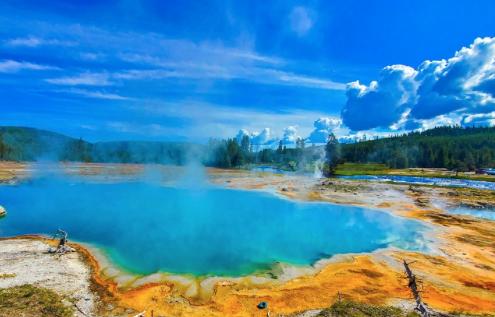
A big, messy surprise greeted Yellowstone National Park early Saturday morning, just as winter officially began. At around 9:23 a.m., a powerful mud eruption took place at the Black Diamond Pool in the Biscuit Basin area. While this might sound like something from a science fiction movie, it was very real — and very muddy.
The U.S. Geological Survey (USGS) released a video showing the moment the hot mud blasted into the air. The word they used to describe it? “Kablooey.” And based on the footage, that seems about right.
Black Diamond Pool is located near some of Yellowstone’s most popular landmarks, including Old Faithful and the Grand Prismatic Spring. According to USGS experts, this particular pool has a history of eruptions. The most recent major one happened in July 2024, when rocks and mud were launched hundreds of feet into the air, damaging a nearby boardwalk. That eruption forced officials to temporarily close off the area to the public due to safety concerns.
Since then, smaller mud bursts have continued to happen every so often. These eruptions can shoot mud up to 40 feet high. Saturday’s event was one of the first recent eruptions caught clearly on camera, as past ones often occurred at night or when cameras were blocked by ice.
Shocking mud eruption at Yellowstone’s black diamond pool caught on webcam pic.twitter.com/neSIX6R1NC
— New York Post (@nypost) December 21, 2025
Thankfully, no one was injured this time, and the eruption didn’t cause any new damage. But the reminder is clear: Yellowstone isn’t just a pretty park with scenic views and wildlife — it’s also one of the most geologically active spots on the planet.
Why? Because the entire Yellowstone region sits on top of a supervolcano. Yes, really. Beneath all the beauty lies a massive underground magma chamber. Scientists call it a “caldera,” and it was formed by three enormous volcanic eruptions over the last couple million years.
Should visitors to Yellowstone be cautious of geological activity after the recent mud eruption?
Support: 0% (0 Votes)
Oppose: 0% (0 Votes)
The first major eruption happened about 2.1 million years ago, spreading volcanic ash across more than a million square miles — from the Pacific Ocean all the way to Texas and Iowa. It was over 6,000 times more powerful than the 1980 Mount St. Helens eruption.
The second big eruption, about 1.3 million years ago, was smaller but still packed a punch — around 700 times stronger than Mount St. Helens. Then, about 640,000 years ago, the last major eruption occurred. That one spread ash across nearly 1.5 million square miles and was more than 2,000 times the size of the Mount St. Helens event.
Since then, there have been smaller eruptions, lava flows, and regular signs of hydrothermal activity — like hot springs, geysers, and yes, mud pots that occasionally go “kaboom.”
Park officials say Yellowstone is home to more than 10,000 hydrothermal features, including over 500 geysers. It’s the highest concentration found anywhere on Earth, and that’s what makes the park so special — and so unpredictable.
Experts believe another major volcanic eruption like those in the distant past is very unlikely anytime soon. While the area remains under close watch, there’s no current sign of an eruption of that scale. Scientists regularly monitor the park for changes in temperature, earthquakes, and ground movement to help provide early warnings if anything more serious were to happen.
So, while Saturday’s mud burst may have startled a few scientists and made for some wild video footage, it’s not a sign that the supervolcano is about to blow. It’s simply a reminder that Yellowstone is alive — and sometimes, it likes to make a little noise.
In the meantime, park officials say there’s no reason to cancel your holiday plans. The geysers will keep steaming, the wildlife will keep roaming, and the mud will likely settle… at least for now.