Millions Watch Marco Rubio’s Speech On Left-Wing Violence
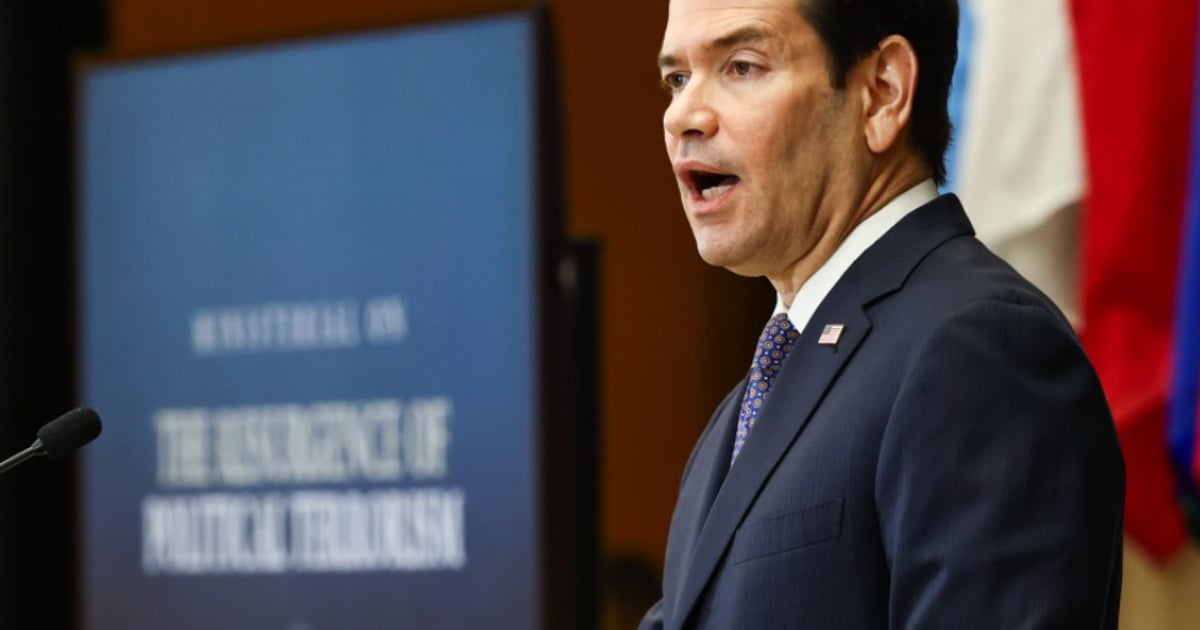
Secretary of State Marco Rubio warned Friday that left-wing extremism poses a serious international security threat, arguing that political violence from the far left is too often minimized or excused by influential institutions. Speaking at a conference focused on political terrorism, Rubio said governments must remain vigilant against threats from Islamic extremist groups while also […]
Secretary of State Marco Rubio warned Friday that left-wing extremism poses a serious international security threat, arguing that political violence from the far left is too often minimized or excused by influential institutions.
Speaking at a conference focused on political terrorism, Rubio said governments must remain vigilant against threats from Islamic extremist groups while also recognizing what he described as a growing danger from radical left-wing movements. According to a transcript of his remarks published by the State Department, Rubio argued that the media and academic institutions frequently dismiss concerns about left-wing political violence as exaggerated or partisan.
He said acts of terrorism should be judged by the same standard regardless of the ideology behind them. A bombing carried out by a neo-Nazi organization, Rubio said, is rightly condemned as an act of evil. However, he argued that similar violence committed by a Marxist or revolutionary group is often portrayed as a misguided attempt to achieve a supposedly honorable goal.
Rubio accused political leaders, journalists, and other influential figures of treating violence differently when it is associated with left-wing causes. He pointed to the unrest following the death of George Floyd in 2020, claiming that destructive acts during those demonstrations were not merely defended but sometimes presented as legitimate political expression.
He also emphasized that far-left terrorism is not a recent invention. Rubio described it as a major source of political violence throughout much of the modern era. He cited figures suggesting that between 1970 and 1980, 93 percent of terrorist attacks in Western countries were committed by groups associated with the extremist left.
According to Rubio, the world is now facing a renewed version of that threat. He referred to recent assassination attempts against a sitting president and the killing of Turning Point USA founder Charlie Kirk, whom Rubio described as one of the most influential conservative activists of his generation.
Rubio characterized radical left-wing violence as being driven by resentment toward established institutions, cultural traditions, achievement, religion, and social order. He argued that extremists who are unable to create or build lasting institutions often turn instead to destruction.
Advertisement
In his remarks, Rubio described radical leftism as a movement that uses the language of equality, justice, and liberation while promoting hostility toward successful individuals and functioning institutions. He said violent extremists seek to tear down what others have built rather than offer practical or constructive alternatives.
Rubio also rejected the familiar argument that communism is appealing in theory but unsuccessful in practice. In his view, communism is objectionable at the theoretical level as well. He said its vision of society discourages ambition, creativity, courage, faith, heroism, and individual excellence.
The world imagined by communism, Rubio argued, is one in which exceptional achievement is viewed with suspicion and human differences are suppressed in the name of equality. He described it as a society stripped of spiritual meaning, historical tradition, and the freedom to rise above ordinary expectations.
Rubio also warned that modern extremist networks can operate across several countries at once. A group might raise money in one country, manage its communications from another, receive training somewhere else, recruit members in a fourth location, and carry out an attack in a fifth.
Because of that international reach, Rubio called for greater cooperation between governments. He said countries must share information, coordinate law enforcement efforts, and close the gaps that terrorist networks use to avoid detection.
Rubio ended his remarks by drawing a distinction between people who build institutions and those who seek to destroy them. Creating something valuable, he said, requires discipline, talent, patience, and cooperation. Destruction is far easier.
His broader message was that political violence should never be ignored or excused because of the cause it claims to represent. Terrorism remains terrorism, Rubio argued, whether it comes from the far right, religious extremists, or the radical left. Governments that fail to apply that principle consistently risk allowing violent movements to grow stronger.
Advertisement