Ukraine Is Not Losing, 'Grandpa' is Not Winning
Yesterday the Atlantic published a story by Anne Applebaum which makes the case that momentum in the war between Russia and Ukraine has shifted. A year ago, the consensus seemed to be that Russia's sheer mass would eventually overwhelm Ukraine, especially if the United Stated ducked out of the conflict. But that's not what has happened. On the contrary, even since Elon Musk turned off Russia's access to Starlink, the war seems to have turned a corner.
Advertisement
Since 2022, many public arguments about the war, even in Europe and the U.S., have adopted the narrative put out by Russian propaganda, tacitly assuming that Ukraine, outmanned and outgunned, would eventually lose. Helping Ukraine was a way to stave off disaster, nothing more. When the Trump administration stopped sending military and financial aid to Kyiv in 2025, some in Washington expected (and maybe wanted) the end to come quickly.
Instead, Europeans have provided money. Ukrainian society produced networked situational awareness. And when Ukrainian President Volodymyr Zelensky toured the Gulf states in late March and signed a series of security agreements, something changed in the international narrative. The leaders of Qatar, the United Arab Emirates, and Saudi Arabia were talking to Ukraine, not because they felt sorry for a war victim, but because they wanted to acquire drone interceptors like the ones I saw in action last weekend. Iranians use the same drone technology as the Russians, and the Ukrainians know better than anyone how to fight it.
The Gulf leaders are not alone: Suddenly, many people have understood that the Russian narrative is wrong: The Ukrainians are not losing. The Russians are not winning, and more important, they don’t know how to win.
Applebaum says the shift in momentum is visible in three different aspects of the war, starting with the ground war.
Advertisement
Since early spring, at the start of its annual offensive, Russia has lost more territory in Ukraine than it has gained. Right now, it is hard to see how the Russian army can move forward, because the front line is not a line at all, but rather a broad no-go zone, some 20 miles wide. Everything inside this zone is visible to drones, which means that any Russian truck, tank, or infantryman seeking to attack new territory is instantly identified and can easily be hit. Because the Russian commanders keep attacking anyway, the Ukrainians are killing and wounding thousands of enemy soldiers, perhaps as many as 30,000, every month. They say their goal is to remove more Russians from the battlefield than can be recruited to replace them, and they may be close to succeeding.
The next big change is Kyiv's ability to strike distant targets inside Russis, such as oil refineries and, most recently, an oil storage facility in St. Petersburg on the day Putin was opening his annual economic forum.
More significant than a handful of strikes in Moscow are the now common attacks on Russia's supply lines inside what used to be Ukrainian territory. Those strikes are making it impossible for Russia to organize a summer offensive and they've already led to gasoline shortages in Crimea.
Finally, there's the PR war. This is arguably one that Russia was winning last year, but no longer. It's now clear to a lot more Russians that the war is not going well and that victory is not just right around the corner.
Advertisement
When Elena Vladimirovna woke up around 4 a.m. to the sound of loud buzzing over her Moscow region apartment, she looked out of the window to see multiple drones overhead.
The noise quickly faded, and she thought the danger had passed. But then came a loud bang from close by.
“Below us, under the balcony, there is a canopy like a ledge. The drone fell on this canopy, and then it burst into flames, black smoke started coming,” she recalled. A room in her fifth-floor apartment caught fire.
The 56-year-old mother-of-two, who preferred not to give CNN her full name, said that she and one of her sons rushed towards the blaze with buckets and basins of water. But when they heard an explosion, they realized they should grab the dog and flee. Her building in Zelenograd was just one of many hit in a mass wave of Ukrainian drone strikes on May 17.
Residents of Russia’s largest cities have largely been sheltered from the daily realities of Russia’s war with Ukraine, now in its fifth year. But as Ukraine increasingly launches long-range strikes into the country, that situation is changing.
Since Putin can't control the reality and the reality isn't going as planned, he's resorted to efforts to control the discussion of reality via social media. But that effort is also backfiring on him a bit. Russians aren't supposed to complain about this media crackdown, but increasingly they are.
Advertisement
Over the past year, Russian authorities have been blocking popular messaging apps and coercing citizens to migrate to MAX, a new state-endorsed messenger platform. The messages there are presumed to be fully accessible to the F.S.B., the state security agency that succeeded the Soviet K.G.B. A recent joke from a comedy show on Channel One, Russian television’s largest outlet, went like this:
“Why are you writing to me in a private chat: ‘Hey everyone!’”? “Well, that’s how it works on MAX!”
That such a joke aired on Channel One — a significant stake of which belongs to Yury Kovalchuk, who also has strong ties to MAX and who is a friend of President Vladimir Putin’s — speaks to the animosity the people of Russia have toward the new app.
Usually the Kremlin faces dissent only from the small, liberal, perpetually-opposed-to-Putin part of society. But the state’s latest policies — blocking the internet on people’s phones, social media and internet messaging apps and running pro-MAX programming around the clock on many other broadcasts on Channel One — are generating criticism among the core of people who favored the war against Ukraine.
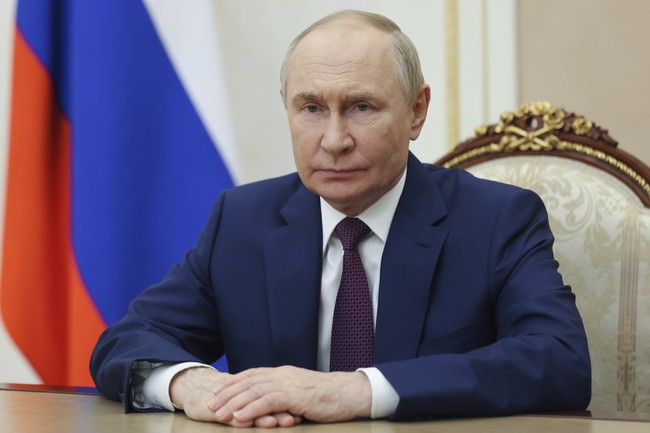
Some Russians are now adopting a new nickname for Putin, one previously only used by the opposition. They call him "grandpa."
Today, the pro-war audience is not happy. In their posts, members are even using the word “grandpa,” a derogatory nickname for Mr. Putin that was previously used mainly by the opposition. It refers not only to his age, 73, but to his relationship with modern technology. The Russian president does not use a smartphone, and only watches television and reads written news reports.
Advertisement
Of course public opinion doesn't really matter much in a police state, but it does show that people are increasingly fed up. And if they are fed up, Putin's cronies are probably getting fed up too. At some point, the system could fracture. Whether or not that happens soon probably depends on Russia's economy which is also struggling.
Editor's Note: Do you enjoy HotAir's conservative reporting that takes on the radical Left and woke media? Support our work so that we can continue to bring you the truth.
Join HotAir VIP and use promo code FIGHT to receive 60% off your membership.