REVIEW: ‘Heartbreak Ridge’
America40: Celebrating the Greatest Movies of 1986
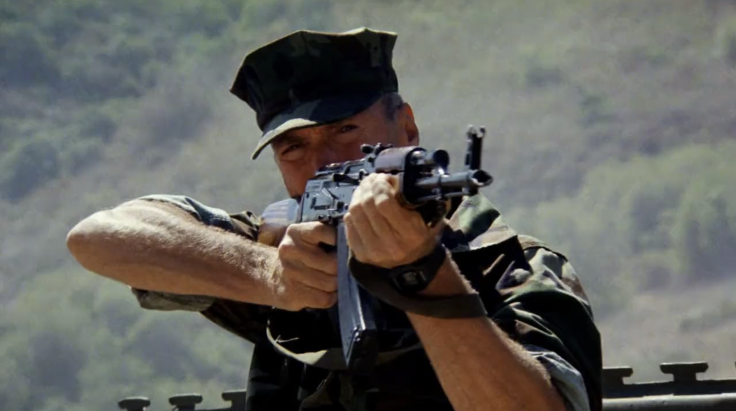 Clint Eastwood in Heartbreak Ridge (IMDb)
When Platoon was released at the end of 1986, I was in college, and the level of excitement was immense. A few months after rah-rah, blah-blah Top Gun had been largely ignored by my fellow left-leaning students, we were all finally going to be shown what it meant to be "in the shit," as Max Fischer would say with awe to Vietnam vet Herman Blume in Rushmore. I didn't see Top Gun until years later, and I hated Platoon. The military movie of the era that spoke to me, an unlikely ROTC cadet who would soon become an unlikely second lieutenant (and sent off to fight a small war in Southwest Asia), was a movie that came out the same month as Platoon: Heartbreak Ridge.
I will always respect Oliver Stone for dropping out of Yale, which he hated, and volunteering for the infantry in Vietnam, providing him with the experience that led to his writing and directing Platoon. But I followed the opposite course: I loved Yale and got an ROTC scholarship to pay for it, despite having no interest whatsoever in the military; like Alvy Singer in Annie Hall, I always pictured myself being classified "4-P. In the event of war, I'm a hostage." Platoon reminded me of an ROTC training weekend in Connecticut, in which it rained nonstop and the only defense I had against it was a "shelter half," a large piece of canvas with no posts to hold it up. Ever been rained on for 48 hours? Unpleasant. Ever try to sleep in a mud puddle squeezed under a large branch only sort of holding up your shelter half? Also unpleasant. It rained excessively in Platoon, it gave me ROTC PTSD, and I thought: If they ever send me off to war, I hope it's someplace dry. Wish granted!
I could not identify at all with the operatic heroes-and-villains theming of Platoon (which may indeed place viewers in the shit, but is also fairly dopey and overwrought; Stone was very young when he wrote it). What I did identify with was Heartbreak Ridge's depiction of garrison life—the hanging out part of the military career, the bit between wars, and consequently the vast majority of your life in uniform. The soldiers (in this case, the Marines) play tricks on each other, goof off, go on runs, do whatever their day-to-day assignments may be. Watching over them all is a clueless young dope barely out of school, as I would soon be. He's played by a Broadway song-and-dance man named Boyd Gaines. Gaines's character sports what military folk call BCs—military-issue horn-rims so chunky they're nicknamed Birth Control glasses—and tries his wobbly best to seem like a leader of men. Like me, he was a student of his own incompetence and understood the importance of deferring to his nominal inferiors, the senior NCOs, who have vastly more experience and relevant knowledge than the lieutenants but do not have college degrees. The LT's top sergeant—Gunnery Sergeant Tom Highway—is played by another song-and-dance man, Clint Eastwood.
Through Eastwood's character, who is hilariously trying to win back his ex-wife by becoming a sensitive, communicative modern man (though forever scarred by a battle on the titular ridge back in the Korean War), the movie provides a quintessential portrait of garrison living, from the way he trolls the troops with his unpredictable choice of T-shirt for the morning run (everyone who doesn't have a match is out of uniform and consequently has to scramble to get the right one) to his joining in the endless fraternal infighting that means your worst enemy isn't the Russians or the Chinese, it's Delta Company or Second Battalion or what have you. During a gladiatorial fight between Gunny Highway's Recon platoon and a rival, he offers an unforgettable iteration of a maxim I would hear many times in the Army: "If you ain't cheatin', you ain't tryin'." "Your man cheated!" he is told by a disapproving officer after Highway's handpicked Marine bests two others with a double gonad-punch. "I say he improvised," Eastwood's Highway responds, with a textbook snarl. "He adapted. He overcame."
Sneakily, by being tough on his Marines as individuals but fiercely devoted to them as a group, Gunny Highway is transforming these slackers into a band of warriors. He instills in them a level of cohesion and interdependent loyalty that nonmilitary people can never know, unless they devise the means to get shot at in their office cubicles. Even more sneakily, the movie, directed by Eastwood from a script by James Carabatsos, who fought in Vietnam at the same time as Stone, shines a light on a path out of the darkness for the American military that Stone got lost in.
From the late 1960s, drug use and bad behavior became rampant in the military and morale sank to an all-time low, where it remained throughout the 1970s, perhaps hitting rock bottom during the Carter years. America lost confidence in the military, and the military lost confidence in itself. Top Gun was a whiz-bang sugar-high fantasy portrait of American military might. It made the military look fun, sleek, and cool. But Heartbreak Ridge, which hits a climax when Gunny Highway's men, finally shaped into a fierce and lethal force that successfully carries off the 1983 invasion of the Caribbean island of Grenada, is more or less an accurate portrayal of how the military—and the country—rebounded.
The troops rescued some 600 American medical students from St. George's University who were being detained in their dorms by homicidal Cuban-backed Marxists who had shoot-to-kill orders. In a scene that exemplifies the "he adapted, he overcame" ethos, the troops, whose radios aren't working, use a civilian phone and a credit card to make a call back to Fort Bragg to call in an airstrike (something like this actually happened).
This was just four years after Iranian revolutionaries, putting a cap on the '70s and the Carter era, broke the spirit of our country by holding 66 Americans hostage for more than a year. The invasion of Grenada, though much joked about at the time by late-night comics (and my fellow students, who I was beginning to suspect didn't love their country as much as I did), was a small but crucial confidence-building measure. The American military could do good things, punish evil, and ward off disaster. We could take action to protect our citizens instead of wringing our hands while foreign dictators had their way with them. Heartbreak Ridge dramatized this essential change of outlook with the same flair for both disarming comedy and audacious self-confidence that characterized the commander in chief himself. Ronald Reagan was president. America was back, baby.
Editor’s note: This retrospective review is one in a series celebrating 1986, arguably the greatest year in movies—inarguably if you're Gen X.
Kyle Smith is a columnist and film critic at the Wall Street Journal.