A Flag Worth Defending
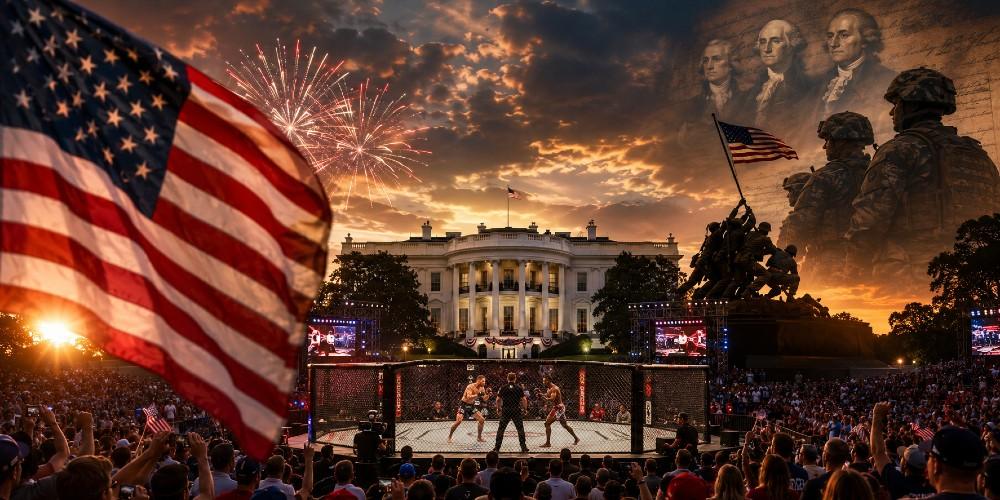
June 14 is both Flag Day and the U.S. Army’s two-hundred-fifty-first birthday. As part of America’s ongoing celebration of its sestercentennial this year, President Trump asked the Ultimate Fighting Championship to hold a mixed martial arts contest on the South Lawn of the White House tonight. UFC Freedom 250 promises to be a fun and patriotic tribute to the greatest country in the world.
This important year in American history finds our nation more fractured than we would like. Fifty years ago, when bicentennial events celebrated America’s two-hundredth birthday, the country was divided, too.
After WWII, returning veterans entered a workforce energized by prodigious industrial growth. Young families bought new homes, had babies, embraced new technologies, enjoyed the comforts of consumerism, and pursued the post-war tranquility of the widely advertised American dream.
As the 1950s came to an end, so did the relatively peaceful respite that gave Americans a sense of common purpose, gratitude, resolve, and quiet dignity. The ‘60s counterculture; the civil rights movement; the sexual revolution; the rise of women in the workforce; the assassinations of President Kennedy, his brother Bobby, and Martin Luther King Jr.; the Vietnam War; the Watergate scandal; and the resignation of President Nixon shook America like a carbonated beverage ready to explode.
When the bicentennial arrived in 1976, Americans chose the milquetoast Jimmy Carter over the forgettable Gerald Ford for president; however else one recalls Carter’s economic and foreign policy blunders, his leadership resembled the color beige. Remembered for his administration’s inability to avert fuel shortages and failure to rescue American hostages held by Iranian terrorists for four-hundred-forty-four days, Carter lacked charisma, and his presidency was neither inspiring nor dynamic.
Still, even amid the challenges of the mid-70s, Americans celebrated the bicentennial with enthusiasm. The turbulence, violence, and uncertainty of the previous decade and a half were put on back burners as Americans took time to appreciate their role as the temporary custodians of an American Experiment that had survived two full centuries.
Political and social divisions were placed in proper perspective — as smaller patches of a larger American quilt that had successfully woven past tribulations into the nation’s resilient threads. Even during a decade when America felt as if it might come apart at the seams, there was enough common patriotic regard for the country’s historic achievements to unite Americans in the spirit of bicentennial triumph.
Fireworks and festivities celebrating America’s birth two centuries earlier were a timely reminder that the country’s promise, fortitude, and proven greatness far exceeded its missteps, miseries, and failures. In 1976, Americans put petty grievances aside to celebrate the one thing they had in common: a country of their own.
In the two-hundred-fiftieth anniversary of America, we do not have a mostly forgotten Gerald Ford or beige Jimmy Carter at the helm. We have a president in the White House who has put his stamp on history much the same way that John Hancock put his signature on the Declaration of Independence.
From reordering global trade and military alliances to renovating and rebuilding parts of Washington, D.C., President Trump looks for opportunities to improve and strengthen America in big and small ways. UFC Freedom 250 is not just a chance for Americans to see great fighters in a historic venue; it’s a conscious change in attitude for the country.
President Obama and the Democrat Party declared war on masculinity, diagnosed it as a “toxic” disease, and condemned strong, confident males as a kind of black mold that must be fumigated and discarded as part of the demolition of America’s so-called “patriarchy.”
In the decade and a half since Democrats began dragging the country through the humiliation ritual of rebranding masculine virtue as a threat, a Jimmy Carter kind of malaise spread across the continent like a “politically correct” fog choking the American spirit. Obama and the Democrats’ desire to collapse the “patriarchy” reflects their hatred for the ideals and principles of the Founding Fathers.
Their war against American men living today has been just a small battle in a much larger campaign meant to undermine America’s historic role in the fight for human liberty. By rejecting the wisdom of the Founding Fathers and tarnishing both the Declaration of Independence and the Bill of Rights as irrelevant relics of a system that denied female suffrage while permitting slavery, Democrats’ loathing for masculinity has provided cover for their hostility toward America’s role as the birthplace for enduring freedom.
UFC Freedom 250, then, should be seen in the context of this ongoing war against both masculine virtue and the genius of our inimitable Founding Fathers who advanced protections for self-government, natural rights, and personal liberty.
Physical combat is not a base entertainment or vile grotesquerie; it’s an opportunity for fighters to demonstrate mental and physical strength that can be built only through hard work, commitment, and discipline. Every fight is won well before it begins; it is the fighters’ preparation and toughness that control the outcome. In the same way, America will overcome adversaries and succeed in the future only by preparing today.
That is the message for America. The White House is using UFC Freedom 250 not only to celebrate America’s sestercentennial but also to inspire Americans to become tough fighters, themselves. The Democrats’ vision for America — in which grievances, whining, and enforced “political correctness” dominate the public square — rejects victory and embraces defeat.
Whether in a fight between warriors or a fight between nations, you perform as you train. Democrats’ campaign against the Founding Fathers’ love of freedom and “toxic” masculinity, more generally, is how you condition a nation of people to accept surrender. Championing grit, determination, mental toughness, and physical strength is how you prepare your countrymen to force other nations’ surrender. Peace, security, and liberty are not freely given; they must be fought for, obtained, protected, and preserved.
It is all the more fitting, then, that June 14 is also the Army’s birthday. “This We’ll Defend” isn’t just a motto; it’s a state of mind. Wherever American soldiers go, they set up a perimeter and promise to repel any attempted breach.
Where the American flag rises overhead, the American soldier digs in and holds that patch of earth regardless of threat or duress. And because the American soldier has earned a reputation for defending the American flag fearlessly, America’s enemies know that they forfeit their lives when they come for that flag.
Those who have prepared their bodies and minds to defend the country tell themselves, “Hold the line,” and tell the enemy, “Not today.” We celebrate Flag Day today because our American soldiers celebrate Flag Day every day.
In turn, the American flag has become a symbol of resolute courage in a world too often tormented by both real and imaginary fears. When Americans find themselves in trouble overseas, they look for that flag and run toward it. When enemies see that flag coming, they turn around and run away.
The American flag is, by far, the most powerful symbol on the planet. When we fly it and honor it, we wrap ourselves in two and a half centuries of American daring, fearlessness, and bravery. We borrow from the strength of past generations and have a duty to ensure strength for future generations. Freedom is never free. There is a price that American patriots must pay.
Think about the cost of freedom during this Flag Day. Consider what it means to be a sentry holding the line against all enemies, foreign and domestic. That job will never be easy because anything worth having always comes with a fight. In one corner are those who fear the challenges ahead. In the other corner are those who have prepared to conquer fear. Pick your side. Find your courage. Stand. Fight.