Tidal Waves Of Drones Coming To Battlefields Across The Globe
Manufacturers around the world are leveraging AI to create drone swarms that could change the reality of war forever.
Both defensive and offensive drone swarm systems are slated to hit global battlefields in the near future. As companies such as Swarm Defense create new systems that will launch tidal waves of drones at targets, other companies like XCaliber Technologies are rapidly working to build a wall of drones and other defensive systems that can defeat the new offensive threat.
Keeping production costs down is critical, as the drones are one-time-use offensive munitions. (RELATED: AI Fighter Jets Take To The Skies)
“Swarm Defense Technologies builds American-made drones at manufacturing scale, along with the software that lets one operator command many of them at once,” a Swarm Defense spokesperson told the Daily Caller News Foundation. “We come out of nine years and tens of thousands of drones of production heritage, and every system we field operates human-in-the-loop, with a person making each engagement decision.”
One video that Swarm Defense posted on X depicts what appears to be hundreds of these drones operating in a contiguous wave, all controlled by a single operator.
Meeting Offense With DefenseThis is not a concept..
Hundreds of drones flown by a single operator.#swarmdefense #droneswarm #militarytech #uas #cuas #dronedominance pic.twitter.com/ppN9OhdKab
— Swarm Defense (@swarm_defense_) April 28, 2026
“Drone technology is a new and progressing tech. It has not and is not likely to fundamentally change the character of war. Frankly, every new, relevant technology in the last 100 years has been heralded as ‘changing’ the nature of war,” national security expert Steven Bucci told the DCNF. “But soon methods to counter them will catch up, and while they will still need to be accounted for, worried about, and considered by both sides in future conflicts. War will go on, with as much continuity as there is change.”
As offensive drone swarm threats of this nature continue to develop and become more advanced, companies such as XCaliber Technologies work to develop defensive capabilities that could defeat this new threat. XCaliber Chief Executive Officer Foad Faridzadeh explained that his company is developing a five-layer system to defeat all kinds of drone threats, from the smallest drones unleashed in the thousands, all the way up to singular jet-powered drones flying at nearly supersonic speeds.
XCaliber’s Phoenix laser system would be used to take out the smaller targets, like drone swarms, Faridzadeh told the DCNF.
“Our [Phoenix] laser has a two-kilometer range with a 1.5-kilometer neutralization capability,” Faridzadeh said. “And it goes through three inches of steel in two seconds.”
But this would not be sufficient to take down bigger targets at longer ranges. XCaliber’s Falcon system would be employed to take down bigger targets, Faridzadeh told the DCNF. He said that the Falcon would hunt down larger targets and then deploy a small warhead to attack the target, and then return to base to be re-armed.
“Falcon is $150,000 with a warhead that is only $30,000,” Faridzadeh noted. “As you can see, it’s a very insignificant cost for our defenders to be able to deter these types of anomalies that are growing by the day.”
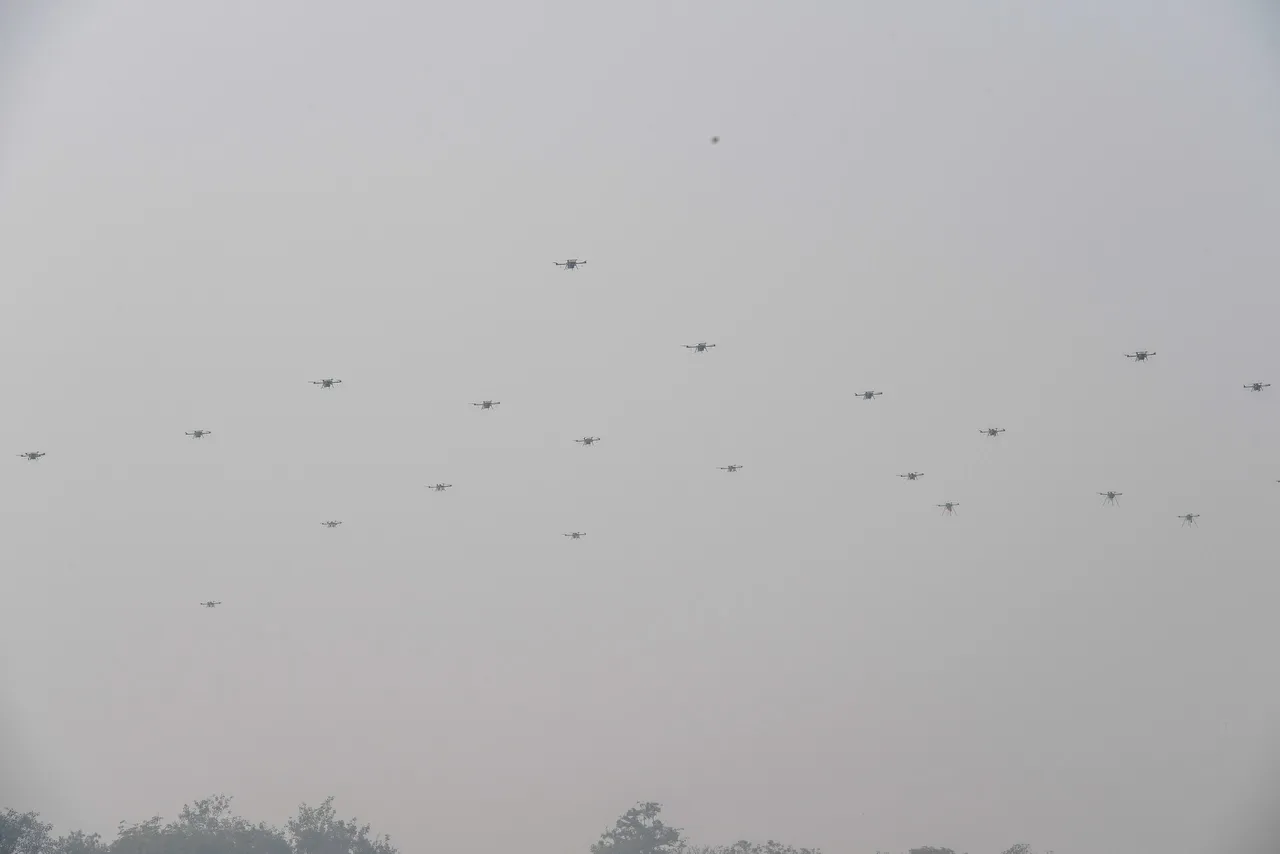
Members of the offensive swarm drone system fly drones to demonstrate skills during a ceremony to celebrate India’s 73rd Army Day in New Delhi on January 15, 2021. (Photo by PRAKASH SINGH/AFP via Getty Images)
Between the Phoenix laser and the Falcon interceptor lies a middle-tier defense, the Starling. The Starlings are smaller drones that are designed to intercept small to medium-sized targets within a five-kilometer radius.
Faridzadeh also described the Hummingbird system, which could defend convoys. The Hummingbird drones can follow along a convoy of trucks or military vehicles and then form up to defend the convoy as drone threats appear.
The systems that XCaliber is developing to use against drone swarms are entirely kinetic, meaning they don’t rely on electronic warfare to take down drone swarms. Kinetic systems rely on physical impacts or explosives to destroy their targets.
Electronic warfare and other jamming technologies could jam friendly communications systems, so it is in the best interest of friendly forces to utilize kinetic systems.
Another system in development by XCaliber is the Sparrow, a rocket-powered interceptor that flies at Mach two to rapidly intercept high-value targets.
The XCaliber drone defense system is currently proposed to be sold in a wholesale package worth $30 million, called Eagle Eye.
The Eagle Eye system includes a command vehicle, called the Rhino, that would be used to manage the defensive operations, and four Starling batteries that each contain 48 Starling interceptors.
This could be supplemented by the Phoenix laser defense system, with a projected cost of $12 million. The Phoenix system would be commanded by “MOSES, our AI-enabled C4 command-and-control platform, allowing coordinated deployment of up to 16 Phoenix systems across a defended battlespace with sensor coverage extending up to 55 kilometers,” according to an XCaliber spokesperson.
The Hordes Are ComingBut these developments from XCaliber are all defensive systems. Some of the most jarring developments in the industry are the offensive systems, such as those being developed by Swarm Defense. (RELATED: The Latest Sign Killer Robots Are Destined To Rule The Waves)
“The problem we exist to solve is the one the Department of War has placed at the center of its drone dominance effort,” a Swarm Defense spokesperson told the DCNF. “America needs affordable, attritable, domestically-produced drones, and the software to coordinate them in numbers, at a scale legacy programs were never built to reach. Our counter-UAS training systems already fly against U.S. military air-defense units today, and our one-way attack and close-quarters platforms carry that same manufacturing base into offensive capability.”
Systems that are “attritable” are designed to suffer through attrition, or sustained losses. Attritable systems are designed to have a much lower cost so that when they are expended in combat, they have a much lower financial impact on the forces that are operating them, according to Military Embedded Systems.
Another video from Swarm Defense in an X post shows just what these drone hordes could look like.
Commercial innovation continues to accelerate defense capability.
Our Swarm Threat Emulator (STE) is built on years of operating autonomous drone swarms at scale across both the commercial and defense industries. The same technology that has powered thousands of coordinated… pic.twitter.com/4eA1wYONPx
— Swarm Defense (@swarm_defense_) July 1, 2026
“We don’t discuss unit pricing publicly, but attritability is central to how we approach cost,” the Swarm Defense spokesperson told the DCNF.
“Our goal is to put affordable, American-made drones and swarm coordination in the hands of the US warfighter at the scale the mission demands,” the spokesperson said DCNF. “We are in volume production today on the commercial side at more than a thousand drones a month, and we are scaling defense production in step with program demand.”
China is not far behind. The Chinese defense industry is developing similar systems that companies like XCaliber could have to face in a future near-peer conflict.
Chinese state-run outlet CGTN America reported in March that China publicly demonstrated the full operational process of its Atlas drone swarm for the first time, with one operator controlling 96 drones launched at three-second intervals, according to an X post.
The Evolution Of DronesChina publicly demonstrated the full operational process of its Atlas drone swarm for the first time. pic.twitter.com/AoLxQLlOJ4
— CGTN America (@cgtnamerica) March 26, 2026
While these drone swarms are new, the genesis of this technology was formed in conflicts throughout the globe, where singular drones acting alone have caused substantial damage.
Unverified videos began to surface from the battlefield in Lebanon, where vehicles like Merkava main battle tanks began to fall victim to fast-moving drones armed with shaped charge warheads. The drones attack their targets from the top down, negating active protection systems. However, it is unclear if the videos depict successful hits. The videos often cut out at the moment of impact when they either lose signal or the fiber optic control cable gets cut.
Technology of this nature was initially pioneered in the Russo-Ukrainian war, where similar drones were used to disable Russian main battle tanks. A video on X from the official Ukrainian military account depicts what these attacks can look like in real life.
A russian tank + a Ukrainian FPV drone = powerful explosion.
📹: 47th Mechanized Brigade pic.twitter.com/QT4ETBRFVo
— Defense of Ukraine (@DefenceU) May 19, 2024
Notably in the video, a sort of fence or grid is visible above the turret on the tank. This is called a “cope cage” and is intended to help defend against these small, agile drones.
The British army is considering putting cope cages on its Challenger 2 main battle tanks, The Defense Post reported on January 29, 2025.
Larger drones have also been devastating for both sides in the Russo-Ukrainian conflict.
Ukrainians launched a drone attack on a dormitory in Russian-held Luhansk on May 23, Reuters reported, citing Russia’s human rights commissioner, Yana Lantratova. The Russians retaliated for the dormitory attack by using an Oreshnik missile, 600 strike drones and 90 air-, sea- and ground-launched missiles on May 24, The Associated Press reported, citing the Ukrainian Air Force.
All content created by the Daily Caller News Foundation, an independent and nonpartisan newswire service, is available without charge to any legitimate news publisher that can provide a large audience. All republished articles must include our logo, our reporter’s byline and their DCNF affiliation. For any questions about our guidelines or partnering with us, please contact licensing@dailycallernewsfoundation.org.