Inside The Plan To Build A New American Internet
A new proposal to build a domestic internet could strengthen U.S. cybersecurity as the digital world sinks its fingers into every aspect of American life.
InfraCo, a 501(c)4 nonprofit, has a meeting with the Department of Transportation next week to propose the $125 billion President Donald J. Trump Digital Security and Information Superhighway Act, which would lay the groundwork for the creation of a publicly owned domestic fiber-optic internet system. InfraCo is calling this system the National Broadband Master Plan, and it could harden U.S. digital infrastructure to be more resistant to foreign cyberattacks.
“We’ve got basically everything connected to the public internet, right?” Vince Aragona, the founder of Neo Network Development LLC, the parent company of InfraCo, told the Daily Caller News Foundation. “And ultimately, that includes 195 foreign countries, 5.6 billion people, you know, in any one of them with a laptop and a decent internet connection could theoretically attack us from any place on earth.”
“TDS-ISA [President Donald J. Trump Digital Security and Information Superhighway Act] is a very big idea with multiple stakeholders working in close collaboration to implement on an accelerated, 5-Year timetable but given the real and present dangers and threats to Homeland Security, National Defense, life, health and human safety, hardening our governance, military and intelligence capabilities, protecting and fortifying our most critical infrastructure from malicious acts of cyber-terrorism, cyber warfare and preserving our national institutions and sovereignty is in everyone’s best interest,” Aragona told the DCNF.
Aragona told the DCNF that this project will bridge nearly all branches of the U.S. government in a cooperative effort to strengthen America.
“We describe the method as a ‘Whole of Government’ approach that we envision involving the DoW (Secretary Hegseth), State (Secretary Rubio), Commerce (Secretary Lutnick), Transportation (Secretary Duffy), Energy (Secretary Wright) Interior the DCDC (Gen. Stanton), FWHA (Administer McMaster), the FCC (Chairman Carr) under the leadership of President Trump and would ultimately involve congressional appropriations and legislation though various committees,” Aragona told the DCNF.
The plan would negate that threat by moving all of the U.S. digital infrastructure into a closed loop where it would be much harder for foreign adversaries to access or tamper with our data networks. (RELATED: Congress, Big Wig Investors Have New Theory To Explain America’s Data Center Revolt)
“We really need to protect ourselves from the internet, so this is kind of an alternative to the internet,” Aragona told the DCNF. “We actually see the internet as our key vulnerability from a national security, homeland security and national defense perspective.”
InfraCo plans to work with with private and public companies and agencies to build a network of pipelines and fiber-optic cables that run alongside the U.S. interstate system. Technically, these would be considered “dark fiber” or inactive fiber-optic cables that remain available for whenever a public or private entity would like to use it.
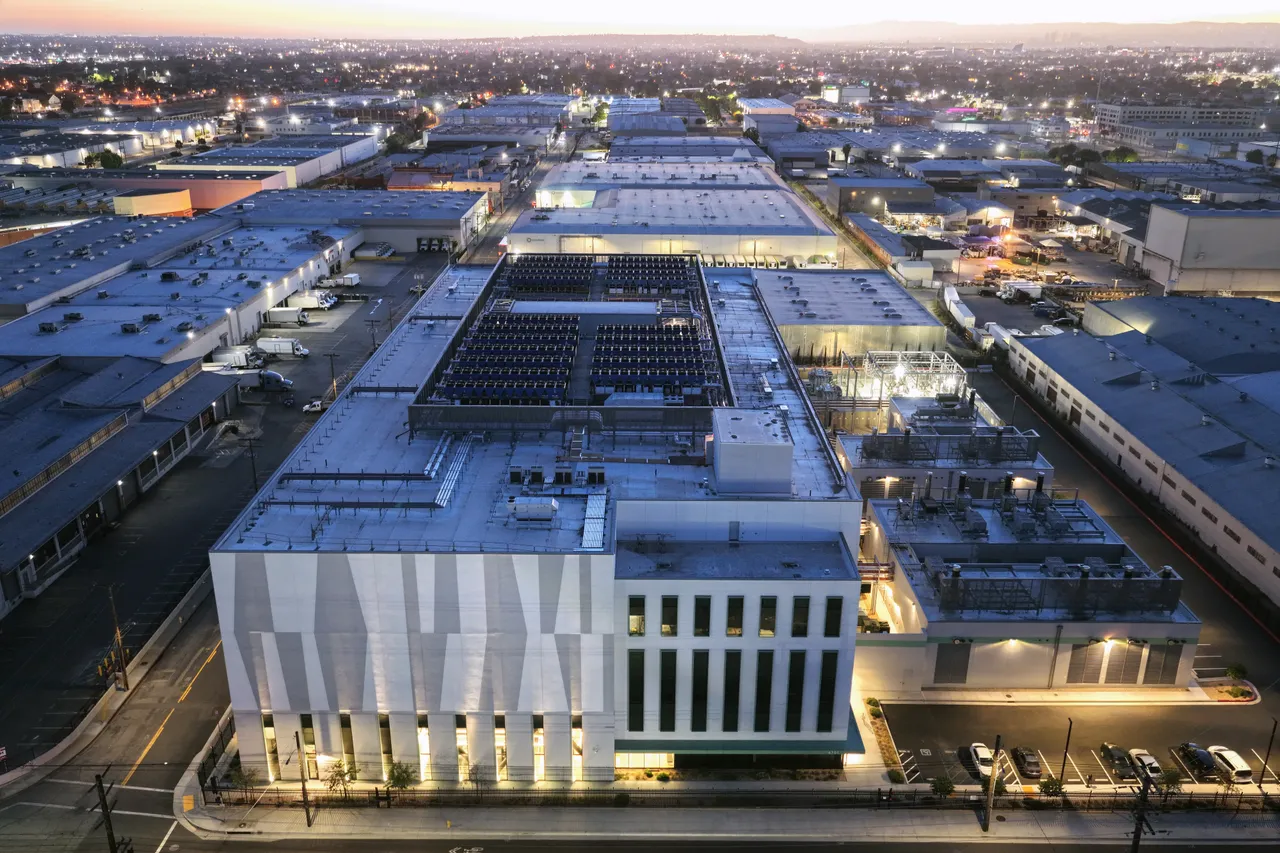
An aerial view of a 33 megawatt data center (C) with closed-loop cooling system on April 14, 2026 in Vernon, California. A surge in demand for artificial intelligence (AI) infrastructure is fueling a boom in data centers across the country and around the globe. (Photo by Mario Tama/Getty Images)
‘Can’t’ Farm It OutChina is decades ahead of the U.S. when it comes to the domestic development of a hardened fiber-optic system.
Beijing completed a 2,000-kilometer fiber-based quantum secure communication backbone linking major cities in 2017, later expanding it into a 10,000-kilometer network covering 17 provinces and 80 cities, according to a 2025 report from the U.S.-China Economic and Security Review Commission.
“The Chinese built their own security, a secure internet, a fiber-optic system, over the last 25 years,” former State Department chief financial officer and Neo Network Board Chairman Bradford Higgins told the DCNF. “Unfortunately, the way we’ve approached this, we let the private sector do it. It’s one of those things where I felt very strongly, as a CFO at the State Department, is that there’s certain things that are inherently governmental that you can’t just sort of farm it out to the private sector.”
The Office of the Director of National Intelligence (ODNI) said that the U.S. is constantly vulnerable to cyber attacks from foreign adversaries.
“Cyber actors from China, Russia, Iran, North Korea, and ransomware groups will continue to pose critical threats to U.S. networks and critical infrastructure,” according to the ODNI 2026 annual threat assessment. “These global cyber actors almost certainly will continue malicious cyber activities because they gain unmatched intelligence collection value and financial incentives from these operations. These cyber adversaries also have the ability to pre-position or execute disruptive and destructive attacks against U.S. critical infrastructure and other targets.”
U.S. agencies confirmed that Chinese-backed cyber attacks compromised the IT environments of multiple U.S. critical infrastructure organizations, according to a Cybersecurity and Infrastructure Security Agency report on Feb. 7, 2024,
Also, Iranian-affiliated cyber actors targeted U.S. water infrastructure in November 2023, according to a joint advisory from U.S. intelligence agencies on April 7, 2026.
“We’ve known for 25 years, the Chinese have told us that if they ever went to war with us, they’re going to shut down our communications and electric systems,” Higgins told the DCNF. “So it’s not like an ‘if’ … that’s how someone would attack America.”
The project would have conduit pipes to protect the fiber-optic cables. These pipes would have 47,000 physical, cast-concrete access points every mile with a power meter, a transformer and an aboveground vertical pole that could be used for transportation agencies and commercial use.
The goal is to organize the project as a 501(c)(4) and “Public-Private Partnership” with the U.S. Department of Transportation, Federal Highway Administration, State Departments of Transportation, Funded Using a combination of taxpayer appropriations and private equity.
The Department of Transportation, the Federal Highway Administration and the White House did not respond to a request for comment.
U.S. Cyber Command told the DCNF they are unaware of the proposal.
Former U.S. Army officer and Neo Network Board Member Terry Kelly told the DCNF that this project could strengthen the U.S. military if it moves forward.
“All modern militaries require extraordinarily reliable and capable communications to pass data to do the things that they need,” Kelly told the DCNF. “If you look at the intel feed, what the military uses, there are terabytes and terabytes of data for the ability to reliably and consistently and very quickly pass that information. It’s extra important with the advent of AI … because AI, of course, requires very fast decision cycles and an integrated ability to push data.”
“AI is embedded in everything that we do now. Command and control systems, I mean, if you think just again going back to intel, the ability to get through terabytes of data, find the things that are important, find the things that you need, and then use those things, that’s an enormous amount of data,” Kelly told the DCNF. “AI can do that stuff extremely well.”
One data expert told the DCNF that this program is a good start to data security for the U.S. government.
“Calling attention to this is a good first step—this issue is top of mind for Trump’s FCC and Chairman Carr has been keenly focused on addressing our network’s security via a myriad FCC proceedings,” Joel Thayer, senior fellow for AI & Emerging Technology at the America First Policy Institute, told the DCNF. “A national dark fiber and conduit network is technically realistic. America has laid big telecom backbone before, and states already run fiber along their highways.”
Who Pays For This?Thayer cautioned that the construction isn’t the big challenge; the operation of the system is.
“The hard part isn’t the digging; it’s who runs it and how,” Thayer told the DCNF. “Putting government traffic on its own dedicated fiber does reduce some risks, but most breaches don’t come through the cable in the ground. Nowadays, they come through people, passwords, and the systems on either end, so a new network only gets you so far.”
The way that Aragona described the proposed management system sounds remarkably similar to the Federal Reserve, which operates with a mix of public authority and private-sector involvement.
“It’s intended not only to solve the immediate needs of government and government agencies, but also it’s intended to generate non-tax revenue, so that it becomes self-sustaining and resilient,” Aragona said. “So, it’s a different animal”
InfraCo’s plan has multiple steps, first the U.S. interstate system would receive the conduit, fiber optic cable and access points. After this is completed, the plan is to expand onto federal highways, and then finally state and county roads.
Thayer cautioned that a plan of this nature could work, but the U.S. needs to be sure that no foreign companies are allowed to get their hands on the construction of this system.
“So, the first question on any plan this size is what it protects that we can’t already protect for less,” Thayer told the DCNF. “Before anyone spends real money, lawmakers ought to be asking what we actually get per dollar, who controls access, who’s allowed to build it — and it should be trusted American companies, not foreign ones. That way you keep one large, centralized system from becoming a single point of failure.”
Higgins told the DCNF that there is a way to make this happen without costing the taxpayers anything.
“In the meantime, the revenues from it, from being paid to the government, would largely make this self-sustaining, rather than have a government be expected to pump in billions of dollars every year to support it … we’re not looking to the taxpayers to pay for this, ” Higgins told the DCNF. “If they [key industry players like Microsoft, Google and Amazon] pay rent … it should be self-sustaining. Money should be going in to keep it upgraded rather than having to ask Congress for a couple 100 billion every year.”
All content created by the Daily Caller News Foundation, an independent and nonpartisan newswire service, is available without charge to any legitimate news publisher that can provide a large audience. All republished articles must include our logo, our reporter’s byline and their DCNF affiliation. For any questions about our guidelines or partnering with us, please contact licensing@dailycallernewsfoundation.org.