As Medical Org Pushing Child Sex Changes Lucks Out In Court, A Bigger Legal Battle Brews
Florida’s lawsuit against a medical association pushing child sex change procedures is stalled after a federal judge declared the case to be “weak” — from nearly 1,000 miles away.
The ruling has sparked a legal battle over whether federal judges in blue states can constrain red states from enforcing conservative policies. This week, a Clinton-appointed federal judge in Illinois blocked Florida Attorney General James Uthmeier from prosecuting the American Academy of Pediatrics (AAP) for allegedly deceiving parents and children about sex-change procedures on minors.
Uthmeier and other state attorneys general say the ruling could have grave implications about overreach of the federal judiciary.
Uthmeier initially sued AAP, the World Professional Association for Transgender Health (WPATH) and the Endocrine Society in December under a false claims law. The AG accused AAP of false advertising because it promoted sex-change procedures on minors as safe and reversible, without sufficient scientific evidence.
WPATH is an association of doctors and medical experts that publishes standards of care for transgender surgeries. The AAP helped convince WPATH to removing age minimum requirements irreversible sex-change procedures in WPATH’s most recent Standards of Care (SOC-8) guidelines in 2022, the Daily Caller News Foundation previously reported.
AAP, WPATH and Uthmeier’s office did not respond to the DCNF’s requests for comment.
AAP filed a lawsuit in March against Uthmeier at a federal court in Chicago, and so far the generally left-leaning court has ruled against Florida. WPATH and the Endocrine Society are not a part of the federal cases. (RELATED: EXCLUSIVE: Here’s How A Small Band Of Pediatricians Pushed Medical Org Into Nixing Age Minimums For Sex Changes)
District Judge Matthew Kennelly ruled June 2 that Uthmeier’s lawsuit in Florida cannot continue. Kennelly issued a restraining order Tuesday that barred Uthmeier from continuing the Florida case against AAP.
“And although state attorneys general are entitled to have enforcement priorities, the weakness of the state complaint suggests that Uthmeier is retaliating against AAP without a reasonable expectation of success,” Kennelly wrote.
Kennelly’s memorandum opinion goes into great detail about the facts of Uthmeier’s lawsuit in Florida courts. He assessed the complaint and found Uthmeier’s arguments were weak and at times misrepresented AAP’s and WPATH’s statements on sex-change procedures. Kennelly determined that Uthmeier’s lawsuit was “undertaken in bad faith and without a reasonable expectation of success.”
Uthmeier appealed to the Seventh Court of Appeals, which on Wednesday denied Uthmeier’s request for an immediate administrative stay on the restraining order. Indiana and 21 other states filed an amicus brief supporting Uthmeier’s appeal in the Seventh Circuit.
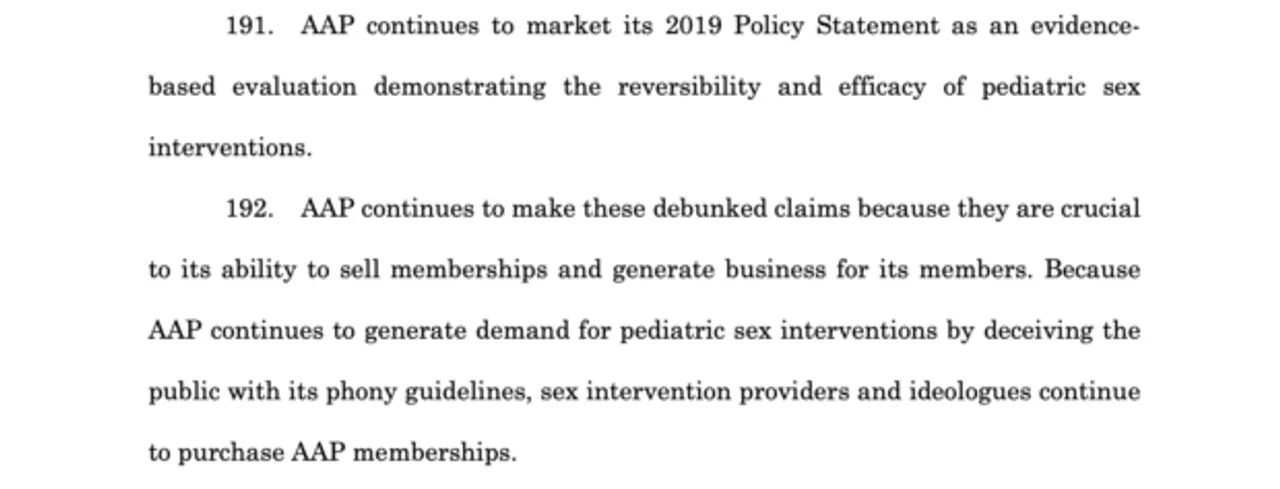
Screenshot of Florida AG Uthmeier’s lawsuit against AAP, WPATH and the Endocrine Society (Florida AG’s office/Court Documents)
The red state AG’s said in their brief that federal jurisdiction “would soon swallow state authority if a federal court could seize control of a state court action merely because it might make a different decision than a state court.” (RELATED: EXCLUSIVE: Parents Urge Congress To Investigate Pediatricians Pushing Transgenderism On Minors)
“No Florida court has yet ruled that the Attorney General’s claims are utterly without merit under Florida law, and it very well may turn out that the Attorney General will win his lawsuit in state court. But the district court did not even attempt to discern how Florida courts would apply their law (as one would expect a federal court to do in any case about state law). It did not cite a single Florida decision. Rather, this Illinois-based district court considered one factor only—its own view of what makes for a ‘weak’ claim,” the amicus brief says.
Kennelly’s ruling was an unprecedented action from the federal judiciary, Uthmeier’s office wrote in its emergency appeal to the seventh circuit Tuesday.
“That injunction is historic, for all the wrong reasons,” Florida’s motion says. “So far as Appellant Florida Attorney General James Uthmeier can tell, no federal court has ever enjoined an enforcement action pending in another State in this context, let alone an enforcement action filed by another State’s chief legal officer.”
Blocking the state case means Florida “would suffer the sovereign harm of being told by a faraway federal judge that it cannot pursue a civil enforcement action brought under Florida state law in Florida state court, and its consumers would continue to suffer the consequences of AAP’s illegal conduct,” Uthmeier’s filing states. “If the injunction is stayed, AAP will merely continue asserting its First Amendment defense in state court, which is not an irreparable injury.”
Judge Kennelly on June 2 argued Uthmeier’s claims that the jurisdiction was improper because “a federal court may enjoin a state proceeding that is brought in bad faith or to harass.”
AAP argued that Uthmeier’s emergency appeal was meritless and “would allow Uthmeier to resume the retaliatory and unconstitutional enforcement action in Florida state court that the district court determined is causing irreparable harm to AAP while this Court considers the stay motion.”
“That is not a temporary ‘pause’ to maintain the status quo—it is the ultimate relief the Attorney General seeks on appeal,” AAP wrote in a court filing on Tuesday.
AAP has defended its statements on free speech grounds and contend that Uthmeier’s claims about false advertising are moot because the association does not profit directly from sex-change procedures.
Kennelly admitted in his ruling that “some portions [of AAP’s guidelines] do seem to approve of and promote gender-affirming care, but they do so in a way that resembles standard scientific and medical advocacy, not a money-making scheme,” he wrote.
The AAP has faced criticism for its guidelines on sex-change procedures for minors. The UK’s 2024 Cass review found that documents including AAP’s policy guidelines on gender procedures for minors, WPATH’s SOC-8 and the Endocrine Society’s guidelines did not meet accepted criteria for clinical practice.
All content created by the Daily Caller News Foundation, an independent and nonpartisan newswire service, is available without charge to any legitimate news publisher that can provide a large audience. All republished articles must include our logo, our reporter’s byline and their DCNF affiliation. For any questions about our guidelines or partnering with us, please contact licensing@dailycallernewsfoundation.org.