Tina Peters’ Escape from Devil’s Island
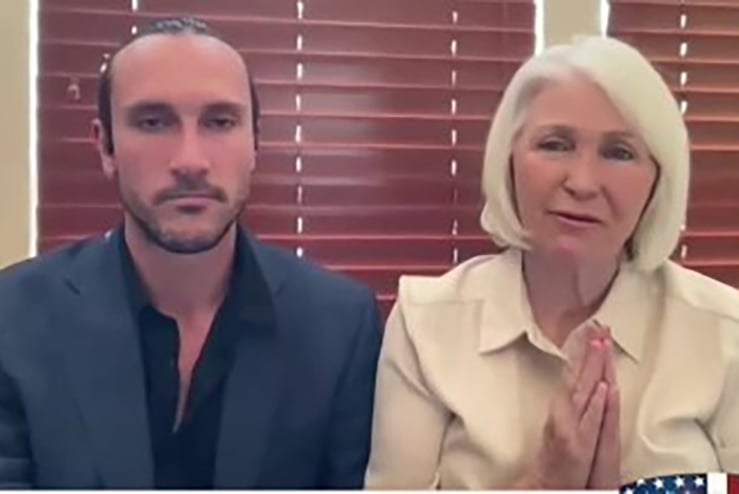
Yesterday, a great evil came to an end as former Colorado election official Tina Peters was finally freed from prison. Like so many Americans who have been targeted in the last decade by biased prosecutors, Peters never belonged there in the first place. Peters was railroaded at the insistence of election officials in Colorado who were trying to punish her for her investigation of the compromised 2020 presidential election. Singled out as she was for exemplary punishment, Peters was subjected to abusive conditions and periodic assaults by fellow prisoners. All of this was for following her conscience as county clerk and recorder of Mesa County, Colorado, in acting to prevent and detect election fraud.
Concerned (correctly) that there was evidence of fraud in the 2020 presidential race in her county, she made copies of voting data before it could be destroyed—an act that Colorado authorities convinced a biased judge was criminal. Although her political enemies clearly hoped that she wouldn’t outlive her long, outrageous sentence, it was recently and mercifully commuted by Colorado Gov. Jared Polis, thanks in part to pressure brought on them by the Trump administration.
Peters’ full story deserves to be made into a movie about the corruption of justice in our country.
But another film, unjustly forgotten, tells a remarkably similar tale: 1991’s Prisoner of Honor, directed by Ken Russell and starring Richard Dreyfuss. The film depicts the persecution, imprisonment, rigged trials, and final vindication of French Army Captain Alfred Dreyfus—commonly known as the Dreyfus Affair. The American actor (no relation to the film’s subject) doesn’t portray the Jewish captain, but the Catholic Col. Georges Picquart, who defied orders and became Dreyfus’ champion.
The film, which you can watch for free on YouTube, is brilliantly acted, straightforward, and faithful to events—a fine way to introduce yourself to a controversy that had ripples extending for decades, even into the politics of Vichy France, and the vindictive postwar purge by French Communists of thousands of innocent Catholic patriots falsely labeled “collaborators.” (I learned this about the “épuration sauvage” from Catholic philosopher Thomas Molnar, who witnessed its outrages firsthand, but thankfully escaped.)
In 1884, Captain Alfred Dreyfus was the only Jewish Frenchman who had been able to rise to the General Staff, when he was charged with spying on behalf of the hated Germans, who’d utterly humiliated the poorly led French army in 1871 during the Franco-Prussian War, toppling the Second Empire and stripping France of Alsace and Lorraine. The French Army had been seething ever since that defeat, preparing for a rematch, and keeping a keen eye for scapegoats and “traitors.”
Like the case against Peters, the case against Dreyfus was flimsy from the beginning. As Sean Durns noted of the Dreyfus Affair at Commentary:
In September 1894, French counterintelligence came into possession of a document known as a bordereau, or note. It had been found, ripped in several pieces, in the trash of the office of the German military attaché. The bordereau offered to supply information about the workings of the hydraulic brake of the 120-millimeter cannon, as well as information about troop maneuvers, artillery formations, and French policies relating to its colony, Madagascar.
Dreyfus was an unlikely candidate to be a spy. Independently wealthy, he seemed to lack a motive. The author was uncertain in the note about artillery matters—a subject in which Dreyfus was well versed. Moreover, the author of the bordereau said that he was going on maneuvers at a time and place that would have been impossible for interns of the General Staff, including Dreyfus. And the handwriting sample that Dreyfus provided didn’t even match the note.
At the time, the French Army had become the bastion of patriotic, conservative Catholics—who were systematically excluded from government positions by a Third Republic which organized itself around Masonic lodges, even keeping spies at local churches to report on which notables attended Mass, so they could be blackballed. Public schools had been secularized and pushed Jacobin agitprop that justified atrocities such as the Revolutionary genocide in the Vendée. France would become one of the last Western countries to grant women the vote—after World War II—because women were regarded at the time as more devout and therefore more likely to vote in defense of the Church. The politicians of the Third Republic believed in managing their electorate.
Whether those Army officers who’d filed the charges believed in Dreyfus’ guilt at first, his innocence was soon obvious to them and their superiors. It even turned out that the information provided to the Germans was of no military value. Rather than take the public relations hit of admitting its mistake, however, the Army hardened its position vis-à-vis Dreyfus. Top-ranking officers resented the presence of a Jew in their midst, even one as manifestly patriotic and competent as Dreyfus. So they forged fresh evidence and denied Dreyfus’ counsel the opportunity even to inspect it during the trial, which was held in secret. Within 90 days, Dreyfus was convicted, publicly stripped of his uniform, and shipped off to Devil’s Island, where he was expected to die of some tropical plague. A newly popular gutter, anti-Semitic press trumpeted the exposure of the “foreign” traitor.
Dreyfus would languish for years in wretched conditions on Devil’s Island, while the French Army held one rigged forum after another. At one point, the actual traitor who was responsible for offering military secrets to the Germans came to light: Ferdinand Walsin Esterhazy, a debt-ridden, libertine gambler who also worked in French military intelligence. His handwriting was a conclusive match to that on the bordereau. Yet the French Army held another trial, in secret, and acquitted Esterhazy. As an institution, the Army had staked its credibility on Dreyfus’ conviction and preferred to keep a genuine spy in its ranks rather than admit its collusion in these unjust and embarrassing proceedings. (Does any of this sound familiar to those who have followed leftist lawfare since 2016?)
This cynical stratagem backfired for the corrupt military officers involved, spawning a decade of controversy, in which the bitterly anti-Catholic French left championed Dreyfus’ innocence—and used the case as a stick to beat both the Army and the Church. Meanwhile, a viciously anti-Semitic far-right press scapegoated Jews in general and Dreyfus in particular for the secular mistreatment of patriotic French Catholics—almost all of which mistreatment came at the hands of secularized French Gentiles.
In The Origins of Totalitarianism, Hannah Arendt argued that the most powerful tropes of later Nazi anti-Semitism were pioneered by the anti-Dreyfusard press, whose leaders included some of the most gifted writers on the French right, such as Charles Maurras and Maurice Barrès.
While this war of words raged, Pope Leo XIII quietly suggested that Dreyfus had been hastily and unjustly convicted. Few listened, apart from the brilliant young Catholic author Charles Peguy (The Mystery of the Charity of Joan of Arc), who became one of the few church-going Dreyfusards.
In January 1898, France’s most famous living novelist, Émile Zola, published the expose “J’Accuse…!”, which exposed the facts and the military’s gross mishandling of the case. Rather than take his accusations seriously, the French government prosecuted Zola for libel, and he had to flee the country. But Zola had set a trap: the libel case would have to be prosecuted in open court, allowing Dreyfus’ family and counsel to expose the shoddiness of his conviction to the public. That’s precisely what happened, and the slow drip of revelations about how squalidly the Army had behaved savaged its reputation.
It harmed the Church much more severely. The spectacle of habited priests chanting hateful slogans and peddling vicious tracts in the streets made the Masonic political elites’ anti-clericalism seem justified to voters.
Eventually, Dreyfus was vindicated and restored to his rank. The Army was humiliated, and the Church was subject to a “secularization” law in 1905 that seized much of its property, closed most of its schools, and expelled from the country religious orders that had shaped French culture for centuries, most of which were not involved in the campaign against Dreyfus. It was a persecution more complete—if less genocidal—than that of the Jacobins.
There are vast differences between the Dreyfus Affair and the legal persecution of Trump supporters in today’s America. No vast political project goaded the French Army’s decision to falsely imprison Dreyfus. While his selection as scapegoat was driven by religious bigotry, it was not part of any campaign to persecute Jews in general. The motive for the cover-up was institutional face-saving, not massive election fraud and media censorship, in the service of creating a one-party state.
Thus, the sheer scale, malice, and intentionality of the purges aimed at Trump’s supporters dwarfs the squalid, comic-opera machinations of the smug, unimpressive French officers who railroaded Captain Dreyfus. It’s only when you remember that some young anti-Dreyfusards really would end up collaborating with the Nazis decades later that the moral weight of that affair reasserts itself: Those who would callously imprison one innocent man prepare the way for persecuting thousands of others.
Today, the same kind of people who hoped to see Tina Peters die in prison talk openly about “re-education camps” for Trump supporters, whom they warn are “semi-fascists,” or cheer when medical professionals say they’ll refuse treatment to ICE officers.
Is Tina Peters the new Captain Dreyfus? In some crucial ways, she is. As Joachim Osther wrote at The Stream:
As the clerk for Mesa County, [Tina] Peters was warned about the potential for malfeasance before the election and advised to keep a back-up copy of voting records.
The vote-dumping events that took place late on Election Night in 2020 aroused Peters’s suspicions, so she made a “forensic copy” of the county’s election files before an inspection of the voting machines by Secretary of State Jena Griswold. After Griswold and a group of technicians performed what is called a “trusted build” update, Peters brought in an expert to make another forensic copy.
The indictments against Peters revolve around the access that she gave the forensic experts to inspect the equipment. The charges also claim that she was not forthcoming about the identity of the expert, and lastly that she attempted to influence a public servant.
Peters’ legal team was barred by the judge from presenting any evidence that her actions were reasonable owing to the fraud vulnerabilities inherent in the election software Mesa County used. As former prosecutor David Clements (who fought more than anyone for Peters’ release) wrote, “Analysis of the Dominion election management system she forensically imaged revealed that over 29,000 election records were altered or deleted during Dominion’s ‘trusted build.’”
Dominion was using software from a Venezuelan firm it had recently acquired called Smartmatic. According to the former head of the Venezuelan secret service (now in U.S. custody), Hugo Carvajal Barrios:
Smartmatic was born as an electoral tool of the Venezuelan regime but soon derived into a tool to help keep the regime stay in power forever. I know this because I placed the head of IT of the National Electoral Council (CNE) in his position, and he reported directly to me. The Smartmatic system can be altered—this is a fact. This technology was later exported abroad, including to the United States. Regime operatives maintain relationships with election officials and voting-machine companies inside your country. I do not claim that every election is stolen, but I state with certainty that elections can be rigged with the software – and has been used to do so.
Of course, no evidence of this sort (Peters’ lawyers had plenty, long before Carvajal spoke out) was permitted in Peters’ trial. When she was duly convicted by a low-information jury, the judge made it clear that he was imposing the maximum sentence, nine years, in part because of Peters’ political opinions. She would not retract her suspicions about the honesty of the 2020 election, so he would throw the book at her.
President Trump issued a federal pardon for Peters, but it had no legal effect on her imprisonment for state charges. A Colorado appeals panel, reviewing her conviction, has raised serious concerns about its legality,
questioning whether an improper jury instruction led to Peters’ conviction on a felony charge despite drawing language from a misdemeanor statute. More broadly, the panel appeared sympathetic to arguments made by Peters’ attorneys that her sentencing — which followed statements made by presiding District Court Judge Matthew Barrett calling Peters a ‘charlatan’ who peddled ‘snake oil’ — violated her right to free speech.
“My read of the (sentencing) transcript is that the judge considered that, and it went into the calculation of the sentence,” Welling said. “And that’s a First Amendment problem.”
He added that the issue “fundamentally calls into question the fairness of the sentence.”
The state’s Democratic governor, Jared Polis, questioned the severity of Peters’ sentence, and raised the possibility of commuting it—to the outrage of Colorado Secretary of State Jena Griswold, the public official supposedly in charge of ensuring honest elections in 2020. The frail Peters was subsequently attacked by a much younger fellow inmate, then charged with felony assault for defending herself, and thrown in solitary confinement for days.
Perhaps that incident helped make up Polis’ mind for him. On June 1, Tina Peters was set free by a governor’s order commuting her sentence. She came back from Devil’s Island and found herself in a country just as divided as the France to which Col. Dreyfus returned.
The Trump administration is rightly trying to reverse the impact of such lawfare and political prosecution. As one-time federal prosecutor—now a persecuted election integrity activist, herself—Sidney Powell told me:
I don’t know of any president in our history who has shown his care and concern for the American people more than President Trump. His recent settlement of his own case, solely to create a fund to help citizens like the January 6 defendants and others who have been so wronged by pure lawfare and abuses by our government, is an unprecedented act of generosity. The Obama and Biden administrations deliberately and baselessly destroyed many families and lives with their wrongful prosecutions and harassment. Their abuses of power should never be repeated. Reparations combined with prosecutions of the real wrongdoers will begin to allow many people to heal. I wrote a whole book, Licensed to Lie, exposing abusive, specious prosecutions like the one that targeted Tina Peters. Thank God she’s finally free.
I’d like to give Tina herself the last word. Here’s a link to her first public appearance, fresh from prison, on Steve Bannon’s War Room. Every American owes this patriot a debt.