The Disappearing Middle Eastern Christians - Chronicles
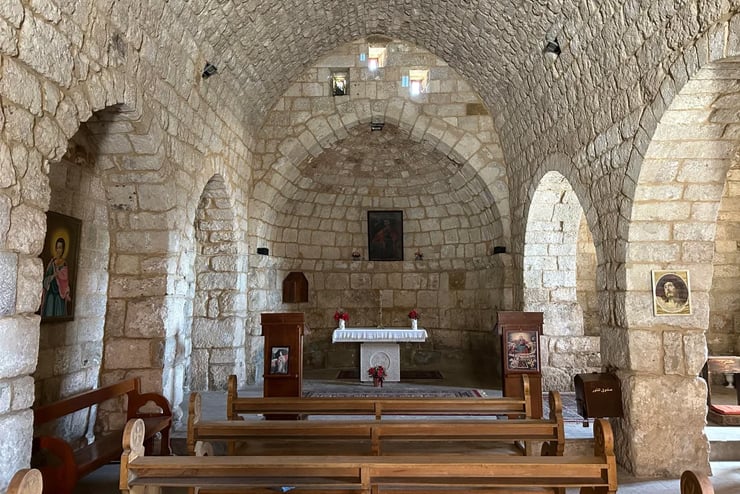
On this Christmas Day, let us spare a thought for the plight of Middle Eastern Christians, arguably the most endangered religious minority in today’s world. I addressed this neglected issue 14 years ago (“A Grim Christmas,” Chronicles, December 2011), and those communities’ position has grown much worse since then.
Counting Eastern Christians is difficult: few reliable surveys have been conducted, and, moreover, religious leaders tend to overestimate their numbers. Statistics thus vary from one source to another and should be considered indicative rather than absolute. It is nevertheless clear that they are leaving their homelands in droves. It is likely that their numbers in Lebanon have fallen to under 20 percent, which is half their share before the civil war there. The most recent exodus is that of the Chaldeans from Iraq since 2003, and the Orthodox from Syria, starting in 2011 but accelerating after the fall of Bashar al-Assad’s regime in December 2024.
In absolute numbers, there are probably no fewer Christians in the Middle East at the beginning of the 21st century than a hundred years ago, but their percentage of the regional population has steadily declined, sometimes very significantly. According to recent estimates, in the early 20th century Christians accounted for between 12 percent and 15 percent of the population in the Arab countries of the Middle East. At the beginning of the 21st century, their share fell to just 5 percent of some 300 million Arabs.
What happened? As I noted in an online Chronicles article posted in April 2017, the widespread belief in the non-Muslim world that Islam accords respect to the Old Testament and the Gospels as steps in progression to Mohammad’s revelation is mistaken. The Koran makes reference to Jesus, Mary, and events related to them, but with a critical distinction. It explicitly denies that Jesus was crucified and rejects the whole concept of the cross.
Jews and Christians, “People of the Book” (ahl al-kitab), were distinguished from pagans and elevated to somewhat higher status, but their refusal to accept Islam dooms them to unbelief and eternal suffering after death. “People of the Book” have historically held the low status of a “protected minority” (dhimmi), which entailed discrimination and persecution. Traditionally, they paid a poll tax (jizya) in exchange for protection and the right to practice their faith, but without civil equality.
Numerous anti-Christian acts occur regularly in Muslim-majority countries, where Christians are often perceived as allies of the West or even as aliens. The early Islamic state was long a polity based primarily on communities, not on territory, over which it did rule, but did not always occupy the entire area. For many dissident Christian groups that had been denounced as heretical from Constantinople, it seemed preferable at first to be ruled by largely absentee non-Christian overlords who cared only about taxes.
At the time of Muhammad’s birth, Christianity had covered, outside Europe, the ancient Roman province of Asia, extending across the Caucasus to the Caspian Sea, Syria with the Holy Land, and a wide belt of North Africa all the way to the Atlantic Ocean. Christians numbered over 30 million by A.D. 311, despite imperial persecution that often entailed martyrdom. Most of them lived not in Europe but in Asia Minor and Africa, the home of many famous Christian fathers and martyrs, such as St. Paul of Tarsus, Augustine of Hippo, Polycarp of Smyrna, Tertullian of Carthage, Clement of Alexandria, John Chrysostom of Antioch, and Cyprian of Carthage. The Seven Churches of Revelation were all in Asia Minor. (Smyrna was the last of these and kept her light burning until 1922, when the Turks destroyed it, along with its Christian population.) For the millions of trapped eastern Christians, as well as the Jews, the Zoroastrians of Persia, and the Hindus and Buddhists of the Subcontinent, the heirs to the most advanced civilizations of the time, a long night was descending.
As Turkey declined after the second siege of Vienna, its provincial governors and warlords—often, though not always, local converts to Islam with a suppressed grudge against their former co-religionists—grew stronger, and increasingly asserted rebellious independence, most notably in the Balkans. At the same time, the great Western powers, and Great Britain in particular, actually supported the continuing Turkish subjugation of Christian Europeans on the grounds that the Mohammedan empire was a stabilizing force and a counterweight against Austria and Russia. Their alliance with Turkey against Russia in the Crimean War reflected a pernicious frame of mind that has manifested itself more recently in the overt or de facto support of most contemporary Western powers for the Muslim side, over the past three decades, in Bosnia-Herzegovina, Kosovo, Chechnya, Cyprus, East Timor, and Kashmir.
By the time Levantine Christianity was in its death throes, the biggest Christian-killing machine in history—set up by Vladimir Ilyich Lenin and his cohorts—had been in operation for over four years. Bolshevism is now dead, but jihad is alive and well. Antonio Socci, the author of The New Persecuted: Inquiries into Anti-Christian Intolerance in the New Century of Martyrs (2002), provided evidence that some 160,000 Christians have been killed every year since 1990, the vast majority by Muslims. Chronicling attacks, pogroms, and wars in East Timor, Indonesia, Sudan, Egypt, Pakistan, India, Nigeria, and the Balkans, Socci identified Islamic aggression as the main danger. And yet, he wrote, “This global persecution of Christianity is still in progress but in most cases is ignored by the mass media and Christians in the West.”
The new martyrs’ example and legacy are precious because in this century it will be the turn of Western Christians to experience it. In Western Europe, Christian believers are already persecuted by the unholy alliance between Christophobic wokedom of the therapeutic state and a resurgent Islam, which is as relentless demographically as it is implacable ideologically.
Christians of different traditions and in different lands need to hang together, or else they will most assuredly hang separately. Merry Christmas!
(Correction: An earlier version of this story provided an incorrect date for the fall of Bashar al-Assad’s regime in the last sentence of the second paragraph.)