SoCal Faults Reach 1,000-Year Stress Peak
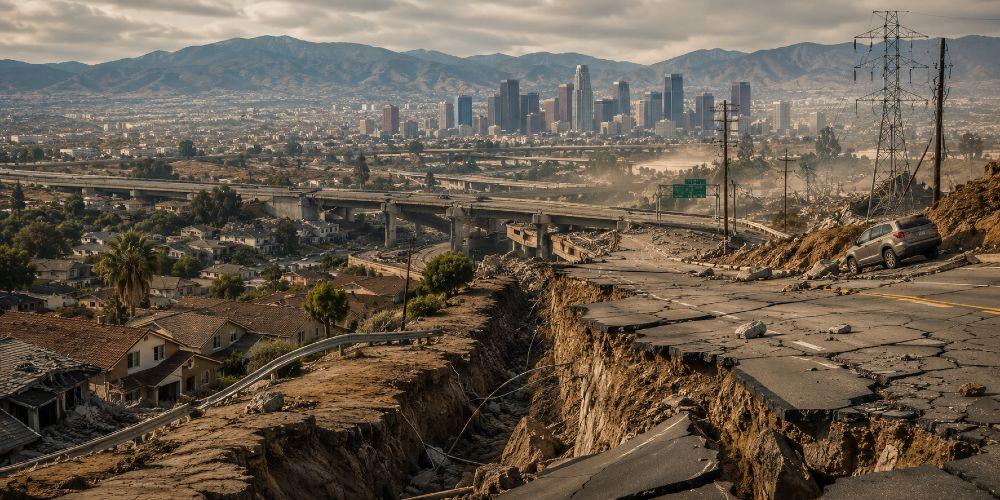
Scientists have delivered a sobering update on the seismic risks facing Southern California. Stress levels along the San Andreas and San Jacinto fault systems have climbed to their highest point in at least a millennium, raising legitimate questions about when the region’s long-dreaded major earthquake might strike.
This is not alarmism from headlines. A new study published in the Journal of Geophysical Research: Solid Earth, led by researchers including Liliane Burkhard of the University of Hawaiʻi at Mānoa, used paleoseismic data, radiocarbon dating, historical records, and sophisticated modeling to reconstruct a thousand years of tectonic activity.
The results show stress accumulation now at or exceeding previous peaks, particularly concerning at the Cajon Pass convergence zone northeast of Los Angeles.
Cajon Pass functions as a critical “earthquake gate.” Depending on how ruptures propagate, an event could remain isolated or cascade across multiple faults, impacting a vast area from Los Angeles through San Bernardino, Riverside, and into the Coachella Valley.
With stress on the San Jacinto-Bernardino segment reaching 3.6 megapascals and the Mojave South section of the San Andreas at 2.8 megapascals, the conditions for a through-going rupture appear more favorable than at any time in the modeled period.
It has been nearly 170 years since the magnitude 7.9 Fort Tejon earthquake rattled the San Andreas Fault. In the intervening time, Southern California’s population has exploded into the millions, with dense urban development, critical infrastructure, and transportation networks layered atop this unstable ground.
The last major event on these systems occurred in a far less populated era. A similar quake today would test the resilience of a region already strained by other challenges.
Researchers emphasize that precise timing remains impossible to predict. Earthquakes do not announce themselves on calendars. Yet the data underscores elevated probability for large events capable of widespread disruption. This reality demands attention beyond academic circles.
California officials have long issued warnings about the “Big One,” yet bureaucratic inertia and misplaced priorities often hinder genuine preparedness. Billions flow toward green initiatives and expansive government programs, while basic infrastructure hardening, building code enforcement in high-risk zones, and public education on seismic safety receive inconsistent focus. History shows that when nature strikes, communities with strong personal and local resilience fare best.
Preparation is not panic—it is wisdom. Families should secure heavy furniture, stock emergency supplies including water, food, medications, and first aid kits for at least two weeks. Homeowners would do well to retrofit where possible and review insurance coverage. Local churches and community groups can play vital roles in organizing neighborhood response plans.
In an age of technological dependence, the fragility of power grids, water systems, and supply chains becomes glaringly apparent when the ground shifts. Southern California’s experience offers lessons for the entire nation about self-reliance in the face of natural forces beyond human control.
The tectonic plates move with relentless indifference to human timelines. While science illuminates the risks, it cannot provide ultimate security. True discernment calls believers to live with vigilance, stewarding families and resources responsibly while trusting in the Lord who holds the earth in His hands.
For millions in Southern California, this latest study serves as another urgent prompt: the time to strengthen homes, communities, and faith is now, before the next major shake tests them all.