The Rise of AI Data Centers: Power, Promise, and the Surveillance Economy
Data centers have long powered the internet, cloud computing, and digital services. Today, the explosive growth of artificial intelligence is driving a new generation of hyperscale facilities (Stratos Project, Utah - approximately 45,000 acres) that consume staggering amounts of electricity, water, and land. While promoters tout breakthroughs in science and productivity, a more skeptical view reveals these centers as the backbone of an emerging surveillance economy — where much of the vast computational power serves government and corporate interests in monitoring, predicting, and influencing citizen and consumer behavior.
What Makes AI Data Centers Different?Traditional data centers focus on storage, websites, and general cloud services. AI data centers are optimized for training and running massive models using dense clusters of GPUs and accelerators.
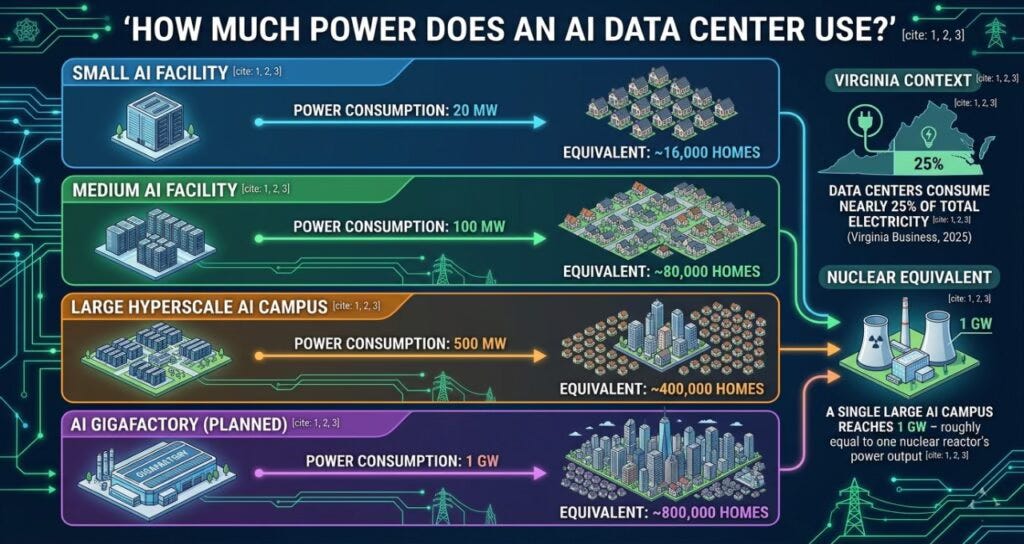
Power Density: AI racks routinely draw 30–120+ kW (and up to 300+ kW in advanced designs), versus 5–15 kW for standard racks. Large campuses can demand 100 MW to over 1 GW — enough electricity for hundreds of thousands of homes.
Cooling Demands: Extreme heat requires liquid cooling systems that consume millions of gallons of water daily.
Infrastructure: These facilities need reinforced structures, massive electrical systems, and ultra-high-bandwidth interconnects.
Projections indicate U.S. data centers could consume 6.7–12% of national electricity by 2028, with AI as the main driver. The question lingers: how much of this power-hungry infrastructure is truly advancing human knowledge versus enabling unprecedented surveillance?
Why the Massive Scale?Hyperscale designs offer economies of scale for the intensive computing required by frontier AI. Yet this centralization also creates ideal conditions for storing and analyzing vast troves of personal data. Much of the capability in these centers supports government contracts and corporate platforms that track consumer habits, spending patterns, location data, social interactions, and more. Facilities like these power the algorithms behind targeted advertising, behavioral prediction, credit scoring, and law enforcement tools — raising serious concerns about privacy and autonomy in an era of pervasive digital tracking.

Examples include massive proposals such as the Stratos Project in Utah and numerous developments in Pennsylvania’s PJM region, including the rural Endless Mountains areas near Scranton.
Local Impacts and Competition with AgricultureCommunities are often promised construction jobs and tax revenue. In reality, permanent operational jobs are minimal (dozens to ~150 per site on the high end), while long-term economic benefits frequently fall short of hype due to generous tax abatements.
A deeper concern is the direct competition with farming and food production. Large data center campuses can consume hundreds or thousands of acres of land previously used for agriculture or natural ecosystems. This shift prioritizes surveillance and AI infrastructure over the foundational systems that have sustained humanity for millennia. In rural regions like Northeast Pennsylvania, converting productive land raises legitimate questions about food security, local resilience, and whether short-term corporate gains justify long-term loss of agricultural capacity and environmental diversity.
 Environmental and Resilience Concerns
These facilities impose heavy burdens:
Electricity and Grid Strain: Competing with residential and industrial needs, often leading to higher rates for everyone.
One analysis notes that data center growth alone could increase average U.S. electricity bills by 6–29% by 2030, with much higher increases (up to 50%+) in hotspots like Virginia and parts of PJM.
Water Consumption: Massive draw for cooling in areas that may already face scarcity.
Land Use: Displacement of farming and natural habitats.
Additionally, the entire system is fragile. A major solar storm (Carrington-level event) could trigger widespread grid failures, potentially disabling these power-hungry centers for weeks or longer. These data centers are not being designed to be resilient to these events.
Alternatives and Emerging SolutionsThe extreme resource demands are spurring alternatives that could reduce Earth’s burden: Why are we rushing to utilize our valuable farmland and open areas without a robust discussion of emerging alternatives to these hyperscale AI behemoths? Why the almost absolute lack of public discussion and debate on this topic? Emerging alternatives include:
Edge Computing: Local processing on devices or smaller sites, limiting centralized data hoarding.
Processes data closer to the source (devices, local servers, or small facilities) instead of shipping everything to big centralized centers. Reduces latency, bandwidth needs, and central power demand. Many AI inference tasks already run efficiently on phones/laptops or on-site hardware.
Advanced Hardware: Neuromorphic and photonic chips for far greater efficiency. These include photonic and optical storage which uses light instead of electricity for computations – slashing energy and heat. Promising for massive parallelism in AI with orders-of-magnitude efficiency improvements. Still maturing but advancing
Space-Based Computing: Orbital facilities using constant solar power and vacuum cooling (e.g., projects linked to Google, NVIDIA, and SpaceX). These could theoretically offload some training loads but may still feed the same surveillance pipelines back to Earth.
Humanity’s rush toward technological dominance risks over-reliance on fragile, resource-heavy infrastructure. As demand grows, balancing innovation with efficiency, decentralization, and resilience will be critical.
Whether through smarter terrestrial designs, edge solutions, or space-based alternatives, the future of AI infrastructure need not remain tethered to ever-larger terrestrial power sinks. Communities, policymakers, and technologists face important choices about where and how we build the backbone of the AI age.
Are county commissioners, county supervisors, and state and federal elected officials even aware of all the options that are coming online?
The Bigger PictureAI data centers undeniably might accelerate certain capabilities in science and industry. However, a skeptical lens reveals that a substantial portion of this infrastructure supports government and corporate surveillance — storing and analyzing citizen and consumer data at unprecedented scale. The rush to “win” the AI race often masks a deeper centralization of power, where massive resource investments serve control and profit motives more than broad human flourishing.
For most of human history (~300,000 years as hunter-gatherers, then ~10,000+ with agriculture), societies prioritized reliable food, water, shelter, and community. Complex civilizations rose and fell (Maya, Rome, Cahokia, etc.) often due to environmental strain, soil depletion, over-complexity, or external shocks—followed by simplification where people returned to smaller-scale farming and local resilience.
Modern shifts (industrial agriculture, globalization, and now AI/data centers) boost short-term output and power projection but create dependencies and vulnerabilities. “Elimination of farming” isn’t literal, but consolidation, urbanization, and land use for data centers/energy do reduce decentralized food resilience. Winning “bigly” via tech dominance sounds strategic, but history shows over-reliance on fragile systems (e.g., just-in-time supply chains, centralized power) often backfires when shocks hit.
As data centers proliferate, societies must weigh whether the pursuit of ever-larger, ever-more-powerful facilities justifies the drain on energy, water, farmland, and privacy. True progress may lie not in bigger terrestrial data sinks, but in decentralized, efficient, and resilient alternatives that prioritize human autonomy over centralized dominance.
This Substack is reader-supported. Please consider becoming a free or paid subscriber.
Thanks for reading! This post is public so feel free to share it.