Screwworms And The Death Of America’s Beef Industry
Screwworms have been detected in Texas. You probably don’t spend a lot of time thinking about screw worms.
You should.
This Substack is reader-supported. Please consider becoming a free or paid subscriber.
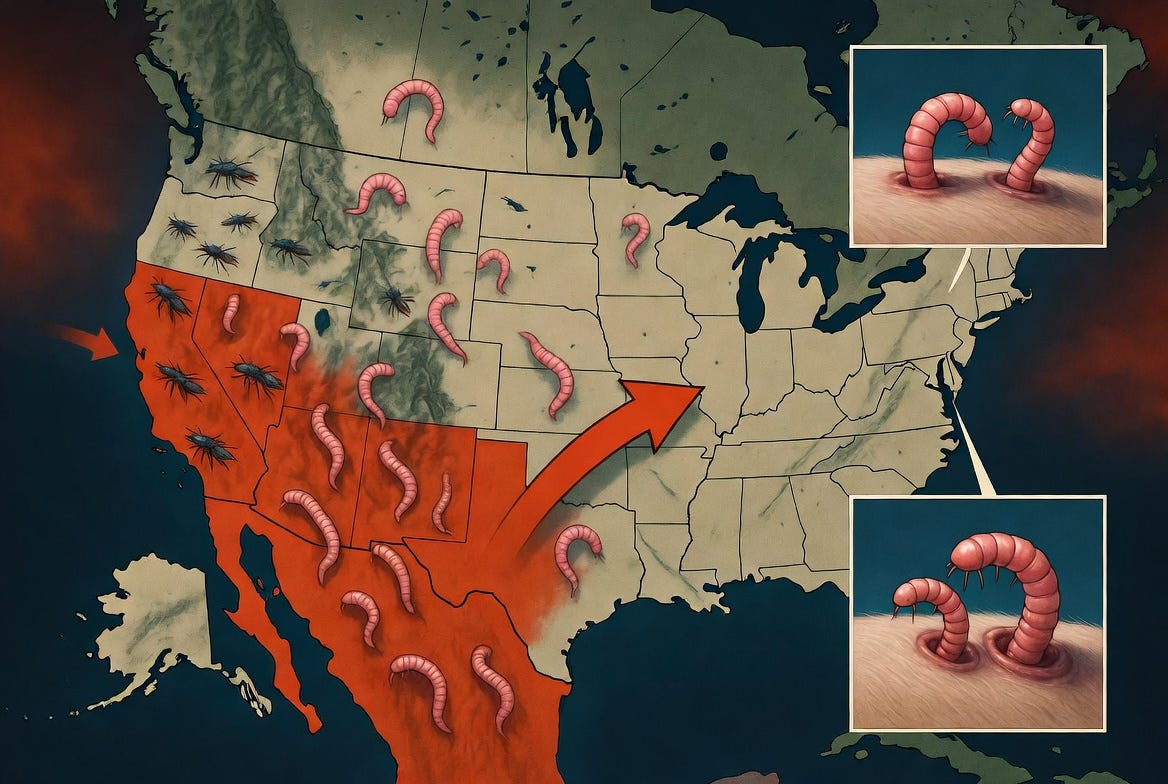
Screw worms are parasitic worms found in Panama and Colombia. They lay their eggs in the skin of live animals, including cattle. The eggs then hatch, and the larvae (maggots) infest and feed on the living tissue of warm-blooded animals.
Report mammals and birds with the following signs:
Eggs hatch within 12-24 hours, and the larvae burrow into living flesh using hook-like mouthparts:
United States Department of Agriculture
Screwworms have been migrating north since mid-2025 at least.
There are also cases in which screw worms have infected people. To prevent that, one of the things that has to be done is that any outdoor laundry drying on lines has to be ironed to kill the eggs and avoid human cases. If you are infected, you then have to dig the developing maggots out of your skin.
Screwworms used to be a huge threat to the cattle industry in this country before we launched a massive effort to eradicate them. Annual losses in the 1930s-1950s reached tens to hundreds of millions of dollars (equivalent to much more today) from deaths, reduced weight gain, lower milk production, treatment costs, and labor. Infestations hit cattle hardest, but affected sheep, goats, horses, and wildlife as well. Newborn calves were especially vulnerable.
We eradicated screwworms in the United States in the 1960’s primarily through the use of something called the Sterile Insect Technique (SIT). SIT worked like this:
Mass-rearing huge numbers of screwworm flies in facilities.
Sterilizing the males (usually as pupae) with radiation (gamma or X-rays), which doesn’t kill them but renders their sperm non-viable.
Releasing the sterile males in overwhelming numbers into the wild (often by airplane).
Wild females mate only once in their lifetime. When they mate with a sterile male, they lay infertile eggs, producing no offspring. This progressively crashes the wild population.
There was a small outbreak of screwworms in the Florida Keys in 2017. It was quickly contained using the same method.
Larval feeding causes rapid, severe tissue destruction: Maggots burrow into living flesh in any open wound (e.g., from branding, castration, dehorning, tick bites, scratches, or umbilical cords in newborns). Wounds enlarge quickly, attract more flies, lead to secondary infections, sepsis, and often death within 7–14 days if untreated.
One infested animal can spread the issue rapidly in a herd due to the fly’s mobility and high reproductive rate (females lay hundreds of eggs per batch; full life cycle in weeks in warm weather). In a full outbreak, significant portions of herds could be affected, with historical infestation rates around 20% in exposed populations.
The screwworm is already in Texas. That one state accounts for 14% of all U.S. cattle.
We have had a lot of warning that this threat was resurging. We don’t seem to have taken advantage of that to get ahead of it. We might want to move now with a sense of urgency. We are talking about the death of the American beef industry.
This Substack is reader-supported. Please consider becoming a free or paid subscriber.
Thanks for reading! This post is public so feel free to share it.