Judgment Day for Colombia
Author: A retired senior CIA officer with long experience in Latin and South America.
On 21 June, Colombians will elect a new president. Their choices are starkly different.
On one side is Abelardo de la Espriella, a colorful lawyer sometimes described as Colombia’s answer to President Trump (who, in a rare gesture, has endorsed him) or El Salvador’s Nayib Bukele, the president who unceremoniously rounded up and jailed tens of thousands of gang members, thus virtually eliminating murders and serious crime in his country. The Western media habitually calls him an “extreme right-winger.” In fact, other than his promise to fight guerrilla terrorism and narcotics traffickers with a mailed fist, he is a fairly typical moderate Latin American politician.
His opponent, Ivan Cepeda, of the Historic Pact (Pacto Historico), is the real extremist. He is a hard-core Communist who has applied a very light coating of insincere respect for the rule of law over his support for the Communist terrorists who have plagued the country for decades. Cepeda’s father, Manuel Cepeda, was gunned down by real right-wing extremists when he foolishly got involved in a plot by the Revolutionary Armed Forces of Colombia (FARC, then the armed wing of the Colombian Communist Party) to have their cake and eat it too.
The elder Cepeda, a CCP Central Committee member, was a candidate for the so-called Patriotic Union (Union Patriotica - UP) when gunmen killed him. The UP was a combined FARC/CCP front political party. The FARC thought they would continue their guerrilla war against the government and, at the same time, elect Communists to the Colombian congress, under the UP cover. It did not work out well. Right-wing businessmen, military officers, and people who had suffered from guerrilla kidnappings, extortion, and the murders of family members virtually annihilated the UP.
The current president of Colombia, Gustavo Petro, is a former M-19 terrorist who has presided over the virtual unraveling of the Colombian military, police, judicial system, and counternarcotics campaign, placing former M-19 terrorists in key government posts and inviting the leaders of criminal cartels without even a fig leaf of political legitimacy to enter into “peace talks” with the government.
The Colombian people – at least most of them – have watched in disbelief as Petro’s “Toal Peace” plan turned vicious murdering gang leaders into participants in a great show of leftist democracy. In the meantime, the so-called “FARC dissidents” (FARC guerrillas who thumbed their noses at the bogus 2016 “peace treaty” foisted on Colombia by Globalist former president Juan Manuel Santos) and National Liberation Army (ELN) pro-Cuba guerrillas joined more conventional narcotics traffickers to explosively increase cocaine production in Colombia.
The 2016 peace treaty with the FARC, negotiated in Havana, was rejected in a referendum, but Santos pushed it through a compliant congress, probably through the distribution of large amounts of cash. The treaty essentially gave the FARC what it had failed to win on the battlefield in decades of bloody, atrocity-laden warfare.
Juan Manuel Santos was well-rewarded for his efforts on behalf of “peace”, when he was awarded the Nobel Peace Prize, joining such distinguished company as Jimmy Carter, Al Gore, Barry Obama, the European Union (!), the United Nations, and the International Peace Bureau, awarded the peace prize in 1910, (the bloom was off that rose by 1914), and many others whose contributions to world peace were hazy or did not stand the test of time. Le Duc Tho of North Vietnam is the only person who had the dignity to refuse it.
It is widely believed that Santos was rewarded in rather more tangible fashion by the regime of Nicolas Maduro of Venezuela, the FARC, and several narcotics cartels. A sum said to exceed $300 million dollars was reportedly deposited in a well-known bank in Italy (or someplace close to it), in return for ramming through the peace treaty.
Colombia is now experiencing the worst violence since the late 1990’s, and cocaine production has exploded. To date, Santos has not returned his peace prize.
If Cepeda manages to get elected, the downward spiral of Colombia started by Petro will accelerate at warp speed. It will become not only a failed state, but also a narco kingdom. One of Latin America’s oldest – if imperfect – democracies will be converted into a criminal empire, with Marxist window dressing. Anybody with the means to flee will, as they did in the 1990’s.
Venezuela’s Marxist regime is still firmly in power. The arrest of Nicolas Maduro and the naming of his friend Delcy Rodriguez as “president” of Venezuela have not resulted in any significant changes in the oppressive Chavez/Maduro government. Venezuelans still live in fear and misery, and they are still threatened by regime thugs if they dare to protest. It appears that an amoral gang of American businessmen with interests in Venezuela pushed President Trump to settle for the illusion of “stability” and oil, rather than freedom for Venezuela. We will pay a heavy price for the incompetence of our Latin American intelligence analysts who fell for this dirty deal and urged it on Trump. A recent article in Politico suggests that some of the worst actors, including a Palm Beach bottom-feeding oil and asphalt mogul, are now under investigation by the FBI for their shenanigans.
If Colombia falls into the hands of Cepeda, the two countries will form a bloc that Trump will be unable to deal with. It will be a disaster for American foreign policy in the Western Hemisphere. If Abelardo is elected, President Trump’s stance in Venezuela will become untenable. Unlike the fools who urged on Trump a false plan of “stability” under Delcy Rodriguez, de la Espriella knows exactly what Delcy Rodriguez is and what she, Chavez, and Maduro have done to Colombia. There will be no “peaceful co-existence”. Abelardo de la Espriella is a friend of the United States, but he will not pretend to be a friend of the junta in Caracas. He was the lawyer for Alex Saab, Maduro’s major bagman. Not even a towering diplomatic intellect like Jared Kushner will b.s. him into seeing the Delcy Rodriguez regime as illegitimate and criminal.
Santos was the Wizard of Oz behind the curtain who put Gustavo Petro in power, though they later had a falling out, probably over money. Petro’s “Total Peace” plan, by its very existence, puts a large question mark on the “peace” of Santos, government corruption, and relations with the narcotics trafficking cartels. He is now one of the main movers behind the campaign of Cepeda. Enrique Santos, the brother of Juan Manuel, is a notorious FARC sympathizer, so none of this comes as a terrible surprise.
The origins of this tragic mess are easy to pinpoint.
Modern Colombian history began on April 9, 1948, at a little after one in the afternoon. According to the official, accepted history of the event, a deranged drifter named Juan Roa shot down Liberal Party leader Jorge Eliecer Gaitan in broad daylight on Carrera Septima, the “main street” of the Colombian capital then and now.
Colombian police arrested and tried to protect the alleged gunman, but a furious mob beat him to death with wooden shoe shine boxes and literally tore him to shreds. What followed were the most harrowing days in Colombian history, and Colombia has had more than its share of harrowing days. Those days became known as the Bogotazo.
Enraged mobs burnt half of Bogota to the ground and very nearly seized the presidential palace; had the Presidential Guard not fought desperately to defend, the world might well have seen the president of Colombia strung up from a lamppost.
Gaitan, a Liberal Party reform leader, nationalist, and non-Communist leftist, was the leader of a huge movement of Colombia’s rural Liberal Party voters and many others. Tension had been building for years between the majority Liberals and the Conservatives, but a split in the Liberal Party had put the Conservatives in the presidency.
There was never an official motive given for the assassination, but the familiar “lone gunman” idea was usually put forth, though the Liberals tried to blame ultra-right-wing Conservatives for the killing. Other theories were deliberately dismissed as lacking evidence.
It will suffice to say that years of studying the Gaitan murder have made it clear, at least to the author, that Gaitan was probably the victim of a conspiracy involving the Colombian Communist Party, foreign Communist or pro-Soviet “anti-imperialist” operatives present in Bogota, and the Soviet intelligence services, most likely the GRU, Soviet military intelligence. It is possible that a U.S. diplomat posted to Bogota was involved in suppressing key information about the event; he may have been one of the most important undetected (or unproven) Soviet agents in U.S. history. His name was William Wieland, surely one of the strangest people ever to be employed as a State Department foreign service officer.
Joseph Stalin was determined to stop the consolidation of the Organization of American States (OAS), a regional organization explicitly intended to stop the spread of Communist influence in the Western Hemisphere. One of the major organizational meetings of the OAS was in progress when Gaitan was killed; he had rejected Communist demands that he denounce the OAS meeting. The Colombian Communists hoped to use the killing of Gaitan to spark a civil war, which they believed they would win as the secret power behind the Liberal Party leadership. Colombia had always been a priority Soviet target, although the Soviets were careful to conceal the level of their interest in the country.
A surprising number of historic figures were in Bogota on the day of the murder: George C. Marshall, Vernon Walters, Gabriel Garcia Marquez (another Nobel Prize winner, and at the very least a Communist sympathizer), many important Latin American leaders, and, of course, Fidel Castro. A glance at a map shows that Colombia is the most strategically important country in Latin America, with coasts on the Pacific and Atlantic (Caribbean) and access to the Amazon. Colombia in Communist hands would have constituted a grave threat to the Panama Canal, and Central America would have been threatened as well. It is no accident that the FARC, the only true pro-Moscow peasant guerrilla army in Latin American history, developed in Colombia. At one point, it had effective control over half of the national territory.
Accounts by most historians either rely on questionable information or ignore key facts that were widely known at the time of the Bogotazo. They also ignore what should be logical conclusions from proven evidence, the written accounts of key participants in the dramatic events, and events that occurred outside of Bogota shortly before or after the assassination.
The subject is for another in-depth article, but the chance that Fidel Castro, already believed to be a hardened killer, just happened to be spotted sitting in a café in front of Gaitan’s office building a half hour before he was shot down in the street is vanishingly small. The fact that the next event on Gaitan’s schedule after his never-to-be lunch was a meeting with Castro and his two Communist companions, or that Castro had already met with Gaitan, merely adds to the obvious conclusion. Much ink has been spilled to claim that Castro was a casual bystander to one of the seminal events in Colombian and Latin American history. Believe it if you want to.
The Gaitan assassination set off what is known in Colombia as La Violencia, The Violence. Up to 250,000 people were murdered in an orgy of individual killings and massacres. It was not a conventional war, or even really a guerrilla war. It was up close and personal.
Primarily a fight between Liberal Party and Conservative Party partisans, the Colombian Communists played a relatively minor role after the initial spasm of rage and killing, but that would change.
Again, contrary to most accounts available in English, there was a strong and growing Communist-led, or influenced, incipient rural insurgency in parts of Colombia before Gaitan’s killing, even in the 1930’s. The Colombian Communist Party, a solidly pro-Moscow assemblage of middle-class Stalinist third raters, failed lawyers, drunks, and incompetents (the assessments of their fellow Communists), had theoretical control of the growing rural Communist movement, but it was really led by radicalized peasants from the rural poor.
As La Violencia spiraled out of control, true Communist guerrilla groups formed, mainly in the Tolima Department and northern Huila. The so-called “Independent Republic of Marquetalia”, located in Gaitania, Tolima Department, was the center of a Communist-dominated “self-defense” organization. On May 27, 1964, the Colombian Air Force, supplied with heavy bombers by the U.S, attacked the Communist outpost. The survivors, a few dozen fighters followed by thousands of peasant farmers and their families, fled to the remote Llanos of eastern Colombia. In 1966, the group officially named itself the Revolutionary Armed Forces of Colombia, later to be famous as the FARC or FARC-EP, Ejército Popular.
The Cuban Revolution led to the creation of dozens of guerrilla and terrorist groups throughout Latin America, and Colombia was soon overrun with them. The FARC, the ELN, the EPL, and the M-19 are four of the most well-known. The FARC was at first seen as a minor irritant rather than a real threat. Living a primitive existence in the sparsely populated plains and jungles of eastern Colombia, they did not intrude on the national consciousness the way the flamboyant M-19 or the ruthless ELN did, with their campaigns of urban terrorism. These largely middle-class organizations fielded rural guerrillas, but it was the FARC that formed the first significant rural, peasant-based Communist insurgency in Latin America. Pro-Moscow and with a hard-core Stalinist mindset, the FARC imposed iron discipline on its members and did not tolerate schisms. While the drug wars and spectacular acts of urban terrorism caught the headlines, the FARC slowly built a nationwide structure and tightened its grip on ever larger areas of the most remote parts of Colombia. Led by Moscow-trained cadres, the foot soldiers came from the poorest “campesino” class. The Colombian Communist Party was, in theory, in control of the FARC.
The War on Drugs really picked up steam in the early 1980’s with the growth of the Medellin Cartel, led by Pablo Escobar Gaviria, and the Cali Cartel. The DEA carried out a series of devastating operations against these major cartels that broke them up and drained them of much of their power. The FARC had previously avoided direct involvement in cocaine trafficking for ideological reasons, but the temptation to profit from it became too great when Escobar and other major narcos left the scene. The FARC filled a very large vacuum of power and money.
The cocaine money fueled a rapid expansion of the FARC, and by the late 1990’s, Colombia was on its way to failed state status. A series of humiliating defeats of regular army units stunned the country and caught the attention of Washington.
The result was Plan Colombia, ostensibly a counternarcotics effort but in fact a program to stop the drug flow by combatting the people doing the drug trafficking, which increasingly meant the FARC.
Claims that Plan Colombia was a failure are hard to sustain when the facts on the ground are considered. Between 1999 and 2015, Colombia experienced one of the most important periods of economic growth and improved security in its history. Nobody who knew the before and after saw the claims of failure as anything but a canard invented by those who openly or secretly regretted the virtual defeat of the FARC, for whatever reason. Cocaine continued to flow, but the Colombian state was no longer in danger, and the average Colombian (especially in the rural areas) enjoyed more security than at any time since 1948.
Juan Manuel Santos, elected to succeed the hard-liner anti-guerrilla president Álvaro Uribe, began preliminary talks with the FARC in August 2012; they were then carried on in Havana, Cuba. The actions by Santos enraged Uribe, who saw it as giving in to the FARC when the guerrillas were already on the run. The popularity of Santos dropped, but he continued the peace talks. An unpopular peace treaty was signed in 2016, and Santos received the Nobel Peace Prize, which was probably his real personal objective all along.
There was no readily apparent need to begin peace talks with the FARC in 2012. The FARC was battered, had suffered enormous combat losses, and had seen most of its top leaders killed. Its logistics structures were being steadily destroyed. U.S. support had given the Colombian armed forces the mobility, firepower, and intelligence they needed. Most observers thought that another two years of heavy military pressure would have delivered a decisive victory. With the FARC defeated, the Colombian military and police could have turned on the much smaller ELN and the narcotics trafficking gangs.
The successful Colombian strike on the camp of FARC leader Raul Reyes on March 1, 2008, may contain a clue to the actions of Santos. In addition to killing Reyes, the attackers seized his computers. The information in them proved beyond any doubt that there existed a coordinated program including the Venezuelan government of Hugo Chavez, leftist Ecuadorian President Rafael Correa, the Cuban government, and other leftist groups in Latin America.
Santos, despite trying to project the image of a “moderate”, was in fact aligned with these countries and may well have profited handsomely from it. In addition to wealth, the ego of Santos demanded the title of “peacemaker” in Colombia and the world. Only the Cubans and Chavez (and later Nicolas Maduro) could arrange his “peace treaty” with the FARC.
When Santos left office, Ivan Duqye, a loyal Uribe protégé, attempted to repair the damage he had done, but the COVID crisis wrecked his presidency. Santos then worked to have Gustavo Petro elected, a move which delighted the Cubans and the Venezuelans.
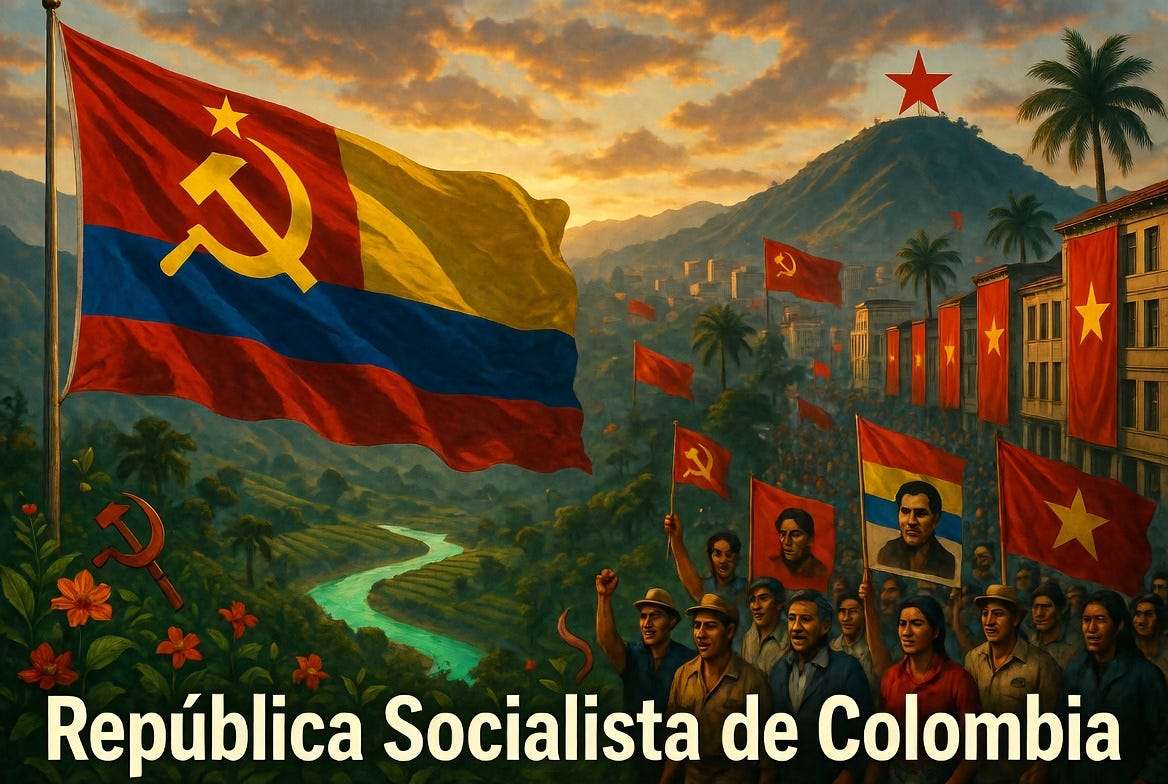
Now, we stand only days away from a turning point in Colombia as crucial as April 9, 1948. The election of Ivan Cepeda will mean, in stark terms, the defeat of Colombian democracy and its replacement with an authoritarian Marxist regime. It might take some time, but Cepeda will move skillfully to ensure that the military, police, and intelligence services are neutered, the Congress will be made into an obedient instrument of the left, and the middle and upper classes will be turned into “class enemies.” The FARC and its friends, the narcotics traffickers, will have won through electoral chicanery what they could never have won on the battlefield, a Communist/Criminal state, in the largest Spanish-speaking country in South America in population, a cultural leader, an historic democracy, and a once firm U.S. ally.
The usual cast of American academics, pundits, media talking heads, NGO’s, and foreign policy “experts,” few of whom know a thing about Colombia, will tut-tut at the idea that Cepeda’s election would mean anything more than a somewhat vigorous liberal/left regime change. Think Denmark or Sweden….or Cambodia.
The clock is ticking.
This Substack is reader-supported. Please consider becoming a free or paid subscriber.
Thanks for reading! This post is public so feel free to share it.