Keep Syria’s Sharaa Away From Lebanon – Ya Libnan
Illustration- The Lebanese people are tired of fighting the wars of others. Their future belongs to one state, one army, and one sovereign Lebanon
Lebanon is pursuing its own path toward sovereignty, security, and peace. The last thing it needs is renewed Syrian involvement in its affairsBy: The Editorial Board, Opinion
President Trump recently suggested that Israel should “let Syria take care of Hezbollah,” adding that Syria would “do a better job.” While the remark may have been intended as a practical solution to a difficult problem, it reveals a troubling misunderstanding of Lebanon’s history and current realities.
For many Lebanese, the idea of giving Syria a role in dealing with Hezbollah is not a solution at all. It is a reminder of a painful chapter that Lebanon spent decades trying to close.
Syria occupied Lebanon from 1976 until 2005. During those nearly three decades, Damascus exercised enormous influence over Lebanese political, military, and security affairs. That presence ended only after the assassination of former Prime Minister Rafic Hariri and the mass demonstrations of the Cedar Revolution, which forced Syrian troops to withdraw under intense international pressure.
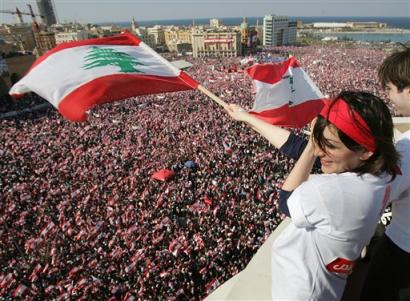 On March 14, 2005, a month after former PM Rafik Hariri’s assassination , over a million Lebanese flocked to downtown Beirut to demand the withdrawal of Syrian troops from Lebanon after a nearly 29-year of military presence. The mass rally was later dubbed the Cedar Revolution or Independence Uprising.
Lebanese citizens who lived through that era have not forgotten it. The last thing Lebanon needs today is the return of Syrian influence under a different name.
Ironically, Syria was also the country that allowed Hezbollah to retain its weapons after the end of Lebanon’s 1975-1990 civil war while most other militias were disarmed. Damascus viewed Hezbollah as a strategic asset and a means of preserving its influence in Lebanon. Suggesting that Syria should now be entrusted with solving the Hezbollah problem ignores this important historical reality.
There is also the question of Syria’s current leadership. President Ahmed al-Sharaa may be seeking international legitimacy and improved relations with the West, but his past associations continue to raise serious concerns among many Lebanese and others throughout the region. His government’s relationship with Syria’s minorities remains controversial, and his security forces include individuals whose backgrounds have fueled skepticism about the direction of the new Syrian state.
More importantly, Syria itself is still struggling to rebuild after years of war. It faces enormous economic, political, and security challenges at home. The notion that it should become a security manager for neighboring Lebanon is neither realistic nor wise.
The timing of President Trump’s suggestion is particularly unfortunate because Lebanon is already pursuing a different path. The Lebanese government has been engaged in efforts aimed at reducing tensions with Israel and addressing long-standing security issues along the border. While these efforts remain fragile, they offer a potential path toward greater stability and a future in which the Lebanese state—not foreign powers or armed groups—exercises authority throughout the country.
There are also ongoing discussions aimed at enabling the Lebanese Armed Forces to assume greater responsibility in sensitive border areas. Strengthening the role of the national army is exactly the direction Lebanon should be moving. Introducing Syria into this equation would only complicate matters, create new tensions, and undermine confidence in Lebanese sovereignty.
The solution to Lebanon’s challenges is not replacing one external influence with another. It is building strong national institutions capable of protecting the country and enforcing the rule of law.
If Washington truly supports Lebanese sovereignty, it should invest in strengthening and arming the Lebanese Armed Forces so they can fully assume responsibility for defending the country’s borders and maintaining security throughout its territory. A strong national army—not foreign armies, militias, or outside powers—is the foundation of a sovereign state.
The Lebanese people are exhausted from serving as the battlefield for the conflicts of others. For decades, Lebanon has paid the price for regional rivalries, foreign interventions, and proxy wars that brought destruction but little benefit to its citizens. They deserve the opportunity to live in a country governed by one state, one army, and one law.
This moment is different from many others in Lebanon’s recent history. For the first time in decades, Lebanon has a president and a prime minister who genuinely believe in Lebanon and are committed to rebuilding the state, restoring public confidence in its institutions, and reviving the Lebanon that was once known as the Switzerland of the Middle East.
Their task is enormous. Years of economic collapse, political paralysis, regional conflicts, and foreign interference have left deep scars. Yet the current leadership offers a rare opportunity for Lebanon to move away from the politics of confrontation and toward the politics of recovery, reform, and state-building.
This is precisely why the United States and all countries that truly care about Lebanon’s future should support the Lebanese government and help it achieve its goals. A sovereign, stable, and prosperous Lebanon would be a victory not only for the Lebanese people but for the entire region.
Mr. Trump, Lebanon does not need Syria’s Ahmed al-Sharaa to “take care” of Hezbollah. Lebanon needs the opportunity to take care of its own future. If America truly believes in Lebanese sovereignty, its message should be simple: keep Syria out of Lebanon, strengthen the Lebanese Armed Forces, and help the Lebanese state stand on its own feet.