Ranked: The World’s Most Powerful Reserve Currencies

Published
7 hours agoon
December 26, 2025 Graphics/Design: See more visuals like this on the Voronoi app.
See visuals like this from many other data creators on our Voronoi app. Download it for free on iOS or Android and discover incredible data-driven charts from a variety of trusted sources.
Key TakeawaysCentral bank reserve holdings are used to stabilize currencies, settle international trade, and manage financial crises.
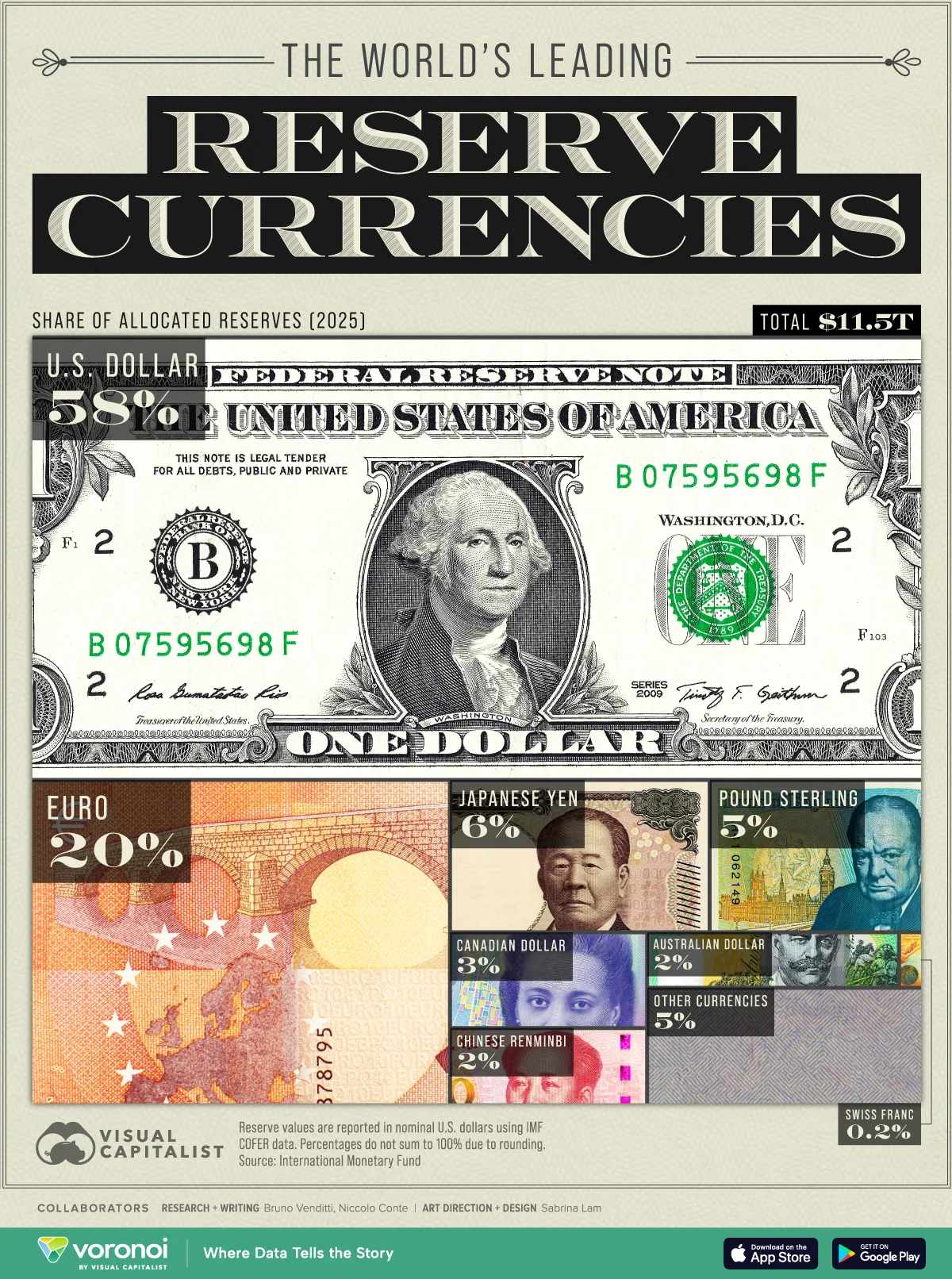
This visualization ranks the world’s leading reserve currencies, showing how global reserves are distributed across major currencies today. The data for this visualization comes from the International Monetary Fund, using COFER (Currency Composition of Official Foreign Exchange Reserves) data. Reserve values are reported in nominal U.S. dollars.
The Dollar Still Dominates Global ReservesThe U.S. dollar remains the backbone of the global reserve system, with central banks holding approximately $6.6 trillion in dollar-denominated reserves. This represents nearly 58% of total reported global reserves.
| U.S. dollar | 6,629,977 | 57.79% |
| Euro | 2,275,618 | 19.84% |
| Japanese yen | 667,012 | 5.81% |
| Pound sterling | 542,754 | 4.73% |
| Other currencies | 532,892 | 4.65% |
| Canadian dollar | 318,074 | 2.77% |
| Chinese yuan (renminbi) | 249,891 | 2.18% |
| Australian dollar | 235,463 | 2.05% |
| Swiss franc | 20,476 | 0.18% |
Despite frequent discussions around de-dollarization, the dollar continues to benefit from deep U.S. financial markets, global trade invoicing, and its role as a safe-haven asset during periods of uncertainty.
The Euro’s Role as the Main AlternativeThe euro ranks second, accounting for nearly $2.3 trillion, or about 20% of global reserves.
Beyond the dollar and the euro, reserve holdings are spread across several smaller currencies. The Japanese yen and British pound together account for roughly 11% of global reserves, reflecting their long-standing financial stability and deep markets.
Other currencies, including the Canadian and Australian dollars, the Chinese yuan, and the Swiss franc, each hold relatively small shares. Notably, while China’s yuan has gained visibility in global trade and finance, it still represents just over 2% of global reserves.
Learn More on the Voronoi App
If you enjoyed today’s post, check out America’s $38 Trillion Mountain of Debt on Voronoi, the new app from Visual Capitalist.